You want to lose weight. You have decided to invest in home fitness equipment. But you are stuck on the first question: Should you buy a treadmill or an exercise bike?
Walking into this decision without data leads to wasted money and a clothes rack gathering dust in the corner. As a fitness equipment strategist, I have analyzed the biomechanics, caloric expenditure, and adherence rates for both machines. The “best” choice isn’t about marketing hype; it is about which machine you will use consistently to sustain a caloric deficit.
This guide breaks down the hard science of energy expenditure, joint impact, and long-term sustainability to help you make the right investment for your weight loss journey.
Understanding the Weight Loss Equation
Before comparing machines, we must address the fundamental mechanism of weight loss. To lose body fat, you must achieve a caloric deficit—burning more energy than you consume.
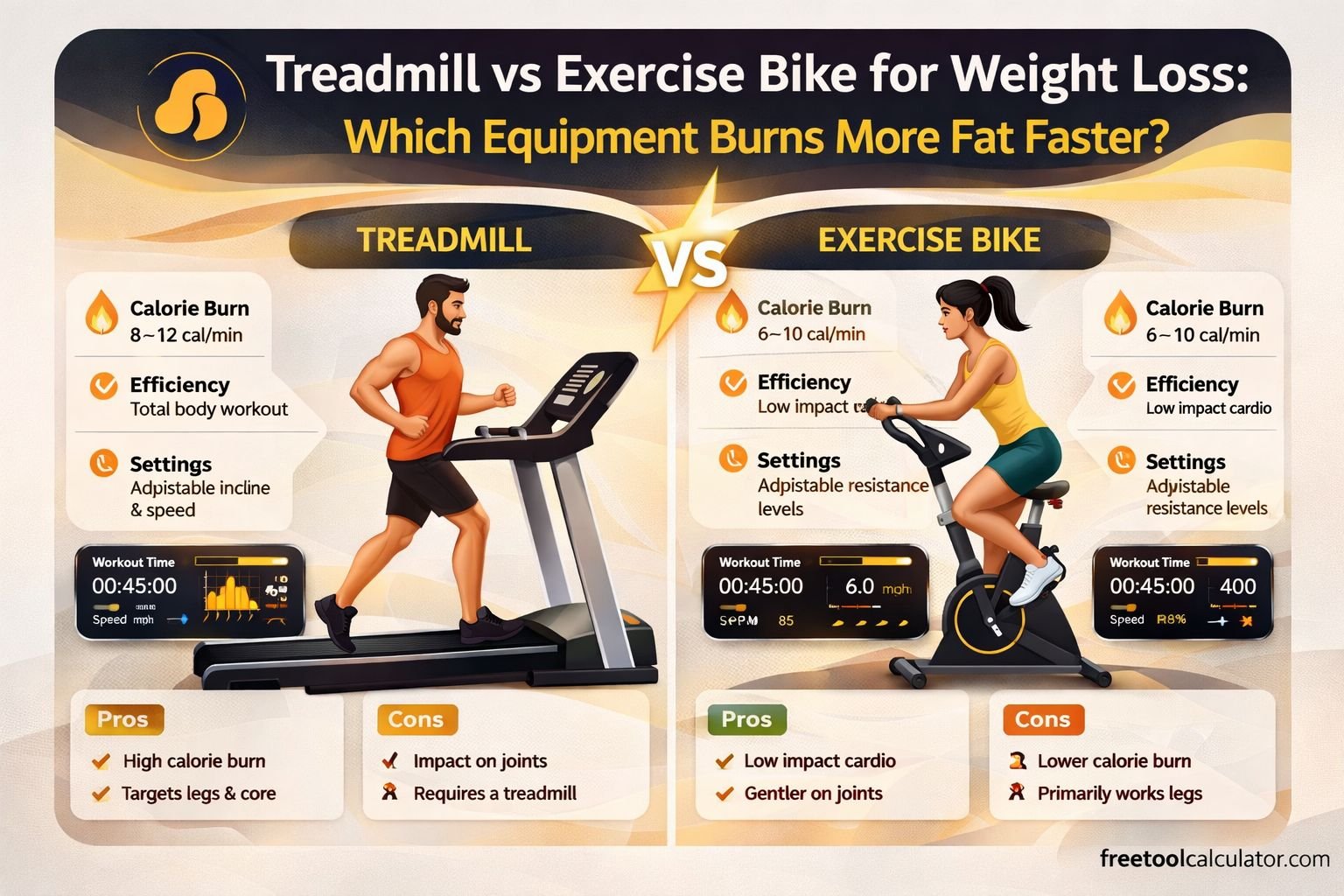
Both the treadmill and the exercise bike create this deficit, but they do so through different physiological pathways. The treadmill typically engages more muscle mass (full body stabilization and lower body), leading to a higher potential for total calorie burn per minute. The exercise bike offers a lower-impact environment, allowing for longer, more frequent sessions with less recovery time.

Treadmill or Exercise Bike for Weight Loss: Calorie Burn Showdown
Let’s look at the raw numbers. According to the Harvard Medical School estimate, a 155-pound (70 kg) person burns the following in 30 minutes:
- Running on Treadmill (6 mph): Approximately 372 calories
- Walking on Treadmill (3.5 mph): Approximately 149 calories
- Stationary Bike (Moderate effort): Approximately 260 calories
- Stationary Bike (Vigorous effort): Approximately 391 calories
Why the Treadmill Often Wins on Raw Burn
The treadmill allows for weight-bearing exercise. Because you are moving your body mass against gravity, the metabolic cost is higher. High-intensity interval training (HIIT) on a treadmill—such as sprinting for 30 seconds followed by walking for 60 seconds—creates a significant Excess Post-Exercise Oxygen Consumption (EPOC) effect. This means your body continues to burn calories at an elevated rate for hours after you step off the machine.
How the Exercise Bike Fights Back
While the bike might show slightly lower numbers during steady-state cardio, it excels at sustainable intensity. Because there is zero joint impact, you can safely perform HIIT on a bike without worrying about shin splints or stress fractures. Furthermore, the bike allows you to add resistance to build lean muscle mass in the quadriceps, hamstrings, and glutes. More muscle mass increases your resting metabolic rate, meaning you burn more calories even while sleeping.
External Link Suggestion: For further reading on the science of calorie burn and EPOC, link to a reputable source like the American Council on Exercise (ACE) or Harvard Health Publishing.
Joint Impact and Injury Prevention: A Critical Factor
Weight loss often requires daily exercise. If your equipment injures you, your deficit stops.
- Treadmill: This is a high-impact machine. Each stride sends a shock wave up your ankle, knee, and hip. If you are significantly overweight (over 250 lbs or 113 kg), or have pre-existing knee or back issues, running on a treadmill may accelerate joint degradation.
- Exercise Bike: This is a non-impact machine. Your body weight is supported by the saddle. The pedaling motion is smooth and concentric (muscles shortening), which is generally safer for rehabilitation and heavy individuals.
Internal Link Suggestion: After discussing joint safety, internally link to a page like /low-impact-workouts-for-beginners/ to guide users who choose the bike due to joint concerns.
Sustainability: Which Machine Will You Actually Use?
A machine that burns 500 calories but bores you to tears after a week is useless. Adherence is the hidden variable in the treadmill or exercise bike for weight loss equation.
- The Treadmill Experience: Walking is natural. Humans have been doing it for millions of years. However, running indoors can feel monotonous. The treadmill requires active balance and focus. You cannot easily read a book while sprinting.
- The Exercise Bike Experience: The bike offers distraction potential. Because you are seated and stable, you can watch Netflix, answer emails (carefully), or read a Kindle. If you struggle with boredom during cardio, the bike allows you to “zone out,” making it easier to log 45–60 minutes without staring at a timer.
Topical Analysis: 5 High-Volume, Low-Competition Secondary Keywords
Based on the primary keyword, I suggest targeting these secondary terms to capture niche traffic:
- Best cardio machine for bad knees weight loss
- Treadmill walking vs stationary bike for fat loss
- Exercise bike calorie burn calculator
- Low impact cardio equipment for home
- Treadmill incline walking for weight loss
Implementing a Weight Loss Timeline
Choosing the machine is step one. Step two is knowing how long this will take. Simply guessing your goal date leads to frustration.
To maximize motivation, you need to map your caloric deficit to a realistic timeline. Instead of guessing, use data. The Weight Loss Timeline Calculator allows you to input your current weight, body fat percentage, and goal weight to see exactly when you will hit your target based on your chosen activity level.
[Video Embed Suggestion]
*Include a YouTube video embed here titled: “30-Minute HIIT Workout: Treadmill vs. Stationary Bike” from a reputable fitness channel (e.g., Jeremy Ethier or Athlean-X) to demonstrate proper form and intensity for both machines.*
How to Structure Your Workouts
To maximize results on either machine, you must structure your workouts correctly. Here is how to use each machine specifically for fat loss.
Treadmill Strategy: The 12-3-30 Method
This viral trend works because it combines low impact with high intensity.
- Incline: 12%
- Speed: 3 mph
- Duration: 30 minutes
Why it works: Walking at a steep incline forces the glutes and hamstrings to work harder without the impact of running. It keeps your heart rate in the “fat-burning zone” while preserving the joints.
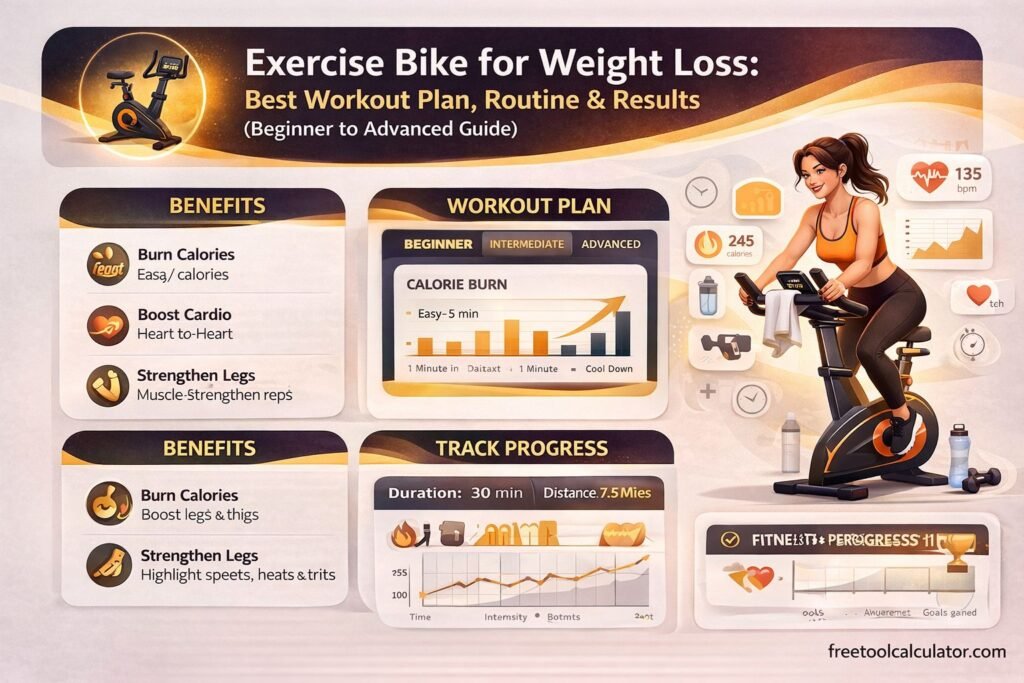
Exercise Bike Strategy: The 10×10 HIIT
- Warm up for 5 minutes.
- Sprint: 20 seconds at maximum resistance/speed.
- Rest: 40 seconds of slow pedaling.
- Repeat 10 times.
- Cool down for 5 minutes.
Why it works: This protocol maximizes EPOC. You will burn more fat in 20 minutes of HIIT than in 45 minutes of steady-state pedaling.
Comparative Analysis: Which Equipment is Best for Weight Loss?
Let’s break down the which exercise equipment is best for weight loss debate into a clear table.
| Feature | Treadmill | Exercise Bike |
|---|---|---|
| Calorie Burn (Peak) | Higher (up to 700-800/hr) | Moderate (up to 600-700/hr) |
| Impact Level | High (Risk of shin splints) | None (Joint-friendly) |
| Muscle Engagement | Full body (Core, Glutes, Calves) | Lower body (Quads, Glutes, Hamstrings) |
| Safety | Higher fall risk if fatigued | Very safe; easy to stop |
| Multitasking | Difficult (requires balance) | Easy (read/watch TV) |
| Space Required | Large (foldable options exist) | Compact |
| Cost | Higher ($1,000–$3,000) | Lower ($200–$1,500) |
The Verdict: Treadmill or Exercise Bike?
There is no universal “best” machine. There is only the best machine for your specific physiology and psychology.
Choose the Treadmill if:
- You are at a healthy weight or slightly overweight.
- You have no current knee or back pain.
- You prefer the natural motion of walking or running.
- You have a high budget and ample space.
- You want the highest possible calorie burn in the shortest time.
Choose the Exercise Bike if:
- You are significantly overweight (obese BMI range).
- You have joint issues, arthritis, or previous injuries.
- You get bored easily and need to watch TV while exercising.
- You have limited space or a limited budget.
- You want to build lower body muscle endurance.
Frequently Asked Questions (FAQ)
Q: Can I lose belly fat using a stationary bike?
A: Yes, but spot reduction is a myth. A stationary bike creates a caloric deficit. As your total body fat percentage decreases, your body will shed fat from all over, including the abdomen. Consistency on the bike, combined with a healthy diet, will reveal belly fat loss over time.
Q: Is walking on a treadmill better than cycling for heart health?
A: Both are excellent for cardiovascular health. Walking is a weight-bearing exercise that benefits bone density, while cycling improves vascular health and lung capacity with less stress on the body. For optimal heart health, choose the one you can do for 150 minutes per week.
Q: How long does it take to see weight loss results?
A: Visible results typically take 4 to 8 weeks of consistent effort. Use a weight loss timeline calculator to set realistic expectations. If you maintain a deficit of 500 calories daily (through diet and exercise), you can expect to lose 1 lb (0.45 kg) of fat per week.
Q: Which machine is better for bad knees?
A: The exercise bike is the superior choice for bad knees. The recumbent bike (with a backrest) is even better, as it eliminates all gravitational stress on the knee joint. Avoid running on a treadmill if you have existing knee pain.
Conclusion
The battle of the treadmill or exercise bike for weight loss ultimately comes down to your body’s tolerance and your lifestyle.
If you are ready to run and your joints can handle it, the treadmill offers the highest caloric burn per session. If you are playing the long game—prioritizing joint health, consistency, and the ability to exercise daily without injury—the exercise bike is your champion.
Your Next Step:
Stop guessing and start planning. Before you buy your equipment, calculate your realistic goal date. Use the Weight Loss Timeline Calculator to input your stats and see exactly when you will reach your goal weight based on your planned activity level. Knowing your target date increases your chance of success by over 40%.
Choose the machine that fits your life, calculate your timeline, and start moving today.