What is this tool
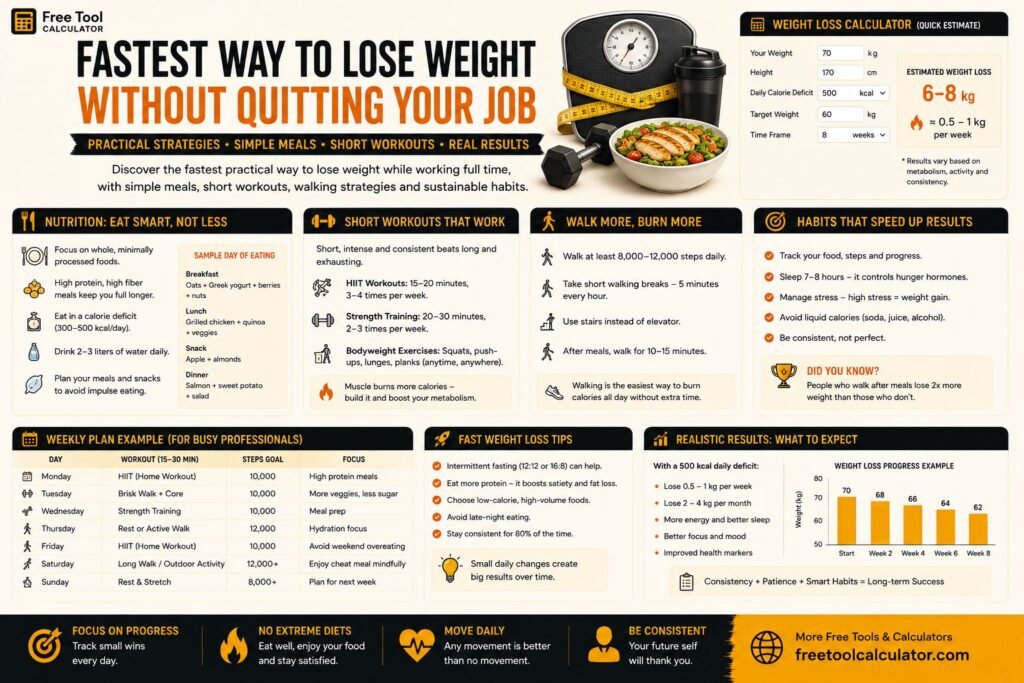
The Weight Loss Timeline Calculator estimates how long it may take to reach a target weight or body fat goal based on current body composition and planned progress. It focuses on body fat reduction rather than scale weight alone, helping users understand realistic timelines for change.
Why this tool is useful
This tool provides a clearer expectation of weight loss progress by accounting for body fat percentage and rate of change. It helps users set achievable goals, avoid unrealistic timelines, and stay motivated by understanding how gradual fat loss contributes to long term results.
How this tool works
The calculator uses inputs such as current weight, body fat percentage, target body fat or weight, and intended weekly fat loss rate. Based on these values, it estimates the total fat to be lost and projects an approximate goal date assuming consistent progress over time.
Key features or capabilities
The tool generates an estimated timeline and goal date based on user input and standard fat loss assumptions. It provides clear results without requiring complex calculations and works entirely online with instant feedback.
Common use cases
Users commonly use this calculator to plan fitness or lifestyle changes, track expected progress over weeks or months, or set realistic milestones for fat loss goals. It is also useful for learning how body fat reduction differs from short term weight fluctuations.
Who should use this tool
This tool is suitable for adults focused on healthy weight management, fitness enthusiasts tracking body composition changes, students studying health fundamentals, and general users seeking structured goal planning.
Accuracy privacy or safety
The results are estimates based on user inputs and general fat loss models. Actual results may vary due to individual metabolism, activity level, and consistency. The tool is intended for informational purposes only and does not provide medical advice. No personal data is stored or shared.
Is this tool free to use
Yes, the Weight Loss Timeline Calculator is completely free to use online with no registration, subscriptions, or usage limits.
About the Weight Loss Timeline Calculator
Weight Loss Timeline Calculator is an educational estimation tool designed to help you understand the relationship between the inputs you enter and the result shown. The interactive tool above is the main feature of this page; the guide below explains how to use it responsibly, what the result means, and what to check when the number will be used for a real decision.
How to use this tool
- Read each field label and enter the requested values using the units shown.
- Check that decimal points, percentages, dates, or units have been entered correctly.
- Run the calculation or generation step and review the complete result rather than copying only one number.
- If the result will affect money, health, purchasing, scheduling, or another important decision, verify the inputs and compare the result with an appropriate independent source.
What to know before relying on the result
Body weight does not change in a perfectly linear way. Water, glycogen, adherence, energy expenditure, and health factors can alter the timeline.
How to interpret the result
Treat the result as an estimate rather than a diagnosis, prescription, or personal medical recommendation. Health-related outputs can change with age, body composition, activity, sleep, medication, pregnancy, illness, measurement method, and other individual factors that a simple online calculator cannot fully capture.
Important health limitation
This tool is for general educational information. It is not a substitute for advice from a doctor, registered dietitian, physiotherapist, psychologist, or other qualified professional. If a result concerns you, conflicts with professional advice, or relates to symptoms or a medical condition, discuss it with an appropriate healthcare professional.
Common mistakes to avoid
- Mixing measurement systems or entering a value in a different unit from the one requested.
- Using rounded or estimated inputs when more accurate values are available.
- Assuming an online result includes every real-world variable, fee, exception, or personal factor.
- Copying the output without checking whether the result is plausible for the values entered.
Frequently Asked Questions
Is the Weight Loss Timeline Calculator free to use?
Yes. You can use the tool in your browser without purchasing specialist calculation software.
Why might my result differ from another calculator?
Different tools can use different assumptions, rounding rules, data sources, formulas, defaults, or conversion precision. Compare the inputs and methodology before deciding that one result is incorrect.
Can I use the result for professional decisions?
It can be useful for preliminary calculations and cross-checking. For regulated, medical, legal, tax, engineering, or other high-stakes decisions, confirm the result with the relevant official source or qualified professional.
How can I report a problem?
If you find a calculation, wording, usability, or technical issue, contact Free Tools Calculator and include the page URL, the inputs you used, the result you received, and what you expected. That makes the issue easier to reproduce and review.
Complete Guide to the Weight Loss Timeline Calculator
This supporting guide explains how to use the weight loss timeline calculator, what the output means, how to check the result, and which assumptions matter. The interactive tool remains the main feature; the content below is designed to make the result easier to understand and verify.
What a Weight Loss Timeline Estimate Shows
A weight loss timeline calculator projects how long a change in body weight could take under the assumptions entered. It is a planning estimate, not a promise. Real body weight changes are affected by water, glycogen, food mass, adherence, metabolic adaptation and many other factors.
For a dependable result, enter values using the units and definitions requested by the tool, then check whether the output is an exact mathematical result or an estimate based on assumptions. When the calculation affects an important financial, health, employment, tax, academic or purchasing decision, confirm the relevant inputs and rules independently.
How the Projection Works
A simplified model relates an estimated energy deficit to expected weight change over time. Static calorie-to-weight rules are useful for rough planning but become less accurate over longer periods because energy needs can change as body weight and behavior change.
Why Scale Weight Does Not Move Linearly
Day-to-day weight can fluctuate because of hydration, sodium, carbohydrate intake, digestion, menstrual cycle and other factors. A flat week does not necessarily mean no fat was lost, and a sudden drop does not necessarily represent the same amount of fat loss.
Calorie Deficit and Timeline
A larger theoretical deficit produces a shorter mathematical timeline, but aggressive restriction can be difficult to sustain and may be inappropriate for some people. Energy needs vary by individual. A calculator cannot determine a medically appropriate calorie target for everyone.
Tracking Progress
Compare trends across multiple measurements taken under similar conditions rather than reacting to a single weigh-in. Waist measurements, fitness performance, dietary consistency and other measures can provide additional context depending on the goal.
When the Estimate Needs Recalculation
Recalculate after a meaningful change in body weight, activity or goal, or when the original assumptions no longer reflect actual behavior. A timeline is most useful when it is updated rather than treated as a fixed deadline.
How to Validate the Result
Start with a simple test case whose answer you can calculate manually. Compare that answer with the tool, then return to your real inputs. Recheck decimal points, percentage formats, signs, units, dates and category selections. For estimates, change one input at a time to see which assumptions have the greatest effect on the result.
Editorial and Accuracy Notes
FreeToolCalculator combines interactive utilities with explanatory content so users can understand rather than merely copy an output. We distinguish straightforward arithmetic from estimates and avoid presenting a calculator as a substitute for an official source or qualified professional when the topic is consequential. Tool outputs depend on the accuracy of the values entered and the methodology described on the page.
Using the Weight Loss Timeline Calculator as a Health Estimate
Health-related calculators simplify complex individual differences into a small number of inputs. Use the result as an educational reference, not as a diagnosis or a personalized treatment target. Measurements can vary because of age, body composition, activity, sleep, medication, pregnancy, medical history and the method used to collect the input data.
Improve the Quality of Your Inputs
Use recent measurements, enter the requested units exactly, and avoid guessing when an accurate measurement is available. If you repeat the calculation, try to measure under similar conditions. This makes changes easier to interpret and reduces the chance that normal measurement variation is mistaken for a meaningful change.
When Professional Context Matters
If you are using the result to make a significant change to diet, exercise, medication, pregnancy planning or management of a medical condition, discuss it with an appropriately qualified professional. The calculator can help you understand the numbers, but it does not know your full health history or replace individualized assessment.
Final Check for Weight Loss Timeline Calculator
Review the original input one final time before copying the result. Check decimal places, signs, units, dates and any selected options. If the value will be shared, include enough context for another person to understand what was entered and what the output represents. This final check reduces transcription errors and makes the calculation easier to reproduce.