Stress Level Calculator | Daily Stress Assessment
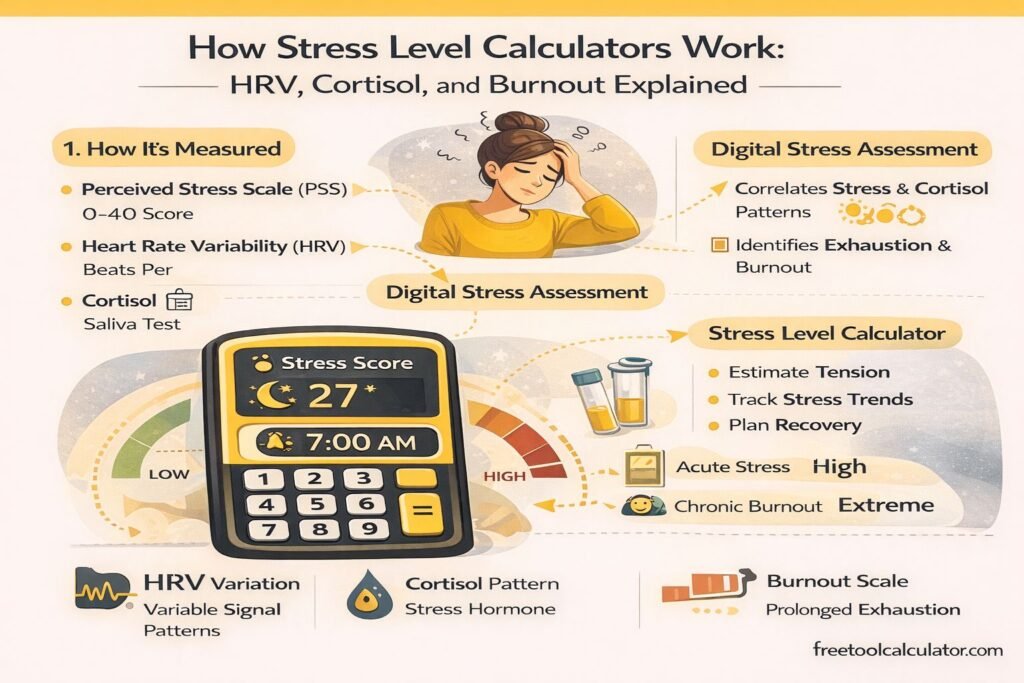
A Stress Level Calculator is a simple tool designed to help you understand and track your daily stress levels. By evaluating common mental and physical indicators, it provides a clear snapshot of how stress may be affecting your overall well-being.
What Is a Stress Level?
Stress level reflects how your body and mind respond to daily pressures such as work, responsibilities, sleep quality, and emotional load. While some stress is normal, consistently high stress can impact focus, energy, sleep, and long-term health.
How the Stress Level Calculator Works
A Stress Level Calculator typically uses inputs such as mood, sleep patterns, workload, physical activity, and perceived tension. These factors are scored and combined to produce an overall stress rating, helping you identify whether your stress is low, moderate, or high.
Why Measuring Stress Matters
Tracking stress levels helps you recognize patterns and triggers before they become overwhelming. It supports better decision-making, encourages healthy coping strategies, and helps you take early steps to protect both mental and physical health.
Benefits of Using a Stress Level Calculator
Using a calculator brings awareness and clarity to something that is often hard to measure. It helps monitor changes over time, supports mindfulness, and encourages balance through actionable insights rather than assumptions.
Final Thoughts
A Stress Level Calculator offers a practical way to assess and manage daily stress. By understanding your stress level, you can make informed lifestyle adjustments, improve emotional balance, and support long-term well-being with confidence.
About the Stress Level
Stress Level is an educational estimation tool designed to help you understand the relationship between the inputs you enter and the result shown. The interactive tool above is the main feature of this page; the guide below explains how to use it responsibly, what the result means, and what to check when the number will be used for a real decision.
How to use this tool
- Read each field label and enter the requested values using the units shown.
- Check that decimal points, percentages, dates, or units have been entered correctly.
- Run the calculation or generation step and review the complete result rather than copying only one number.
- If the result will affect money, health, purchasing, scheduling, or another important decision, verify the inputs and compare the result with an appropriate independent source.
What to know before relying on the result
A short self-assessment cannot diagnose anxiety, depression, burnout, or another condition. Persistent or severe distress deserves professional support.
How to interpret the result
Treat the result as an estimate rather than a diagnosis, prescription, or personal medical recommendation. Health-related outputs can change with age, body composition, activity, sleep, medication, pregnancy, illness, measurement method, and other individual factors that a simple online calculator cannot fully capture.
Important health limitation
This tool is for general educational information. It is not a substitute for advice from a doctor, registered dietitian, physiotherapist, psychologist, or other qualified professional. If a result concerns you, conflicts with professional advice, or relates to symptoms or a medical condition, discuss it with an appropriate healthcare professional.
Common mistakes to avoid
- Mixing measurement systems or entering a value in a different unit from the one requested.
- Using rounded or estimated inputs when more accurate values are available.
- Assuming an online result includes every real-world variable, fee, exception, or personal factor.
- Copying the output without checking whether the result is plausible for the values entered.
Frequently Asked Questions
Is the Stress Level free to use?
Yes. You can use the tool in your browser without purchasing specialist calculation software.
Why might my result differ from another calculator?
Different tools can use different assumptions, rounding rules, data sources, formulas, defaults, or conversion precision. Compare the inputs and methodology before deciding that one result is incorrect.
Can I use the result for professional decisions?
It can be useful for preliminary calculations and cross-checking. For regulated, medical, legal, tax, engineering, or other high-stakes decisions, confirm the result with the relevant official source or qualified professional.
How can I report a problem?
If you find a calculation, wording, usability, or technical issue, contact Free Tools Calculator and include the page URL, the inputs you used, the result you received, and what you expected. That makes the issue easier to reproduce and review.
Why Inputs Matter
Most incorrect results begin with an incorrect assumption or input. A calculator cannot know that a value was typed in the wrong unit, a date was interpreted in the wrong order, or text contained an unintended character. Before relying on the output, review every input and ask whether it describes the real problem. If the result looks surprising, change one input at a time and see which assumption causes the difference.
Practical Example
Suppose you use this tool for a real project and receive a result that you plan to share with someone else. First record the original input. Run the tool, then repeat the task with a simple value whose outcome you can predict. If that check behaves as expected, return to the original result and confirm the units, labels, date, text, or settings. This small verification step is especially useful when a result will be copied into a document, spreadsheet, website, assignment, schedule, or business workflow.
When This Tool Is Most Useful
This tool is most useful for quick calculations, comparisons, conversions, planning, learning, and first-pass checks. It can save time when you need a repeatable method and want the same rules applied consistently. It is less suitable when the task depends on information the tool does not collect, when a professional or official determination is required, or when the result could change because of external rules that are not represented in the inputs.
How We Approach Tool Quality
FreeToolCalculator aims to pair interactive tools with plain-language explanations. Tool logic and supporting content should be reviewed when formulas, standards, interfaces, or common practices change. Where a calculation is based on a formula, the page should explain the variables and assumptions. Where a utility transforms data, the page should explain what the transformation does and does not validate. This transparency is more useful than asking users to trust an unexplained output.
Related Search Questions
Users looking for a stress level test often also want to understand related terms such as check stress level, stress level check, measure stress level, stress levels test online, stress level quiz, stress level calculator, stress level scale, stress level 1-10. The sections above address these topics in context so you can choose the correct workflow instead of relying on a keyword or label alone.
Editorial note: Supporting guidance reviewed October 2026. Interactive results should always be interpreted in the context of the inputs and limitations described above.
Complete Guide to the Stress Level
This guide expands the existing Stress Level with practical instructions, interpretation guidance, verification steps and limitations. The interactive calculator or utility remains the primary feature, and the supporting content is designed to help users understand and check the output.
Example Verification Method
Choose a simple example you can solve independently. Compare the expected answer with the tool’s result, then return to your actual inputs. This confirms that you understand the calculation direction and interface.
Before relying on the output, recheck the source value, selected unit and any assumptions shown by the interface. If a result appears unreasonable, test a smaller known example rather than repeatedly submitting the same input.
Accuracy, Precision and Rounding
The result cannot be more reliable than the source data and underlying method. Use rounding appropriate to the measurement or task and avoid implying precision that the inputs do not support.
Result Verification Checklist
- Check the original source values.
- Confirm units and input format.
- Review all selected options.
- Test a simple known case.
- Use appropriate rounding.
- Verify consequential results independently.
Reading Your Stress Result Over Time
A single stress score is best treated as a snapshot. Daily workload, sleep, conflict, illness, caffeine, exercise and major life events can change how you answer the questions. If you use the tool repeatedly, compare results under similar conditions and look for patterns rather than focusing on one number. A rising pattern may be a useful prompt to review rest, workload, boundaries and sources of support.
What the Score Cannot Tell You
This self-assessment does not establish a mental-health diagnosis and cannot identify the cause of distress. Two people with the same score may have very different circumstances and support needs. If stress is persistent, severe, interferes with daily life, or is accompanied by concerning physical or emotional symptoms, seek advice from an appropriately qualified healthcare or mental-health professional.
Making the Result More Useful
Record the date and the main factors affecting your day when you save a result. That context can make later comparisons more meaningful. Consider practical changes one at a time—such as improving sleep consistency, scheduling breaks, reducing avoidable overload or talking with someone you trust—so you can observe whether your perceived stress changes.
Final Check for Stress Level
Review the original input one final time before copying the result. Check decimal places, signs, units, dates and any selected options. If the value will be shared, include enough context for another person to understand what was entered and what the output represents. This final check reduces transcription errors and makes the calculation easier to reproduce.