What is an energy unit converter
An energy unit converter is an online tool that converts energy electrical and power units into other equivalent units. It helps convert values such as joules kilowatt hours watts volts and amps accurately. This tool eliminates manual formula calculations. It is useful for students engineers electricians and everyday users.
Why energy unit conversion is important
Different fields use different energy and electrical units. Electricity bills use kilowatt hours while physics uses joules and power ratings use watts. Converting between units ensures correct understanding and calculations. It is essential for education technical work and energy planning.
How an energy unit converter works
The converter uses scientifically defined formulas to transform one unit into another. You enter a value select the input unit and choose the output unit. The calculator applies the correct conversion factor instantly. Results are precise and reliable.
What units can be converted using this tool
This energy unit converter supports joules kilojoules watt hours kilowatt hours watts volts amps and more. It covers energy power and basic electrical units. This wide support makes it suitable for multiple use cases. Both small and large values are handled accurately.
Difference between energy and power units
Energy units such as joules and kilowatt hours measure total energy used. Power units like watts measure the rate of energy use. Volts and amps measure electrical potential and current. Understanding these differences helps apply correct conversions.
How to convert joules to kilowatt hours
Joules are converted to kilowatt hours by dividing the value by 3.6 million. This is because one kilowatt hour equals 3.6 million joules. The calculator performs this conversion automatically. This is useful in energy consumption analysis.
How watts volts and amps are related
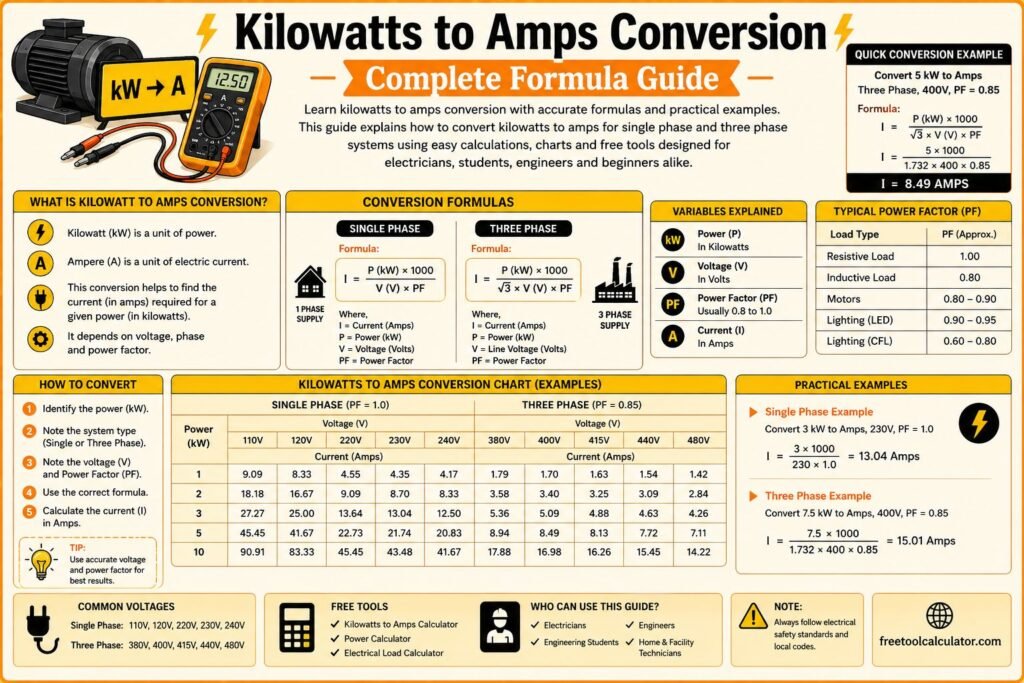
Watts volts and amps are related through electrical power formulas. Power in watts equals volts multiplied by amps. This relationship helps calculate missing values in circuits. The converter assists with quick and accurate conversions.
Is this energy unit converter useful for students
Yes students studying physics electrical engineering and science use energy conversions frequently. This tool helps with homework exam preparation and understanding concepts. It saves time and improves accuracy. Teachers also use it for demonstrations.
Can professionals use this energy unit converter
Engineers electricians technicians and energy analysts rely on unit conversions daily. This tool helps with system design troubleshooting and reporting. It reduces calculation errors and increases efficiency. It is suitable for professional use.
Does the converter support decimal and large values
Yes the energy unit converter supports decimal values and very large numbers. Precision is maintained across all conversions. This makes it reliable for scientific and industrial calculations. Results remain consistent.
Is this energy unit converter free to use
Yes this energy unit converter is completely free. No registration or payment is required. You can use it unlimited times. Results are instant and private.
Who should use an energy unit converter
This tool is ideal for students teachers engineers electricians and general users. Anyone dealing with energy or electrical calculations can benefit. No technical setup is required. The interface is simple and user friendly.
Energy Unit Converter
The Energy Unit Converter is a versatile tool designed to convert between various energy and power units quickly and accurately. It allows users to convert joules, kilowatt-hours, watts, kilowatts, volts, amps, calories, and BTU in one easy-to-use interface. Whether you are studying physics, working with electrical systems, managing energy consumption, or calculating energy efficiency, this tool provides clear results and helps you understand energy measurements in different units.
Many users frequently search for what is the energy SI unit, what are units for energy, is kilowatt a unit of energy, or what units are used to measure kinetic or potential energy. This Energy Unit Converter addresses all these queries by providing instant conversions and definitions for each energy unit. It also helps clarify common misconceptions, such as the difference between watts (a unit of power) and kilowatt-hours (a unit of energy consumption).
Understanding energy units is essential for physics students, engineers, electricians, researchers, and anyone involved in energy management. By converting between units, you can interpret scientific data, analyze electricity bills, calculate appliance energy usage, or compare different energy sources effectively.
What Is Energy and Its SI Unit?
Energy is the capacity to do work or produce heat. It is a fundamental concept in physics and engineering, measured in various units depending on context. The standard SI unit for energy is the joule (J). One joule is defined as the energy transferred when a force of one newton acts over a distance of one meter.
Other commonly used energy units include kilowatt-hours (kWh) for electricity, calories (cal) for food energy, and British Thermal Units (BTU) for heating and cooling systems. Understanding these units and how to convert between them is crucial for accurate calculations and effective energy management.
How to Convert Energy Units
The Energy Unit Converter simplifies conversions between different energy units. The conversion process involves the following steps:
Step 1: Select the Input Unit
Choose the energy unit you want to convert from, such as joules, kilowatt-hours, calories, or BTU.
Step 2: Enter the Energy Value
Input the numerical value of the energy quantity you want to convert. Ensure that the value corresponds to the selected input unit.
Step 3: Select the Target Unit
Choose the unit you want to convert to. The converter supports a wide range of energy and power units for flexible calculations.
Step 4: View Converted Results
The tool displays the equivalent energy in the chosen target unit, along with a breakdown if necessary. This helps you understand the magnitude of energy in different measurement systems.
Common Energy Units
Understanding the most frequently used energy units is essential for science, engineering, and everyday applications.
- Joule (J): SI unit of energy, used for work, heat, and mechanical energy.
- Kilowatt-hour (kWh): Common unit for electricity consumption, often seen on utility bills.
- Calorie (cal): Unit of energy used in food energy and nutrition.
- British Thermal Unit (BTU): Energy used for heating and cooling systems, especially in HVAC calculations.
- Electronvolt (eV): Used in atomic and particle physics.
- Watt (W): Unit of power, representing energy per unit time.
- Kilowatt (kW): 1000 watts, commonly used for appliances and industrial power systems.
- Volt (V) × Ampere (A) × Time: Sometimes used to calculate electrical energy consumption.
How Energy Is Measured in Different Contexts
Energy measurement varies depending on the application:
- Electricity: Measured in kilowatt-hours (kWh), often monitored by utility meters.
- Mechanical Work: Measured in joules (J) or newton-meters (N·m).
- Food Energy: Measured in calories or kilocalories.
- Heating and Cooling: Measured in BTUs or kilojoules.
- Physics and Chemistry: Uses joules, electronvolts, or calories depending on context.
Calculating Energy Consumption
Energy consumption is the amount of energy used over a period of time. For electrical systems, the calculation is:
Energy (kWh) = Power (kW) × Time (hours)
Cost = Energy (kWh) × Price per kWh
For thermal or mechanical systems, energy can be calculated using formulas based on work done, force applied, or heat transferred. The Energy Unit Converter allows you to switch between units instantly, making these calculations easier.
Applications of Energy Unit Conversion
- Electricity billing and utility calculations
- Estimating energy costs for appliances and industrial equipment
- Comparing fuel sources such as gasoline, natural gas, and electricity
- Understanding food energy content and nutrition labeling
- Scientific research in physics, chemistry, and engineering
- Calculating heating and cooling loads for buildings
- Energy auditing for residential and commercial properties
- Renewable energy systems performance analysis
- Educational purposes in teaching energy and power concepts
- Engineering design and efficiency optimization
Common Questions About Energy Units
What is the SI unit of energy?
The SI unit of energy is the joule (J).
Is kilowatt-hour a unit of energy?
Yes. A kilowatt-hour (kWh) represents 1000 watts of power used over one hour and is commonly used in electricity billing.
What is the unit for kinetic energy?
Kinetic energy is measured in joules (J) in the SI system.
What is the unit for potential energy?
Potential energy is also measured in joules (J).
How is electricity consumption calculated?
Energy consumption in kWh = Power (kW) × Time (hours). Multiply by the local rate to find the cost.
Are watts a unit of energy?
No. Watts (W) are a unit of power, which measures the rate of energy transfer. Energy in watts over time can be converted into kWh.
How do you convert energy units?
Use conversion formulas or an Energy Unit Converter to switch between joules, kWh, calories, BTU, and other units.
Why Use an Energy Unit Converter?
Converting energy units is essential for scientific calculations, billing, and energy management. Different units are used in different contexts, and accurate conversions are necessary for comparison and analysis. The Energy Unit Converter provides a reliable, easy-to-use platform for:
- Physics and engineering calculations
- Estimating electricity bills
- Energy audits
- Comparing fuel efficiency
- Converting between electrical, mechanical, and thermal energy units
- Educational and academic purposes
- Monitoring energy consumption for cost reduction
- Planning renewable energy generation and storage
- Understanding the energy content of food or chemical fuels
- Optimizing industrial and commercial energy use
How to Use the Energy Unit Converter
- Select the unit of energy you have (e.g., joule, kWh, calorie, BTU).
- Enter the value you want to convert.
- Select the target unit to convert into.
- View the converted value instantly.
- Repeat for multiple units as needed to compare different energy forms.
Benefits of Using the Energy Unit Converter
- Instant and accurate energy unit conversions
- Supports a wide range of units including electrical, mechanical, thermal, and food energy
- Easy to use for students, engineers, and professionals
- Reduces errors from manual calculation
- Helps in understanding energy equivalences
- Supports budgeting and electricity cost estimation
- Facilitates energy efficiency analysis and comparison
- Educational aid for physics and chemistry learning
- Useful for designing energy systems and appliances
- Free and accessible online
Conclusion
The Energy Unit Converter is a reliable, user-friendly tool for converting energy and power units. Whether you need to calculate electricity usage, compare kilojoules to calories, estimate kWh costs, or convert BTU to joules, this calculator simplifies the process and provides accurate results. Understanding energy units is essential for scientific, educational, and practical applications, and this tool helps users make informed decisions about energy usage, efficiency, and cost management.