Introduction
Many people struggle when they need to convert metric units in daily tasks. You may be working on homework cooking measuring distance or handling technical data and suddenly you need to switch between units. Without a clear method this process becomes confusing and time consuming. Even small mistakes in conversion can lead to incorrect results.
A metric units conversion chart solves this problem by giving you a simple visual guide. Instead of memorizing complex formulas you can rely on an easy system based on patterns. This makes conversions faster and more accurate. Whether you are a student or a professional this tool becomes very useful.
In this guide you will learn how the metric system works how to use a conversion chart effectively and how to avoid common mistakes. You will also understand real life applications so you can apply this knowledge with confidence. By the end you will feel comfortable converting units without hesitation.
What is a Metric Units Conversion Chart
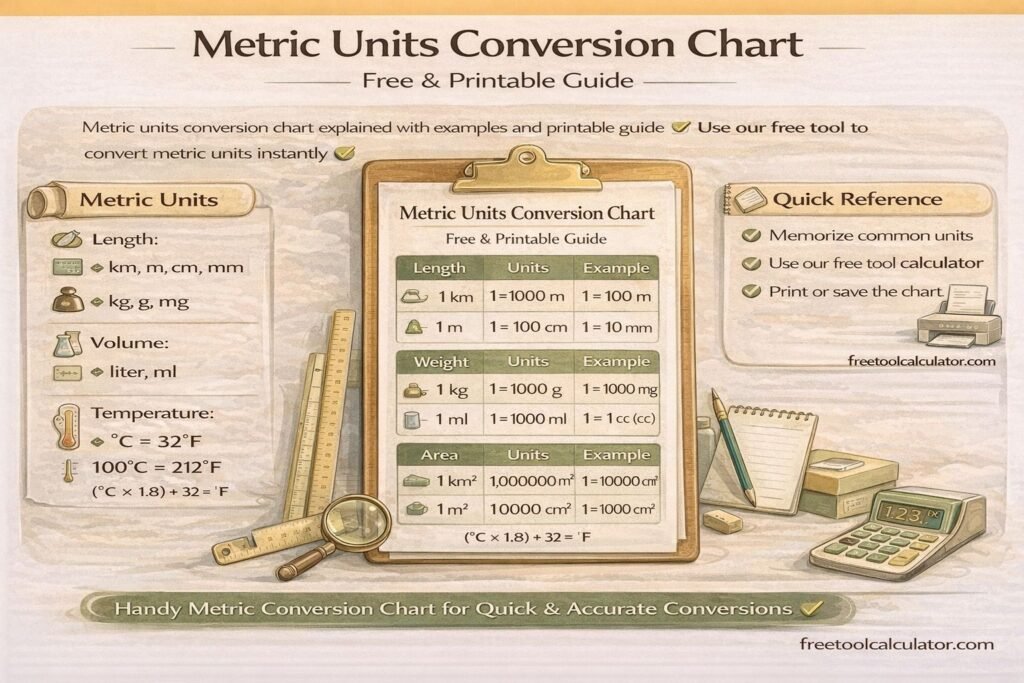
A metric units conversion chart is a visual reference that shows how different units relate to each other. It helps you understand how to move between units without confusion. The chart usually follows a fixed order which makes it easy to remember and apply in different situations.
The metric system uses a base unit and a set of prefixes. Each prefix represents a multiple or fraction of ten. This structure makes it very logical and consistent. Unlike other systems you do not need to memorize unrelated values for each conversion.
A typical chart includes units for length weight and volume. For example you will see meter gram and liter as base units. Around them you will find prefixes like kilo centi and milli. This arrangement helps you quickly identify how to convert from one unit to another.
Understanding the Metric System Basics
The metric system is built on a simple idea of scaling units by powers of ten. This means every step in the system is either ten times bigger or ten times smaller. Because of this pattern calculations become very easy and predictable.
The main prefixes in order are kilo hecto deca base deci centi and milli. Each step represents a shift in decimal place. Moving to the right means smaller units and moving to the left means larger units. This consistent pattern removes confusion and speeds up calculations.
For example one kilogram equals one thousand grams and one meter equals one hundred centimeters. These relationships stay the same across the system. Once you understand this structure you can convert any unit without needing extra formulas.
How a Metric Conversion Chart Works
A converting metric units chart works like a ladder or scale. Each level represents a unit and moving between levels changes the value. When you move down the chart you multiply by ten and when you move up you divide by ten. This simple rule applies to all metric conversions.
To use the chart you first identify your starting unit and your target unit. Then you count how many steps you need to move between them. Each step changes the value by a factor of ten. This helps you determine how to adjust the decimal point.
For example if you move three steps down you multiply by one thousand. If you move two steps up you divide by one hundred. This method makes conversions quick and reliable. You do not need to remember complex equations or conversion tables.
Step by Step Method to Convert Metric Units
To convert metric units easily you can follow a simple step by step method. This approach works for all types of measurements including length weight and volume. It helps you stay accurate and avoid confusion.
First identify the unit you are starting from and the unit you want to convert to. Next count how many steps are between them on the chart. Then decide whether you are moving up or down. Finally move the decimal point based on the number of steps.
For example converting meters to centimeters requires moving two steps down. So you multiply by one hundred. This gives you the correct result quickly. Practicing this method helps you become faster and more confident over time.
Metric Conversion Chart for Length
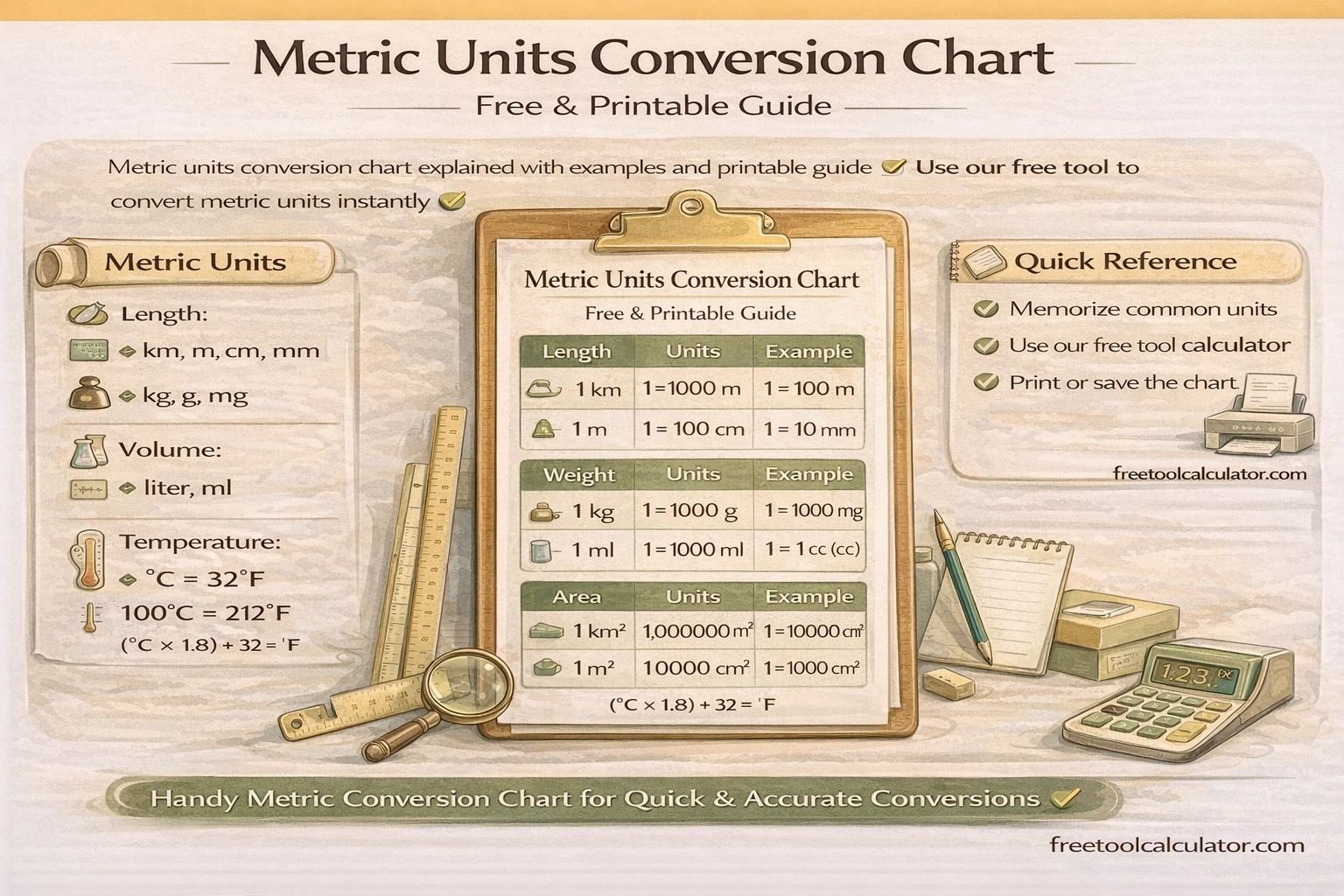
In the metric system the standard unit of length is the meter. Below is the commonly used conversion chart.
Meter to other units
1 Kilometer = 1000 Meters
1 Meter = 100 Centimeters
1 Meter = 1000 Millimeters
1 Centimeter = 10 Millimeters
Quick reference
1 km = 1000 m
1 m = 100 cm
1 cm = 10 mm
Metric Conversion Chart for Weight
In the SI system the standard unit of weight is the gram. Below is the commonly used conversion chart.
1 Kilogram = 1000 Grams
1 Gram = 1000 Milligrams
1 Pound = 0.456 Kilograms
1 Metric Ton = 1000 Kilograms
1 Gigagram = 1000 Megagrams
1 Decagram = 10 Grams
Quick reference
1 kg = 1000 g
1 g = 1000 mg
1 lb = 0.456 kg
1 tonne = 1000 kg
1 dag = 10 g
Metric Conversion Chart for Volume
In the metric system the standard unit of volume is the liter. Below is the conversion chart.
1 Kiloliter = 1000 Liters
1 Liter = 1000 Milliliters
1 Milliliter = 0.001 Liters
Quick reference
1 kl = 1000 l
1 l = 1000 ml
1 ml = 0.001 l
Full Metric Ladder Chart
This is the most important chart for converting metric units quickly
Kilo
Hecto
Deca
Base unit meter gram liter
Deci
Centi
Milli
How to use this chart
Move down multiply by 10
Move up divide by 10
Example
Meter to centimeter move 2 steps down multiply by 100
Milligram to gram move 3 steps up divide by 1000
Combined Metric Conversion Table
Here is a simple table format like your reference for easy understanding
Length
1 Kilometer = 1000 Meters
1 Meter = 100 Centimeters
1 Centimeter = 10 Millimeters
Weight
1 Kilogram = 1000 Grams
1 Gram = 1000 Milligrams
Volume
1 Liter = 1000 Milliliters
Importance of a Printable Metric Chart
A metric chart printable version is very helpful especially for beginners. It allows you to keep a physical reference that you can use anytime. This reduces the chances of making mistakes and improves your understanding.
Having a printed chart nearby helps you learn patterns faster. Instead of searching for information you can simply glance at the chart. This saves time and keeps your workflow smooth. It is also useful during exams or practical tasks.
Teachers often recommend printable charts because they support visual learning. Students can refer to them while practicing conversions. Over time this builds strong memory and reduces dependency on external help.
Common Metric Conversions Explained
Some metric conversions are used more frequently than others. Understanding these common conversions can make your work much easier. They form the foundation of most calculations you will perform.
For length one meter equals one hundred centimeters and one kilometer equals one thousand meters. For weight one kilogram equals one thousand grams and one gram equals one thousand milligrams. For volume one liter equals one thousand milliliters.
These basic relationships cover most real life scenarios. Once you remember them you can perform conversions quickly. They also help you estimate values without needing detailed calculations.
Real Life Applications of Metric Conversion
Metric conversions are used in many areas of daily life. In cooking you often need to convert between milliliters and liters. Accurate measurements are important for achieving the desired results. This makes conversion skills very useful in the kitchen.
In travel distances are usually measured in kilometers. You may need to convert units to understand maps or directions. This helps you plan your journey more effectively. It also improves your understanding of distances.
In science and engineering precise measurements are critical. Professionals rely on accurate conversions to ensure correct results. Even small errors can lead to major issues. This shows how important it is to master metric conversions.
Common Mistakes People Make
Many people make mistakes while converting metric units because they misunderstand the process. One common mistake is moving the decimal in the wrong direction. This leads to incorrect results and confusion. Always double check the direction before making changes.
Another mistake is counting the wrong number of steps between units. This happens when you are not familiar with the chart structure. Practicing regularly helps you avoid this problem. It also improves your speed and accuracy.
Some people try to memorize conversions instead of understanding the system. This approach makes learning harder. It is better to understand the pattern and use the chart. This way you can handle any conversion easily.
Using Tools for Faster Conversion
Manual conversion is useful but sometimes you need quick results. In such cases using an online tool can save time and effort. It allows you to convert units instantly without worrying about calculations.
You can use this simple tool for quick conversions
https://freetoolcalculator.com/unit-converter/
This tool helps you convert different units easily and accurately. It reduces the chances of error and speeds up your work. It is especially helpful when dealing with large or complex values.
Tips to Master Metric Conversions
To master metric conversions you need consistent practice and a clear understanding of the system. Start with basic units and gradually move to more complex conversions. This builds a strong foundation and improves your confidence.
Use visual aids like charts to understand relationships between units. This makes learning easier and more effective. You can also practice with real life examples to see how conversions work in practical situations.
Always double check your answers to avoid mistakes. Use tools when needed but try to understand the logic behind conversions. Over time you will be able to convert units quickly without any difficulty.
Benefits of Learning Metric Conversions
Learning metric conversions offers many benefits in both academic and professional life. It improves your ability to work with measurements accurately. This skill is useful in many fields including science engineering and everyday tasks.
It also saves time because you can perform conversions quickly. You do not need to rely on others or search for solutions. This increases your efficiency and productivity.
Understanding metric conversions also improves your problem solving skills. It helps you think logically and apply patterns. This makes learning other concepts easier as well.
Conclusion
A metric units conversion chart is a powerful tool that simplifies measurements. It helps you convert units quickly and accurately without confusion. By understanding the system you can handle any conversion with ease.
The key is to learn the pattern and practice regularly. Use charts and tools to support your learning and improve your skills. Over time you will become confident in converting units in any situation.
Start practicing today and make metric conversions a simple part of your daily work.