What is a body fat percentage calculator
A body fat percentage calculator estimates how much of your total body weight comes from fat tissue. It uses measurements such as height weight age gender and body circumferences. This provides a clearer health picture than weight alone. It is widely used in fitness and medical assessments.
Why body fat percentage matters more than body weight
Body weight does not distinguish between fat muscle bone and water. Body fat percentage helps identify unhealthy fat levels even when weight appears normal. Clinically it is a better indicator of metabolic and cardiovascular risk. This makes it more useful for long term health tracking.
How a body fat percentage calculator works
Most calculators use validated formulas such as the US Navy method or BMI based estimates. Measurements like waist neck and hip circumference improve accuracy. The calculator processes this data to estimate fat mass versus lean mass. Results are quick and non invasive.
What information do I need to calculate body fat percentage
You typically need your gender age height and weight. Some calculators also require waist neck and hip measurements. Accurate measurements taken with a tape measure improve reliability. Consistency in measurement technique is important.
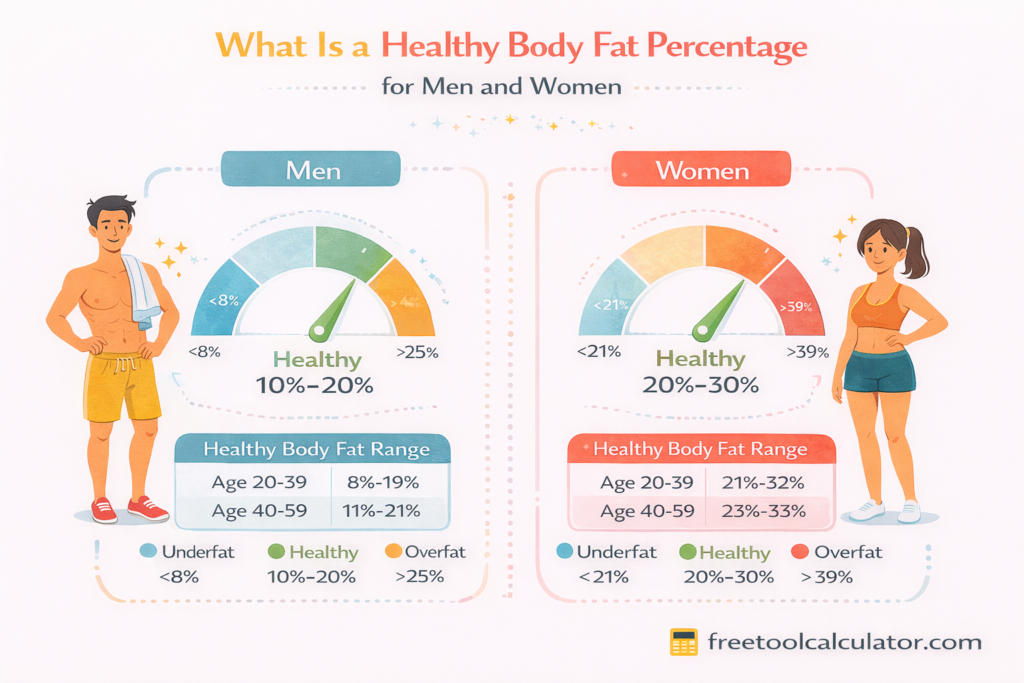
What is a healthy body fat percentage for men and women
Healthy body fat ranges differ by gender due to hormonal differences. For men a healthy range is generally 10 to 20 percent. For women it is usually 18 to 28 percent. Athletes may fall outside these ranges while still being healthy.
Can body fat percentage help with weight loss planning
Yes body fat percentage helps set realistic fat loss goals. It allows you to track fat reduction instead of just scale weight. Clinicians and nutritionists use it to adjust calorie and exercise plans. This leads to more sustainable results.
How accurate are online body fat percentage calculators
Online calculators provide estimates not medical diagnoses. Accuracy depends on the formula used and measurement precision. They are reliable for trend tracking over time. For clinical precision methods like DEXA scans are used.
How often should I check my body fat percentage
Checking every 2 to 4 weeks is usually sufficient. Daily measurements are unnecessary due to natural fluctuations. Regular intervals help track progress effectively. Consistent timing improves comparison accuracy.
Can body fat percentage change without weight change
Yes body fat can decrease while weight stays the same due to muscle gain. This is common during strength training. It reflects positive body recomposition. This is why body fat percentage is a superior progress metric.
Who should use a body fat percentage calculator
This tool is useful for adults monitoring fitness health or weight goals. Athletes trainers and nutrition professionals also use it. It is not intended for children without professional guidance. Always interpret results in context.
Is this body fat percentage calculator free to use
Yes this body fat percentage calculator is completely free. No registration or payment is required. Results are instant and private. It is designed for easy and accurate everyday use.
Body Fat Percentage Calculator – Estimate Body Fat Using the US Navy Method
A Body Fat Percentage Calculator helps estimate how much of your total body weight comes from body fat. Unlike BMI, which only considers height and weight, body fat percentage provides a more detailed picture of body composition by estimating the proportion of fat tissue compared to lean mass such as muscles, bones, organs, and water.
Our Body Fat Percentage Calculator uses the widely recognized US Navy Method for men and women to estimate body fat levels quickly and accurately. The calculator also provides body fat categories, visual guidance, health recommendations, and easy-to-understand results that help users better understand their fitness and health status.
Whether your goal is weight loss, muscle building, athletic performance, or general health improvement, understanding your body fat percentage can provide more meaningful insights than weight alone.
What Is Body Fat Percentage?
Body fat percentage is the proportion of your total body weight that consists of fat. For example, if a person weighs 80 kilograms and has 16 kilograms of body fat, their body fat percentage is 20%.
Unlike body weight, body fat percentage helps distinguish between fat mass and lean mass. Two individuals may weigh the same and have the same BMI but have completely different body fat percentages.
Why Body Fat Percentage Matters
Body fat percentage is often considered a better indicator of body composition than weight alone. It can help identify whether weight comes primarily from muscle or fat and provides a clearer picture of overall fitness.
Body Composition Explained
Your body is made up of multiple components, including fat, muscle, bones, organs, and water. Body fat percentage focuses specifically on the amount of fat relative to total body weight.
How to Calculate Body Fat Percentage
Many people search for how to calculate your body fat percentage, how do I calculate body fat percentage, how to calculate percentage of body fat, and how to calculate body fat percentage at home. While there are several methods available, the US Navy Method remains one of the most popular because it requires only basic body measurements.
US Navy Body Fat Formula
The US Navy Method estimates body fat percentage using measurements such as waist circumference, neck circumference, height, and for women, hip circumference.
These measurements are entered into a formula that estimates body fat levels without requiring expensive equipment.
Why the US Navy Method Is Popular
The US Navy Method is widely used because it is practical, affordable, and reasonably accurate for most individuals. It can be performed at home with a measuring tape and basic body measurements.
How to Use the Body Fat Percentage Calculator
The calculator simplifies the entire process and provides instant results.
Step 1: Select Gender
Choose whether the calculation is for a male or female because the formulas differ slightly.
Step 2: Enter Height
Input your height using the supported measurement unit.
Step 3: Enter Required Measurements
For men, measurements typically include neck and waist circumference. For women, measurements usually include neck, waist, and hip circumference.
Step 4: View Results
The calculator estimates your body fat percentage and displays the corresponding body fat category.
How Can You Check Body Fat Percentage?
One of the most common questions is how can you check body fat percentage or how can I check my body fat percentage. There are several ways to estimate or measure body fat.
Online Body Fat Calculators
Online calculators using the US Navy Method provide a fast and convenient estimate without requiring specialized equipment.
Body Fat Calipers
Calipers measure skinfold thickness at specific locations on the body to estimate body fat levels.
DEXA Scans
DEXA scans are considered one of the most accurate methods for measuring body composition but are more expensive than online calculators.
Bioelectrical Impedance Scales
Many modern smart scales estimate body fat percentage using electrical impedance technology.
How to Measure Body Fat Percentage at Home
Many users search for how can I measure body fat percentage at home, how do you check body fat percentage at home, and how to find out body fat percentage at home.
The easiest home method is using a body fat percentage calculator with tape measurements. This approach is inexpensive and accessible to most people.
Measurements Needed for Men
- Height
- Neck circumference
- Waist circumference
Measurements Needed for Women
- Height
- Neck circumference
- Waist circumference
- Hip circumference
What Is a Healthy Body Fat Percentage?
Many users ask what percentage body fat is healthy, what should my body fat percentage be, and what is an average body fat percentage.
Healthy body fat ranges vary based on age, gender, genetics, and activity level.
Healthy Body Fat Percentage for Men
- Essential Fat: 2%–5%
- Athletes: 6%–13%
- Fitness: 14%–17%
- Average: 18%–24%
- Higher Body Fat: 25% and above
Healthy Body Fat Percentage for Women
- Essential Fat: 10%–13%
- Athletes: 14%–20%
- Fitness: 21%–24%
- Average: 25%–31%
- Higher Body Fat: 32% and above
What Is the Average Body Fat Percentage?
Questions such as what is the average body fat percentage, what’s the average body fat percentage for men, what is the average body fat percentage for females, and what’s the average body fat percentage for women are extremely common.
Average body fat percentages vary by country, age group, and lifestyle factors. In general, men tend to have lower average body fat percentages than women because women naturally require more essential body fat for biological functions.
What Is the Normal Body Fat Percentage for Women?
For many adult women, a body fat percentage between approximately 21% and 31% is considered normal, although individual circumstances may vary.
What Is an Average Body Fat Percentage for Men?
For many adult men, a body fat percentage between approximately 18% and 24% is often considered average.
Is BMI the Same as Body Fat Percentage?
Many people search for is BMI the same as body fat percentage, is body fat percentage the same as BMI, is BMI and body fat percentage the same, and is body mass index the same as body fat percentage.
The answer is no. BMI and body fat percentage are different measurements.
What Is BMI?
BMI estimates weight status using only height and weight.
What Is Body Fat Percentage?
Body fat percentage estimates the proportion of body weight that consists of fat tissue.
Which Is Better?
Body fat percentage generally provides more information about body composition, while BMI serves as a quick screening tool.
What Body Fat Percentage to See Abs?
One of the most searched fitness questions is what body fat percentage to see abs, what body fat percentage shows abs, what percentage of body fat to see abs, and what body fat percentage do you need for abs.
Visible abdominal muscles depend on both body fat levels and muscle development. Simply reducing body fat does not guarantee visible abs if abdominal muscles are not developed.
Body Fat Percentage for Abs in Men
Many men begin to see abdominal definition around 10%–15% body fat, although genetics and muscle development play significant roles.
Body Fat Percentage to See Abs Female
Women typically require slightly higher body fat percentages than men due to natural physiological differences. Visible abdominal definition often occurs at higher body fat levels than those seen in men.
What Different Body Fat Percentages Look Like
People frequently search for what body fat percentage looks like, what does body fat percentage look like, and what do different body fat percentages look like because they want visual context.
Appearance varies significantly between individuals. Factors such as genetics, muscle mass, body shape, and fat distribution influence how body fat percentages appear.
Lower Body Fat Levels
Lower body fat percentages often show greater muscle definition and more visible muscle separation.
Average Body Fat Levels
Average body fat levels typically provide a balanced appearance with moderate muscle visibility.
Higher Body Fat Levels
Higher body fat percentages generally result in less visible muscle definition and increased fat storage.
How to Lower Your Body Fat Percentage
Many users search for how to decrease body fat percentage, how to lower body fat percentage, how do you lower your body fat percentage, and how can I lower my body fat percentage.
The most effective approach involves creating sustainable habits that support fat loss while preserving muscle mass.
Maintain a Moderate Calorie Deficit
Consuming slightly fewer calories than you burn can help reduce body fat over time.
Increase Protein Intake
Adequate protein supports muscle maintenance during fat loss.
Strength Training
Resistance training helps preserve lean muscle mass while reducing body fat.
Stay Physically Active
Regular activity can increase calorie expenditure and support overall health.
How to Lower Body Fat Percentage Without Losing Muscle
Many people specifically search for how to lower body fat percentage without losing muscle or how to reduce body fat percentage without losing muscle.
Maintaining muscle while losing fat typically requires sufficient protein intake, progressive strength training, adequate recovery, and avoiding excessively aggressive calorie deficits.
Focus on Strength Training
Resistance exercises signal the body to preserve muscle tissue.
Prioritize Recovery
Sleep and recovery play important roles in muscle retention and overall body composition.
How Fast Can You Lose Body Fat Percentage?
Questions such as how fast can you lose body fat percentage, how fast can you reduce body fat percentage, and how fast can you drop body fat percentage are very common.
The rate of fat loss varies significantly depending on starting body composition, nutrition, activity level, genetics, and overall health.
Gradual, sustainable progress is generally more effective and easier to maintain than rapid changes.
How to Reduce Body Fat Percentage from 25 to 15
Reducing body fat percentage from 25 to 15 represents a significant body composition change that often requires consistent nutrition, exercise, and lifestyle improvements over an extended period.
Individual results vary, and realistic expectations are important for long-term success.
What Body Fat Percentage Is Considered Obese?
Body fat categories vary by organization and context. Unlike BMI, there is no single universal body fat percentage cutoff used everywhere for obesity classification.
Healthcare professionals typically consider multiple factors, including body composition, health markers, medical history, and overall risk assessment.
What Is the Lowest Body Fat Percentage Ever Recorded?
Searches such as what is the lowest body fat percentage ever recorded, who has the lowest body fat percentage, and what’s the lowest body fat percentage are often driven by curiosity.
Extremely low body fat percentages are generally observed only in highly trained athletes, bodybuilders during competition preparation, or exceptional cases. Maintaining extremely low body fat for extended periods may not be healthy or sustainable for most individuals.
What Is the Highest Body Fat Percentage Ever Recorded?
Similarly, searches about the highest body fat percentage ever recorded often reflect interest in human body composition extremes. Individual body fat levels vary widely, and health outcomes depend on many factors beyond body fat percentage alone.
Where Can I Get My Body Fat Percentage Measured?
Many people ask where can I get my body fat percentage measured or where to get body fat percentage measured.
Fitness Centers
Many gyms and fitness centers offer body composition testing.
Medical Clinics
Healthcare providers may offer professional body composition assessments.
Sports Performance Facilities
Advanced testing methods such as DEXA scans may be available through specialized facilities.
Why Trust This Body Fat Percentage Calculator?
This Body Fat Percentage Calculator uses the established US Navy Method, one of the most recognized body fat estimation techniques available. The calculator provides practical estimates, body fat categories, and educational guidance designed to help users better understand their body composition.
While no estimation method is perfect, the US Navy Method offers a practical balance of convenience, accessibility, and accuracy for most users.
Calculate Your Body Fat Percentage Today
Use our free Body Fat Percentage Calculator to estimate body fat levels using the US Navy Method. Discover your body fat category, compare your results with healthy ranges, understand the difference between BMI and body fat percentage, and learn practical strategies for improving body composition safely.
Enter your measurements, view your results instantly, and take the first step toward better understanding your overall health and fitness.