element-4.png

Degrees to Radians Converter

Convert degrees and radians instantly with clear formulas, quick examples, and a visual indicator for angle size and type.

Convert degrees ⇄ radians instantly with formula, quick presets, and a clean visual result.

Enter a value

deg
Tip: You can use decimals (example: 3.14159).
Quick presets
Presets auto-switch depending on selected conversion.
Formula: rad = deg × π / 180

Result

Visual indicator + exact conversion output.

Input: — Output: —
Indicator
Convert to see status
Quick check
Small Medium Large
We’ll show a simple magnitude label after conversion.

Converted value
Note: This tool uses π ≈ 3.141592653589793 for accurate conversion.
Tip: 180° = π radians, 360° = 2π radians.

What is a degrees to radians converter

A degrees to radians converter is a simple mathematical tool used to convert angle values from degrees into radians. Radians are the standard unit of angular measurement used in mathematics physics and engineering. This converter removes the need for manual calculations. It ensures fast and accurate conversions.

Why are radians used instead of degrees

Radians are used because they are mathematically natural and simplify many formulas. Trigonometric functions calculus and physics equations are designed to work in radians. Using radians improves accuracy in advanced calculations. This is why scientific calculators default to radians.

How does a degrees to radians converter work

The converter uses the standard mathematical formula radians equals degrees multiplied by pi divided by 180. You enter a degree value and the tool instantly applies this formula. The result is precise and reliable. No rounding errors occur from manual math.

What is the formula to convert degrees to radians

The conversion formula is radians equals degrees times pi divided by 180. For example 180 degrees equals pi radians. This formula is universally accepted in mathematics. The calculator applies it automatically.

When should I convert degrees to radians

You should convert degrees to radians when working with trigonometric functions calculus physics or engineering problems. Programming languages and scientific tools often require radians. Using degrees in these cases may give incorrect results. Conversion ensures compatibility and correctness.

Is this converter useful for students

Yes students in math physics engineering and computer science frequently use radians. This converter helps with homework exams and practice problems. It saves time and reduces calculation errors. It also supports better concept understanding.

Can I convert decimal and negative degree values

Yes the converter supports whole numbers decimal values and negative angles. This makes it useful for real world applications. Precision is maintained regardless of input type. The output remains mathematically accurate.

Does this degrees to radians converter support pi based output

Some converters display results in decimal form while others show values in terms of pi. Both formats are mathematically correct. Decimal output is often preferred for calculations. Pi based output helps with learning and theory.

Is this degrees to radians converter free to use

Yes this degrees to radians converter is completely free. No registration or payment is required. It works instantly on all devices. The tool is designed for quick and reliable use.

Who should use a degrees to radians converter

This tool is ideal for students teachers engineers developers and researchers. Anyone working with angles and trigonometry can benefit. It is suitable for beginners and advanced users alike. The interface is simple and user friendly.

Degrees to Radians Converter

The Degrees to Radians Converter is an essential tool for anyone working with angles in mathematics, physics, engineering, or navigation. This calculator allows you to convert angles between degrees and radians quickly and accurately, providing clear formulas, examples, and visual indicators of the angle size and type. Whether you are solving trigonometric problems, working with circle measurements, or programming functions that require angle input in radians, this tool simplifies the process and ensures precise results.

Many students and professionals frequently ask how to convert degrees to radians, how to convert radians to degrees, how to calculate radians from degrees, or how to find degrees from radians. This converter handles all these conversions with instant output and easy-to-understand explanations. It is suitable for both academic and professional applications.

Using this converter helps users understand the relationship between the two units of angular measurement and apply them correctly in calculations, graphing, and formula derivation. Whether you are preparing for exams, designing simulations, or solving trigonometric equations, this tool ensures quick and reliable conversions.

What Are Degrees and Radians?

Degrees and radians are two standard units used to measure angles. A degree divides a circle into 360 equal parts, while a radian is based on the radius of a circle. Specifically, one radian is the angle formed when the arc length equals the radius of the circle.

Degrees are commonly used in everyday contexts, navigation, and geometry, whereas radians are often preferred in mathematics, calculus, and physics due to their natural relationship with the unit circle and trigonometric functions.

Understanding both units and being able to convert between them is crucial for anyone studying or working with angles, rotations, or periodic functions.

How the Degrees to Radians Converter Works

Step 1: Enter the Angle

Input the angle you wish to convert. You can enter the value in degrees or radians depending on the desired conversion.

Step 2: Select Conversion Direction

Choose whether you want to convert degrees to radians or radians to degrees. The tool provides clear guidance and ensures that the correct formula is applied.

Step 3: View the Conversion Formula

The converter displays the exact formula used for the calculation. For example, to convert degrees to radians, it shows: radians = degrees × π / 180. For radians to degrees, the formula is: degrees = radians × 180 / π.

Step 4: View Instant Result

The converted value is displayed immediately with optional rounding. The tool may also provide a visual indicator of the angle size for better understanding.

Formula to Convert Degrees to Radians

The standard formula to convert an angle from degrees to radians is:

radians = degrees × π / 180

Example: Convert 90 degrees to radians:

radians = 90 × π / 180 = π / 2

This shows that 90 degrees equals π/2 radians.

Formula to Convert Radians to Degrees

To convert an angle from radians to degrees, use the formula:

degrees = radians × 180 / π

Example: Convert π/3 radians to degrees:

degrees = (π/3) × 180 / π = 60 degrees

This confirms that π/3 radians equals 60 degrees.

When to Use Degrees or Radians

Degrees are often used in navigation, surveying, and everyday angle measurement. Radians are preferred in mathematics, trigonometry, calculus, and physics because they relate naturally to the unit circle and provide simpler expressions in formulas involving trigonometric functions.

For example, when using sine, cosine, or tangent in calculus, angles are usually expressed in radians because the derivatives and integrals are simpler in radian measure.

Common Conversions

  • 180 degrees = π radians
  • 90 degrees = π/2 radians
  • 60 degrees = π/3 radians
  • 45 degrees = π/4 radians
  • 30 degrees = π/6 radians
  • 2π radians = 360 degrees
  • π radians = 180 degrees

Examples Using the Converter

Example 1: Degrees to Radians

Convert 120 degrees to radians:

radians = 120 × π / 180 = 2π / 3

Example 2: Radians to Degrees

Convert 7π/6 radians to degrees:

degrees = (7π/6) × 180 / π = 210 degrees

Example 3: Using Calculator

To convert 45 degrees to radians on a calculator, multiply 45 by π and divide by 180. The converter automates this process for fast and accurate results.

Understanding Related Concepts

Unit Circle

The unit circle is a circle with radius 1. Radians measure angles as the length of the arc along the unit circle, providing a direct link between angular and linear measures.

Trigonometry

Trigonometric functions often require angles in radians for calculus operations such as derivatives and integrals, making radian conversion essential.

Angle Measurement

Degrees are intuitive for everyday use, while radians are more suitable for mathematical modeling, physics calculations, and programming algorithms.

Common Questions and Answers

How do I convert degrees to radians?

Multiply the number of degrees by π and divide by 180.

How do I convert radians to degrees?

Multiply the number of radians by 180 and divide by π.

How many degrees are equal to 29π/18 radians?

degrees = (29π/18) × 180 / π = 290 degrees

How do I convert degrees to radians in Excel?

Use the formula =RADIANS(degree_value) to convert degrees into radians in Excel.

How do I convert radians to degrees in Excel?

Use the formula =DEGREES(radian_value) to convert radians into degrees in Excel.

When should I use radians or degrees?

Use degrees for general measurements and navigation; use radians for mathematics, physics, calculus, and trigonometric functions.

Can I convert repeating decimals to radians?

Yes, convert the decimal to a fraction if necessary, then apply the degrees-to-radians formula.

How do I change my calculator from degrees to radians?

Most scientific calculators have a DEG/RAD toggle button. Set to RAD to perform calculations in radians.

Benefits of Using the Degrees to Radians Converter

  • Instant conversion between degrees and radians
  • Clear formulas for understanding the conversion process
  • Visual indicator of angle size
  • Accurate results for calculations and programming
  • Supports both manual input and calculator-assisted operations
  • Helpful for trigonometry, physics, engineering, and navigation
  • Easy to use for students and professionals
  • Eliminates manual calculation errors
  • Supports conversion of multiple angles efficiently
  • Provides educational examples for learning purposes

Why Trust This Tool?

This Degrees to Radians Converter uses standard mathematical conversion formulas universally recognized in education, engineering, and scientific applications. By applying the formulas radians = degrees × π / 180 and degrees = radians × 180 / π, the tool ensures precise, reliable results for all common calculations. The calculator provides transparent outputs, validation, and visual indicators to help users understand and verify their conversions accurately.

Get Started Today

Use the Degrees to Radians Converter to convert angles instantly and accurately. Enter your value in degrees or radians, view the converted result with clear formulas, and gain a better understanding of angles for mathematics, physics, engineering, and everyday applications. Whether you are studying, solving problems, or programming trigonometric functions, this tool simplifies the conversion process and ensures accurate results every time.
More Tools

Discount Calculator

Calculate sale price, discount savings, and final total from percentage or fixed discounts, with optional tax for accuracy.

Electricity Calculator

Calculate electricity usage and cost using power, usage time, and price per kilowatt-hour for accurate energy expense estimates.

Pythagorean Theorem Calculator

Calculate a missing right-triangle side using the Pythagorean theorem by entering any two sides for instant accurate results.

CGPA Calculator

Calculate CGPA online by entering subjects, credits, and grades to get accurate cumulative GPA with clear breakdown instantly.

Percentage Calculator

Calculate what percent one number is of another instantly using part and total values with accurate results and validation.

Online Math Solver

Solve math expressions instantly online including brackets, percentages, and basic operators with validation and accurate real-time results.

Number Sum Calculator Add a List of Numbers Online

Add comma-separated numbers instantly to get an accurate total, with validation, count checks, and clean results for calculations.

Midrange Calculator for Data Sets

Calculate the midrange of any data set instantly using minimum and maximum values with validation and clear statistical output.

Hypotenuse Calculator for Right Triangle

Calculate the hypotenuse of a right triangle instantly using side A and side B with accurate math and clean results.

Destiny Number Calculator Free Numerology Tool

Find your destiny number using a free numerology calculator that reveals your life purpose personality traits and natural abilities.

Decimal to Fraction and Fraction to Decimal Calculator

Convert decimals to simplified fractions and fractions to decimals instantly with validation, clear output, and quick reference indicators for accuracy.

Convolution Calculator for Two Sequences

Compute discrete convolution of two sequences instantly from comma-separated inputs with validation, clear output series, and visual indicators.

Our Blogs

Ideal Body Weight Calculator Accurate Guide to Find Your Perfect Weight

Ideal Body Weight Calculator Accurate Guide to Find Your Perfect Weight

Learn how to use an ideal body weight calculator to calculate ideal weight accurately This guide explains IBW formulas, healthy weight ranges, and how to track your progress using reliable tools to improve fitness, health, and body composition with simple and practical methods for all users

Treadmill or Exercise Bike for Weight Loss The Definitive Guide

Treadmill or Exercise Bike for Weight Loss: The Definitive Guide

Stuck choosing between a treadmill or exercise bike for weight loss? We compare calories burned, injury risk, and sustainability to help you pick the best machine for your goals.

How To Find Hypotenuse of a Triangle with Simple Formulas and Examples

How To Find Hypotenuse of a Triangle with Simple Formulas and Examples

This blog explains how to find hypotenuse using formulas, angles, and examples. It covers the meaning of hypotenuse in Algebra I, how to calculate it in right and acute triangles, and how online tools make calculations faster and more accurate for students, teachers, and practical geometry applications.

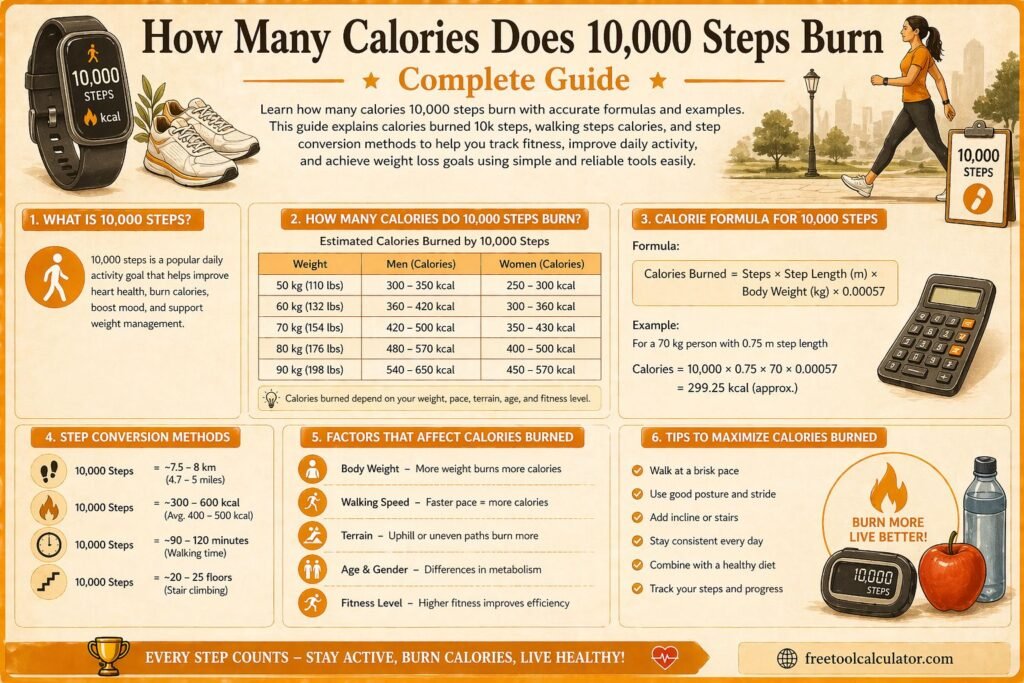
Steps to Calories Conversion and Why It Matters Steps to calories conversion is an important concept for anyone tracking fitness, weight loss, or daily activity levels. It helps estimate how many calories you burn based on the number of steps you take. This calculation is widely used in fitness tracking apps and wearable devices to give users a better understanding of their physical activity. Knowing how to convert steps to calories allows you to monitor your progress and adjust your routine accordingly. Whether you are trying to lose weight, maintain fitness, or improve overall health, understanding this conversion provides valuable insights. You can easily convert steps to calories using this free tool and get accurate results instantly. What Is Steps to Calories Conversion Steps to calories conversion refers to estimating the number of calories burned while walking or running based on step count. Since each step requires energy, your body burns calories during movement. The total calories burned depend on factors such as body weight, walking speed, and step length. This method is commonly used because it is simple and accessible. Most people track their steps daily using smartphones or fitness trackers, making it easy to estimate calorie burn without complex calculations. Understanding steps to calories helps you stay motivated and maintain consistency in your fitness journey. It also provides a clear measurement of your daily activity level. Steps to Calories Formula Explained The steps to calories formula is based on average energy expenditure per step. A common estimate is that a person burns approximately 0.04 to 0.06 calories per step. However, this value can vary depending on individual factors. A simple formula is Calories burned equals steps multiplied by calories per step For example, if you take 10000 steps and burn 0.05 calories per step, the total calories burned would be 500. This formula provides a quick estimate but may not be fully accurate for everyone. Using a reliable calculator ensures better precision and personalized results. Factors That Affect Calories Per Step Calories per step are not the same for everyone. Several factors influence how many calories you burn during physical activity. Body weight is one of the most important factors. Heavier individuals tend to burn more calories because their bodies require more energy to move. Walking speed also plays a role. Faster walking or running increases calorie burn compared to slow walking. Step length and terrain also affect energy expenditure. Walking uphill or on uneven surfaces requires more effort and burns more calories. Understanding these factors helps you make more accurate estimates when performing steps to calories conversion. How to Convert Steps to Calories Accurately To convert steps to calories accurately, start by tracking your daily step count. Then use an appropriate calorie per step value based on your body weight and activity level. Multiply the steps by this value to estimate calories burned. For more accurate results, it is recommended to use a tool that considers multiple factors. You can calculate steps to calories using this free calculator and get personalized results instantly. Using a dedicated tool ensures that your calculations are based on reliable data, making your fitness tracking more effective. Real Examples of Steps to Calories Conversion Examples make it easier to understand steps to calories conversion. If a person walks 5000 steps and burns approximately 0.05 calories per step, they would burn around 250 calories. Similarly, walking 10000 steps may burn about 400 to 600 calories depending on factors like weight and speed. These estimates show how increasing your step count can significantly impact calorie burn. Tracking your daily steps and converting them into calories helps you stay consistent and motivated in your fitness routine. Benefits of Tracking Steps to Calories Tracking steps to calories provides several benefits. It helps you understand how active you are throughout the day and encourages you to stay consistent. It also allows you to set realistic fitness goals and measure progress over time. For individuals trying to lose weight, this method provides a simple way to monitor calorie expenditure. It also helps in maintaining a balance between calorie intake and output. Using tools like a calorie calculator can further enhance your understanding of daily energy needs and improve your overall fitness plan. Common Mistakes in Steps to Calories Calculation One common mistake is assuming that calories per step are the same for everyone. This can lead to inaccurate estimates. Another mistake is ignoring factors such as walking speed and terrain, which can significantly affect calorie burn. Relying solely on step count without considering overall activity level is another issue. For example, strength training and other exercises also contribute to calorie burn but are not reflected in step count. Using accurate tools and understanding the limitations of step based calculations helps avoid these mistakes. Advanced Tips to Improve Accuracy To improve accuracy, consider using wearable devices that track additional metrics such as heart rate and distance. These devices provide more precise calorie estimates. Maintaining a consistent walking routine also helps in getting reliable data. Tracking your progress over time allows you to identify patterns and make necessary adjustments. Combining step tracking with other tools like a tdee calculator can give a complete picture of your daily energy expenditure. This approach helps you manage your fitness goals more effectively. How Steps to Calories Helps in Weight Loss Steps to calories conversion is a useful tool for weight loss. By increasing your daily step count, you can burn more calories and create a calorie deficit, which is essential for losing weight. For example, adding an extra 2000 steps to your daily routine can burn additional calories over time. This small change can lead to significant results when combined with a balanced diet. Understanding how to convert steps to calories allows you to set realistic goals and track your progress effectively. It also helps you stay motivated and consistent. Conclusion Steps to Calories Conversion Made Simple Steps to calories conversion is a simple yet powerful way to track your physical activity and improve your health. By understanding the steps to calories formula and using accurate tools, you can estimate your calorie burn effectively. If you want precise and instant results, you can use this free steps to calories calculator and track your daily activity with ease. Combining this with other health tools ensures a complete and effective fitness strategy for long term success.

Steps to Calories Conversion Guide Accurate Formula Explained

Learn steps to calories conversion with accurate formulas and examples This guide explains how to convert steps to calories, understand calories per step, and track daily activity effectively using simple methods and free tools to improve fitness and health for all users easily and accurately

Add to Date Calculator

How to Use an Add to Date Calculator for Date Calculations

Learn how to use an Add to Date Calculator to quickly find future or past dates by adding days weeks months or years. This expert guide explains common use cases formulas spreadsheet methods and practical examples with tips to avoid common errors and boost productivity.

Body Fat Percentage Calculator Accurate Guide to Measure Body Fat

Body Fat Percentage Calculator Accurate Guide to Measure Body Fat

Learn how to calculate body fat percentage using accurate formulas and tools This guide explains body fat calculator methods, fat percentage ranges, and how to track your progress effectively for better health, fitness, and weight management using simple techniques designed for all users easily and accurately

How to Calculate Area Complete Beginner Guide

How to Calculate Area Complete Beginner Guide

Learn how to calculate area with this complete beginner guide Understand area formulas for squares rectangles circles triangles and other shapes using simple examples practical applications and free online tools designed to make area calculations accurate fast and easy for students homeowners professionals and everyday users

Best Time to Sleep and Wake Up Science Based Complete Guide

Best Time to Sleep and Wake Up Science Based Complete Guide

Learn best sleep time with this science based guide Understand what time is best to sleep, how sleep cycle timing works, and how to build an ideal sleep schedule to improve energy, focus, and overall health using simple methods and practical tools for all age groups

How to Calculate the Difference Between Two Dates in Excel: Complete Guide

How to Calculate the Difference Between Two Dates in Excel: Complete Guide

Master Excel date difference calculations with this complete guide. Learn to use DATEDIF, DAYS, NETWORKDAYS, and simple subtraction to find days, months, years, and working days between dates. Includes practical examples and a free online calculator for quick verification.

How to Calculate Zakat Correctly – Complete Step-by-Step Guide with All Scenarios

How to Calculate Zakat Correctly – Complete Step-by-Step Guide with All Scenarios

This complete Zakat Calculator guide explains how to calculate Zakat on cash, gold, silver, shares, savings, and business assets. Includes Nisab rules, formulas, real examples, and common scenarios explained in simple language so anyone can calculate Zakat correctly and confidently.

What is Legal Size Paper Complete Guide to Dimensions Uses and Printing

What is Legal Size Paper Complete Guide to Dimensions Uses and Printing

Many people face printing problems without even realizing the real cause. You open a document print it and suddenly the content looks cut off or stretched. This usually happens because you selected the wrong paper size.

What Is a Scientific Calculator Complete Beginner Guide

What Is a Scientific Calculator Complete Beginner Guide

Learn scientific calculator meaning with this complete beginner guide Understand what is scientific calculator, its functions, uses, and how it differs from basic calculators to help students and professionals solve complex math problems easily and accurately using simple explanations and practical examples

Report a Bug