Zakat Calculator – Complete Guide to Nisab & Zakat Payable
This Zakat Calculator page helps you correctly determine whether you meet Nisab and how much Zakat is due on your wealth. The method below follows classical fiqh principles used by Islamic scholars: identify zakatable assets, deduct valid liabilities, confirm Nisab, then apply 2.5%. Use the formulas and tables below to calculate accurately and confidently.
What Counts as Zakatable Assets
Include all wealth that is surplus, owned fully, and held for one lunar year:
• Cash in hand
• Bank balances
• Gold and silver (by current value)
• Investment metals and coins
• Business stock and trade goods
• Receivable loans expected back
• Saved rental income
• Shares bought for trading
Do not include personal residence, personal car, furniture, clothing, or daily-use items.
Nisab Threshold (Minimum Wealth Level)
Zakat becomes obligatory when your net zakatable assets equal or exceed Nisab for one lunar year.
Standard Nisab measures:
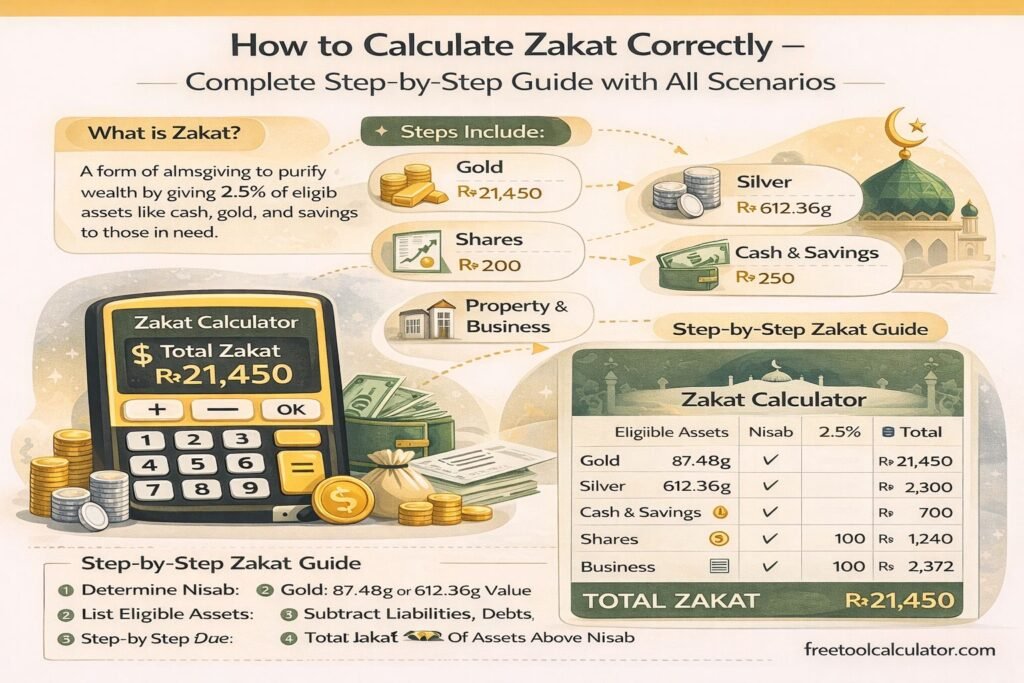
Gold Nisab = 87.48 grams of gold
Silver Nisab = 612.36 grams of silver
Nisab Calculation Formula:
Nisab Value = Current price per gram × Nisab grams
Example (Silver Method — recommended for wider charity impact):
Silver price = $0.90 per gram
Nisab = 612.36 × 0.90 = $551.12
If your net zakatable assets ≥ $551.12 → Zakat is due.
Core Zakat Calculator Formula
Step 1 — Add all zakatable assets
Step 2 — Subtract immediate payable debts
Step 3 — Confirm value is above Nisab
Step 4 — Multiply by 2.5%
Zakat Payable = Net Zakatable Assets × 2.5%
Zakat Payable = Net Assets × 0.025
Zakat Calculation Table (General Assets Example)
| Asset Type | Amount |
|---|---|
| Cash in hand | 2,000 |
| Bank savings | 8,500 |
| Gold value | 3,000 |
| Silver value | 400 |
| Business stock | 5,000 |
| Receivable loans | 1,100 |
| Total Assets | 20,000 |
| Deduct Liabilities | Amount |
|---|---|
| Short-term debts | 2,500 |
Net Zakatable Assets = 20,000 − 2,500 = 17,500
Zakat = 17,500 × 2.5% = 437.50
Zakat Payable = 437.50
Gold Zakat Formula and Example
Gold is calculated at current market value, not purchase price.
Formula:
Gold Zakat = (Gold grams × current gram price) × 2.5%
Example:
Gold owned = 120g
Gold price = $65/g
Value = 7,800
Zakat = 7,800 × 0.025 = 195
Silver Zakat Formula and Example
Formula:
Silver Zakat = (Silver grams × current gram price) × 2.5%
Example:
Silver owned = 900g
Silver price = $0.90/g
Value = 810
Zakat = 810 × 0.025 = 20.25
Business Inventory Zakat Method
All trade goods are valued at current selling price.
Formula:
Business Zakat = (Stock value + cash + receivables − payables) × 2.5%
Example Table
| Item | Value |
|---|---|
| Stock for sale | 12,000 |
| Business cash | 3,000 |
| Customer receivables | 2,000 |
| Supplier payables | −4,000 |
| Net | 13,000 |
Zakat = 13,000 × 0.025 = 325
Rental Property Zakat Rules
• No Zakat on property market value if held for rental
• Zakat due on saved rental profit only
• Deduct expenses first
Formula:
Zakat = Net Saved Rental Income × 2.5%
Example:
Annual saved rent = 6,000
Zakat = 6,000 × 0.025 = 150
Loans Given to Others
| Loan Type | Zakat Rule |
|---|---|
| Strong (likely repayment) | Count yearly |
| Weak (uncertain) | Pay when received |
| Bad debt | No Zakat unless recovered |
Formula when counted:
Loan Amount × 2.5%
Jewelry Zakat Ruling (Scholarly Note)
Many scholars exempt personal jewelry in use. Hanafi fiqh requires Zakat on all gold and silver jewelry. A cautious approach is to include it at market value. The Zakat Calculator should allow a toggle option for jewelry inclusion.
Zakat vs Zakat al-Fitr (Do Not Confuse)
| Zakat | Zakat al-Fitr |
|---|---|
| Annual wealth obligation | End of Ramadan charity |
| 2.5% of assets | Fixed per person amount |
| Requires Nisab | No Nisab condition |
| Asset-based | Person-based |
Recommended Zakat Calculator Workflow
• Enter gold and silver grams
• Enter current metal prices
• Add cash and bank balances
• Add business and investment assets
• Add receivable loans
• Subtract short-term debts
• System checks Nisab automatically
• Final output = Total Zakat Payabl
Complete Guide to This Tool
This guide explains how to use the Zakat calculator, what the result means, what can affect accuracy, and how to avoid common mistakes. It is written to support the calculator or utility above rather than replace the interactive tool.
What This Zakat Calculator Is For
This calculator is designed to help organize a personal Zakat estimate by bringing common Zakat-eligible assets and deductible short-term liabilities into one calculation. Zakat rules can differ by scholarly methodology, asset type, ownership circumstances, local practice, and the nisab standard selected, so the result should be treated as an educational estimate rather than a religious ruling.
For practical use, focus on the inputs that materially change the result and keep units, definitions, and assumptions consistent. If you are comparing results over time, use the same method each time and record any important changes in conditions. This makes the output easier to interpret and reduces the risk of treating a rough estimate as exact.
Basic Zakat Calculation
A commonly used approach for qualifying monetary wealth is to determine net Zakatable assets and, when the applicable conditions are met, calculate 2.5% for a lunar-year assessment. In simplified form: net Zakatable wealth = eligible assets minus eligible deductible liabilities; estimated Zakat = net Zakatable wealth × 0.025. The exact treatment of individual assets should follow the guidance you rely on.
Understanding Nisab
Nisab is the minimum threshold of qualifying wealth associated with the obligation of Zakat. Gold- and silver-based nisab values change with market prices, and scholarly guidance can differ on which standard to use in a particular situation. Use a current, reliable price source and the nisab methodology recommended by a qualified scholar or trusted institution.
Assets Commonly Considered
Depending on the applicable guidance, calculations may consider cash, bank balances, gold and silver, certain investments, money owed to you that is expected to be recovered, and business inventory or trading assets. Personal-use property is often treated differently from assets held for trade or investment, so classification matters.
Liabilities and Deductions
Not every future debt is necessarily deducted in full. Some approaches focus on liabilities that are currently due or payable in the near term. Because treatment varies, enter deductions only according to the scholarly method you follow and keep notes explaining major amounts.
How to Use the Calculator Carefully
Choose a consistent Zakat date, list eligible assets using current values where required, enter permitted deductions, confirm the nisab threshold, and review the result. Keeping the same annual assessment date can make records easier to maintain and reduce accidental omissions.
Zakat on Gold, Silver and Savings
Gold and silver values should generally be based on the relevant weight, purity, market price, and the method you follow. Cash savings are usually easier to value, but questions can arise around jointly owned accounts, money reserved for expenses, or funds held for a specific purpose. Seek qualified guidance when ownership or eligibility is unclear.
Zakat on Business and Investments
Business inventory, trading assets, shares, retirement arrangements, and other investments can require more detailed treatment than a simple cash balance. The relevant amount may depend on the nature of the asset and your scholarly framework. Use the calculator as a worksheet, not as a substitute for asset-specific guidance.
Related Search Terms and Questions
People researching this tool also commonly look for topics such as Zakat calculator, online Zakat calculator, calculate Zakat, Zakat calculation, Zakat on cash, Zakat on gold, Zakat on silver, Zakat on savings, Zakat nisab calculator, 2.5 percent Zakat. These phrases describe closely related intents rather than separate features, and the sections above address the underlying questions naturally.
- Zakat on investments
- Zakat on business assets
- Zakat payable amount
- Islamic Zakat calculator
- Zakat calculation guide
- Zakat eligible assets
- Zakat liabilities
- annual Zakat calculation
- gold nisab Zakat
- silver nisab Zakat
Frequently Asked Questions
Is Zakat always exactly 2.5%?
2.5% is a widely used rate for qualifying monetary wealth assessed on a lunar-year basis, but different asset categories and circumstances can have different rules.
Should I use gold nisab or silver nisab?
Scholarly approaches differ. Use the standard advised by the qualified scholar or institution whose methodology you follow.
Can I deduct all my debts?
The treatment of liabilities varies. Some methods limit deductions to amounts currently due or due within a defined period.
Does this calculator issue a fatwa?
No. It provides an arithmetic estimate and general educational explanation, not a religious ruling.
When should I ask a scholar?
Seek qualified advice when you have complex investments, business assets, pensions, disputed ownership, unusual debts, agricultural assets, or uncertainty about nisab and eligibility.
Editorial and Accuracy Note
FreeToolCalculator aims to make calculations and digital utilities understandable by explaining the method, assumptions, limitations, and practical checks behind the result. Tool outputs should be verified when they are used for purchasing, professional, financial, religious, health, safety, or other consequential decisions. We review tool guidance periodically as standards, software interfaces, and common practices change.
Complete Guide to the Zakat Calculator
This guide adds useful context to the existing Zakat Calculator, including instructions, interpretation guidance, common mistakes and verification steps. The original interactive tool remains the main feature of this page and is preserved.
What This Tool Does
The Zakat Calculator is designed for the task shown in its interactive interface. Correct inputs and a clear understanding of the output are necessary for useful results.
Keep the original source information available until the result has been checked. If the output appears surprising, recheck the input and test a simple known example before assuming the calculation itself is incorrect.
Understand the Inputs
The meaning of an input matters as much as the number or text itself. Confirm units, date order, decimal notation, signs, categories and any other settings shown in the interface.
Understand the Output
Read the result together with its unit and label. Determine whether it is an exact transformation, a mathematical calculation, an estimate or an illustrative value before deciding how it should be used.
Simple Verification Example
Use a small test case whose expected answer you can calculate or inspect independently. Matching that known case helps confirm that the input format and calculation direction are understood.
Accuracy and Rounding
Do not confuse a long decimal result with greater real-world accuracy. The output inherits limitations in the input data and method. Round according to the practical purpose and precision of the source information.
Common Errors to Avoid
Typical errors include selecting the wrong unit, reversing input fields, mistyping a decimal, overlooking a negative value, using the wrong date convention, or assuming an estimate is an exact measurement.
Using Results Responsibly
For routine learning, planning and checking, an online tool can save time. For consequential health, financial, legal, safety, engineering or compliance decisions, verify the result with the appropriate authoritative source or qualified professional.
Quick Accuracy Checklist
- Check the source value or text.
- Confirm units and input format.
- Review selected options.
- Test a known example.
- Use sensible rounding.
- Verify important results independently.