What is this tool
The Total Daily Energy Expenditure plus Macro Breakdown tool estimates how many calories your body needs in a day and how those calories can be distributed across macronutrients. Total daily energy expenditure represents the total number of calories burned through basic bodily functions, physical activity, and daily movement, while the macro breakdown shows how those calories translate into protein, carbohydrates, and fats.
Why this tool is useful
This tool helps users understand their daily energy needs and how to balance macronutrients according to general nutritional goals. Knowing your estimated calorie requirement and macro distribution can support better meal planning, fitness tracking, and lifestyle awareness without requiring advanced nutritional knowledge.
How this tool works
The calculator uses inputs such as age, gender, height, weight, and activity level to estimate basal metabolic rate and overall daily calorie needs. Based on the calculated total calories, the tool applies standard macro ratio guidelines to estimate daily protein, carbohydrate, and fat intake in grams.
Key features or capabilities
The tool delivers instant calorie and macro estimates in a clear format that is easy to interpret. It works entirely online, does not require account creation, and is suitable for general informational use across different activity levels and goals.
Common use cases
Users commonly rely on this tool to plan daily meals, support fitness routines, understand calorie needs for maintenance, or learn how macronutrients contribute to energy intake. It is also useful for students and beginners exploring basic nutrition concepts.
Who should use this tool
This tool is appropriate for adults interested in nutrition awareness, fitness enthusiasts managing calorie intake, students studying health or diet basics, and general users looking for a simple energy and macro estimation.
Accuracy privacy or safety
All results are estimates based on standard formulas and commonly accepted nutritional guidelines. They are intended for informational purposes only and should not replace professional medical or dietary advice. No personal data is stored or shared, ensuring user privacy.
Is this tool free to use
Yes, the Total Daily Energy Expenditure plus Macro Breakdown tool is completely free to use with no registration, subscriptions, or usage limits.
About the TDEE Calculator
TDEE Calculator is an educational estimation tool designed to help you understand the relationship between the inputs you enter and the result shown. The interactive tool above is the main feature of this page; the guide below explains how to use it responsibly, what the result means, and what to check when the number will be used for a real decision.
How to use this tool
- Read each field label and enter the requested values using the units shown.
- Check that decimal points, percentages, dates, or units have been entered correctly.
- Run the calculation or generation step and review the complete result rather than copying only one number.
- If the result will affect money, health, purchasing, scheduling, or another important decision, verify the inputs and compare the result with an appropriate independent source.
What to know before relying on the result
TDEE is an estimate of daily energy expenditure, not a directly measured personal requirement. Track real-world trends and adjust cautiously rather than treating one calculated number as exact.
How to interpret the result
Treat the result as an estimate rather than a diagnosis, prescription, or personal medical recommendation. Health-related outputs can change with age, body composition, activity, sleep, medication, pregnancy, illness, measurement method, and other individual factors that a simple online calculator cannot fully capture.
Important health limitation
This tool is for general educational information. It is not a substitute for advice from a doctor, registered dietitian, physiotherapist, psychologist, or other qualified professional. If a result concerns you, conflicts with professional advice, or relates to symptoms or a medical condition, discuss it with an appropriate healthcare professional.
Common mistakes to avoid
- Mixing measurement systems or entering a value in a different unit from the one requested.
- Using rounded or estimated inputs when more accurate values are available.
- Assuming an online result includes every real-world variable, fee, exception, or personal factor.
- Copying the output without checking whether the result is plausible for the values entered.
Frequently Asked Questions
Is the TDEE Calculator free to use?
Yes. You can use the tool in your browser without purchasing specialist calculation software.
Why might my result differ from another calculator?
Different tools can use different assumptions, rounding rules, data sources, formulas, defaults, or conversion precision. Compare the inputs and methodology before deciding that one result is incorrect.
Can I use the result for professional decisions?
It can be useful for preliminary calculations and cross-checking. For regulated, medical, legal, tax, engineering, or other high-stakes decisions, confirm the result with the relevant official source or qualified professional.
How can I report a problem?
If you find a calculation, wording, usability, or technical issue, contact Free Tools Calculator and include the page URL, the inputs you used, the result you received, and what you expected. That makes the issue easier to reproduce and review.
Complete Guide to the Tdee Calculator
This supporting guide explains how to use the TDEE calculator, what the output means, how to check the result, and which assumptions matter. The interactive tool remains the main feature; the content below is designed to make the result easier to understand and verify.
What TDEE Means
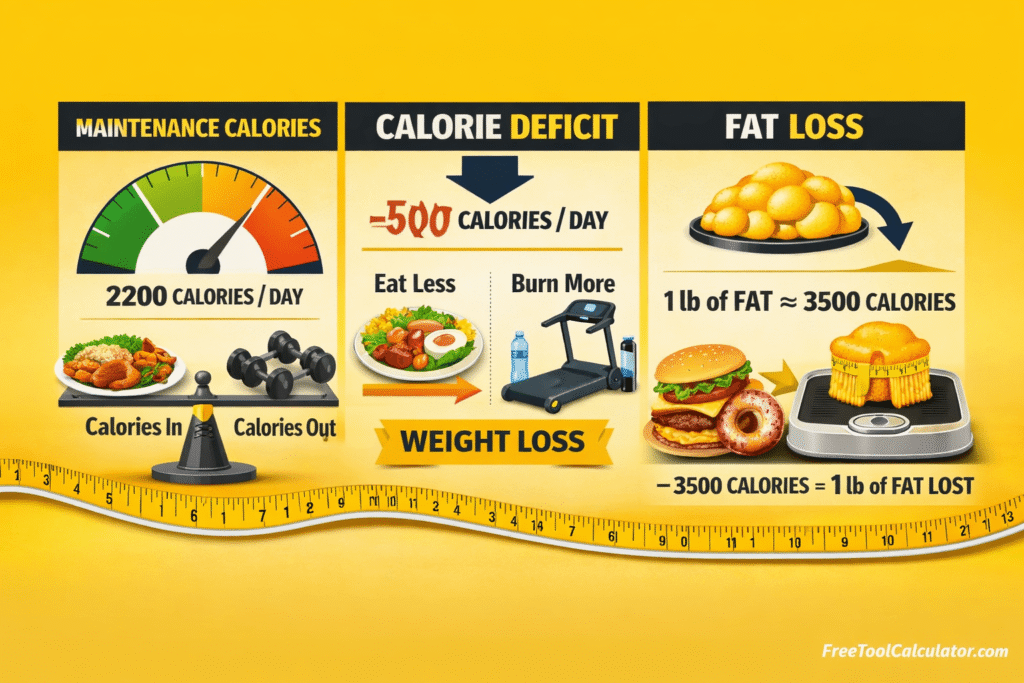
Total daily energy expenditure (TDEE) is an estimate of the energy used across a day. It includes resting energy plus energy associated with movement, exercise, digestion and other processes. It is often used as a starting estimate for maintenance calories.
For a dependable result, enter values using the units and definitions requested by the tool, then check whether the output is an exact mathematical result or an estimate based on assumptions. When the calculation affects an important financial, health, employment, tax, academic or purchasing decision, confirm the relevant inputs and rules independently.
BMR vs TDEE
BMR estimates energy required for essential functions at rest under standardized conditions. TDEE attempts to represent a full day and is therefore higher for most people. Many calculators estimate BMR first and then apply an activity factor.
How Activity Multipliers Work
Activity categories simplify a complex behavior pattern into a multiplier. Two people who both select ‘moderately active’ may still have different true expenditure because jobs, step counts, training, body composition and exercise intensity differ.
TDEE for Weight Change Goals
People often create an intake target above or below estimated TDEE for weight gain or loss. The appropriate change depends on individual circumstances, and the calculator cannot evaluate medical conditions, pregnancy, eating-disorder risk or medication effects.
Why Your Actual Maintenance May Differ
Equations are population estimates. Tracking errors, spontaneous movement, training volume, body composition, sleep and metabolic differences can all affect actual energy needs. Maintenance is better thought of as a range than a perfectly fixed number.
Rechecking Your Estimate
If body weight, activity or training changes materially, estimated TDEE can change. Review trends over several weeks rather than changing intake based on one or two days of scale movement.
How to Validate the Result
Start with a simple test case whose answer you can calculate manually. Compare that answer with the tool, then return to your real inputs. Recheck decimal points, percentage formats, signs, units, dates and category selections. For estimates, change one input at a time to see which assumptions have the greatest effect on the result.
Editorial and Accuracy Notes
FreeToolCalculator combines interactive utilities with explanatory content so users can understand rather than merely copy an output. We distinguish straightforward arithmetic from estimates and avoid presenting a calculator as a substitute for an official source or qualified professional when the topic is consequential. Tool outputs depend on the accuracy of the values entered and the methodology described on the page.
Getting Better Results From the TDEE Calculator
Before using the final output, confirm exactly what question you want the tool to answer. Enter the source information carefully, keep units or labels attached to the values, and review any options that change how the result is produced. A clearly defined input makes the result easier to understand and reproduce.
Use a Small Test Case First
If the interface is unfamiliar, try a simple example whose result you already know. This confirms the expected format and helps identify reversed fields, unsupported characters or an incorrect option before you use more important data.
Save the Context, Not Just the Answer
When a result will be reused later, record the input and settings along with the output. That makes it possible to repeat the process after a value changes and avoids confusion about how the result was obtained. For decisions governed by an external standard or official source, verify the final value against that source.
Final Check for TDEE Calculator
Review the original input one final time before copying the result. Check decimal places, signs, units, dates and any selected options. If the value will be shared, include enough context for another person to understand what was entered and what the output represents. This final check reduces transcription errors and makes the calculation easier to reproduce.