Use our Calorie Deficit Calculator to estimate a daily calorie target based on your maintenance calories (TDEE) and selected calorie deficit. The calculator shows your estimated daily deficit, target calorie intake, weekly calorie deficit, and approximate weekly weight change.
Calorie needs and changes in body weight vary between individuals. Results from this calculator are estimates for general informational and educational purposes and should not be treated as personalized medical or dietary advice.
How to Use the Calorie Deficit Calculator
Using the calculator is simple:
- Enter your maintenance calories (TDEE) — This is your estimated daily energy expenditure, including normal daily activities and exercise.
- Choose a calorie deficit percentage — Select the percentage by which you want to reduce your entered maintenance calories.
- Select a minimum calorie intake option, if available — This can prevent the calculator from displaying a target below the selected minimum.
- Calculate your results — The calculator will estimate your daily calorie deficit, target calorie intake, weekly deficit, and approximate theoretical weekly weight change.
If you don’t know your maintenance calories, use our TDEE Calculator first to estimate your Total Daily Energy Expenditure.
The result is a mathematical estimate. It does not determine whether a particular calorie intake or deficit is appropriate for your individual health or nutritional requirements.
What Is a Calorie Deficit?
A calorie deficit occurs when energy intake is lower than energy expenditure over a given period.
Your body requires energy for basic physiological functions as well as movement, exercise, digestion, and everyday activities. The total amount of energy you use each day is commonly referred to as Total Daily Energy Expenditure (TDEE).
For example, if your estimated TDEE is 2,400 calories per day and you consume 2,000 calories, the mathematical difference is:
2,400 − 2,000 = 400 calories
In this simplified example, the estimated daily calorie deficit is 400 calories.
Energy balance is useful for understanding changes in body energy stores, but actual changes in body weight can be more complex than a simple mathematical calculation.
How Does the Calorie Deficit Calculator Work?
This calculator starts with the maintenance calorie value (TDEE) that you enter.
It does not calculate your TDEE from your age, height, weight, sex, or activity level. If you do not already know your estimated maintenance calories, calculate your TDEE first using our TDEE Calculator.
Once you enter your maintenance calories, the calculator applies your selected deficit percentage to estimate a daily calorie target.
Daily Calorie Deficit Formula
The basic calculation is:
Daily Calorie Deficit = Maintenance Calories × Deficit Percentage
For example:
- Maintenance calories = 2,400 kcal/day
- Selected deficit = 20%
The calculation is:
2,400 × 0.20 = 480 kcal/day
The estimated daily calorie deficit is therefore 480 calories.
Target Calorie Intake Formula
The estimated target intake is calculated by subtracting the daily deficit from maintenance calories:
Target Calories = Maintenance Calories − Daily Calorie Deficit
Using the same example:
2,400 − 480 = 1,920 kcal/day
The calculator would therefore display an estimated target intake of 1,920 calories per day.
This is a mathematical result based on the values entered. It should not be interpreted as a personalized dietary prescription.
Weekly Calorie Deficit Formula
The calculator can also estimate the accumulated deficit across seven days:
Weekly Calorie Deficit = Daily Calorie Deficit × 7
Using a daily deficit of 480 calories:
480 × 7 = 3,360 kcal/week
The estimated weekly calorie deficit would be 3,360 calories.
This assumes the same estimated maintenance level and calorie intake throughout the week.
Calorie Deficit Calculation Example
Suppose your estimated maintenance calories are 2,500 kcal per day and you select a 15% calorie deficit.
Step 1: Calculate the Daily Deficit
2,500 × 0.15 = 375 calories
Estimated daily deficit:
375 kcal/day
Step 2: Calculate the Target Intake
2,500 − 375 = 2,125 calories
Estimated target:
2,125 kcal/day
Step 3: Calculate the Weekly Deficit
375 × 7 = 2,625 calories
Estimated weekly deficit:
2,625 kcal/week
These figures describe the mathematical energy difference based on the values entered. Actual changes in body weight can differ from theoretical estimates.
Understanding Your Calorie Deficit Results
Your calculator results contain several values. Understanding what each number represents can help you interpret the estimate correctly.
Maintenance Calories
Maintenance calories represent your entered estimate of the amount of energy you expend each day.
In this calculator, you provide this value. The calculator does not independently determine your TDEE.
If you need to estimate this value first, use the TDEE Calculator.
Daily Calorie Deficit
This is the difference between the maintenance calories entered and the calculated target calorie intake.
For example, maintenance calories of 2,400 kcal with a calculated target of 1,920 kcal would represent an estimated daily deficit of 480 kcal.
Target Calorie Intake
This is the estimated calorie intake produced after applying your selected deficit percentage to your maintenance calories.
It is a mathematical target rather than an individualized nutrition recommendation.
Weekly Calorie Deficit
This value multiplies the estimated daily deficit by seven.
It assumes that approximately the same deficit is maintained throughout the week.
Estimated Weekly Weight Change
If the calculator displays an estimated weight change, treat it as an approximation rather than a prediction.
The relationship between energy intake, energy expenditure, and changes in body weight is dynamic. Actual results may differ substantially between individuals and over time.
Why Actual Weight Change Can Differ From the Calculator
A calorie deficit calculation provides an estimate, but changes on a weighing scale do not necessarily follow a fixed mathematical pattern.
Body weight can be affected by factors including:
- Changes in body water
- Food and fluid intake
- Glycogen stores
- Sodium intake
- Digestive contents
- Physical activity
- Changes in energy expenditure
- Changes in body composition
- Hormonal and physiological factors
- Individual health circumstances
For this reason, a theoretical calorie deficit should not be interpreted as a guarantee of a specific amount of weight change.
Short-term changes in scale weight can also occur without representing an equivalent change in body fat.
Choosing a Calorie Deficit
There is no single calorie deficit percentage that is appropriate for everyone.
Individual energy and nutritional requirements can vary according to factors such as:
- Age
- Body size and composition
- Physical activity
- Current energy intake
- Health status
- Medications
- Pregnancy or breastfeeding
- Training demands
- Individual nutritional requirements
A larger calorie deficit does not automatically mean a better approach. More restrictive calorie targets can make it harder to meet nutritional requirements and may not be appropriate for some individuals.
The percentages available in this calculator are provided to demonstrate how different deficit levels change the mathematical result. Their presence should not be interpreted as a recommendation that a particular deficit is suitable for you.
If you are unsure about an appropriate calorie intake or weight-management approach, seek individualized advice from an appropriately qualified healthcare professional or registered dietitian.
Nutrition During a Calorie Deficit
Total calorie intake is only one part of nutrition.
A person’s diet also needs to provide appropriate amounts of protein, carbohydrates, fats, vitamins, minerals, fiber, and other nutrients.
Food quality, dietary preferences, physical activity, health conditions, and individual nutritional requirements can all affect what an appropriate eating pattern looks like.
For this reason, the calorie target generated by this calculator should not be treated as a complete nutrition plan.
About the Macro Estimate
If the calculator displays a protein, carbohydrate, and fat breakdown, treat this as an example macro distribution, not a personalized macronutrient recommendation.
A percentage-based macro split simply distributes the calculated calorie target between protein, carbohydrates, and fat according to predefined percentages.
Actual macronutrient requirements can differ according to body composition, activity level, training, health, dietary preferences, and individual goals.
For personalized nutrition recommendations, consult an appropriately qualified nutrition or healthcare professional.
Calorie Deficit vs. Calorie Surplus
A calorie deficit and calorie surplus describe opposite energy-balance conditions.
Calorie Deficit
Energy intake is below estimated energy expenditure.
Calorie Surplus
Energy intake is above estimated energy expenditure.
If you want to calculate a calorie target above your maintenance level instead of below it, use our Calorie Surplus Calculator.
Calorie Deficit vs. TDEE
These terms are related but describe different things.
TDEE (Total Daily Energy Expenditure) is an estimate of the total amount of energy your body uses during a day.
A calorie deficit describes a situation in which calorie intake is below estimated energy expenditure.
For example:
TDEE = 2,400 kcal/day
Calorie intake = 2,000 kcal/day
Estimated deficit = 400 kcal/day
Because this Calorie Deficit Calculator requires maintenance calories as an input, your TDEE should normally be estimated first if you do not already know it.
You can estimate it using our TDEE Calculator.
Calorie Deficit and Exercise
Physical activity contributes to total daily energy expenditure, but estimates of calories burned during exercise also have limitations.
If you want to estimate energy expenditure from individual activities, use our Calories Burned Calculator.
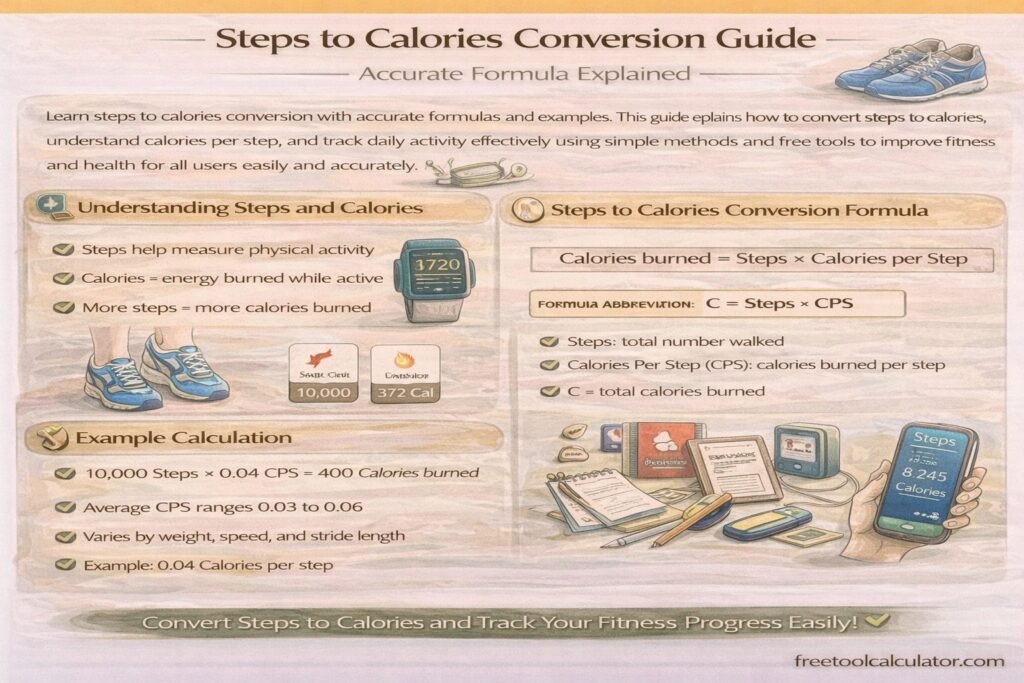
For walking-based estimates, our Steps to Calories Converter estimates calories burned using step count, body weight, walking pace, and step length.
Exercise-calorie estimates should also be treated as approximations rather than exact measurements.
Methodology & Limitations
The Calorie Deficit Calculator uses the maintenance calorie value and deficit percentage entered by the user to perform mathematical energy calculations.
The core calculations are:
Daily Deficit = TDEE × Selected Deficit Percentage
Target Intake = TDEE − Daily Deficit
Weekly Deficit = Daily Deficit × 7
Any weight-change estimate displayed by the calculator is an approximation based on an energy-to-weight conversion assumption. It should not be interpreted as a prediction of actual weight change.
Important Limitations
This calculator:
- Does not directly measure your metabolism
- Does not directly measure your energy expenditure
- Does not independently calculate your TDEE
- Cannot account for every individual metabolic or physiological difference
- Cannot determine whether a calorie target is nutritionally adequate
- Cannot diagnose a medical condition
- Cannot provide individualized medical or dietary advice
- Cannot guarantee a particular change in body weight
The quality of the calculation also depends on the accuracy of the maintenance-calorie value entered.
Sources & References
We aim to base supporting health and nutrition information on reputable and authoritative sources.
Relevant references for understanding energy balance, body weight, nutrition, and healthy weight management may include:
- National Institute of Diabetes and Digestive and Kidney Diseases (NIDDK)
- Centers for Disease Control and Prevention (CDC)
- National Health Service (NHS)
- Dietary Guidelines for Americans
- Peer-reviewed research concerning human energy balance and body-weight dynamics
Where specific formulas, recommendations, or health claims are discussed, relevant authoritative or primary references should be provided alongside the applicable information.
Related Calorie & Nutrition Calculators
TDEE Calculator
Estimate your Total Daily Energy Expenditure before calculating a calorie deficit.
Calorie Calculator
Estimate your daily calorie needs using the information requested by the calculator.
Calorie Surplus Calculator
Estimate a calorie target above your maintenance calories.
Calories Burned Calculator
Estimate calories expended during different physical activities using weight, duration, and MET values.
Steps to Calories Converter
Estimate calories burned from walking using your step count, body weight, pace, and step length.
Workout Calorie Burn
Build a workout with multiple exercises and estimate total energy expenditure using exercise duration and MET values.
Frequently Asked Questions
A calorie deficit describes a situation in which energy intake is lower than energy expenditure over a period of time.
For example, if estimated daily energy expenditure is 2,400 calories and intake is 2,000 calories, the mathematical difference is a 400-calorie deficit.
How do I calculate my calorie deficit?
If you know your estimated maintenance calories and calorie intake, the basic calculation is:
Calorie Deficit = Maintenance Calories − Calorie Intake
This calculator can instead apply a selected percentage to your entered maintenance calories to estimate a target intake.
What does TDEE mean?
TDEE stands for Total Daily Energy Expenditure. It represents an estimate of the total amount of energy your body uses in a day, including basic physiological functions, daily movement, and physical activity.
Does this calculator calculate my TDEE?
No. This Calorie Deficit Calculator requires you to enter your estimated maintenance calories or TDEE.
If you don’t know that value, use our TDEE Calculator first.
Is the estimated weekly weight change guaranteed?
No.
Any weekly weight-change figure produced by the calculator is a theoretical estimate. Actual body weight can be influenced by water balance, food intake, glycogen, activity, changes in energy expenditure, body composition, and many other individual factors.
Is a larger calorie deficit better?
Not necessarily.
Individual energy and nutritional requirements vary, and a more restrictive calorie target is not automatically more appropriate or effective. The deficit options provided by the calculator demonstrate mathematical outcomes and should not be interpreted as individualized recommendations.
Why can my weight increase while eating fewer calories?
Short-term scale weight can fluctuate for reasons unrelated to changes in body fat, including changes in body water, food and fluid intake, sodium intake, glycogen, and digestive contents.
Longer-term body-weight changes are more complex than a single day’s scale measurement.
Can exercise increase my calorie deficit?
Physical activity contributes to total energy expenditure and can therefore affect energy balance. However, both daily energy expenditure and exercise calorie-burn calculations are estimates.
You can use the Calories Burned Calculator to estimate energy expenditure for specific activities.
Can I use this calculator for medical or dietary advice?
No. This calculator is designed for general informational and educational purposes. It does not provide individualized medical or nutrition advice.
Consult an appropriately qualified healthcare professional or registered dietitian if you need advice based on your personal health, nutritional requirements, medications, or circumstances.
Health & Medical Disclaimer
The Calorie Deficit Calculator and accompanying information are provided for general informational and educational purposes only.
The calculator provides mathematical estimates based on the information entered and assumptions used by the calculation. Results are not medical diagnoses, personalized dietary prescriptions, or treatment recommendations.
Do not use calculator results as a substitute for professional medical or nutritional advice.
People with medical conditions, people taking medications, pregnant or breastfeeding individuals, people with a history of eating disorders or disordered eating, and anyone with concerns about their weight or nutritional requirements should seek guidance from an appropriately qualified healthcare professional before making significant dietary changes.
Never delay seeking professional medical advice because of information provided by an online calculator.