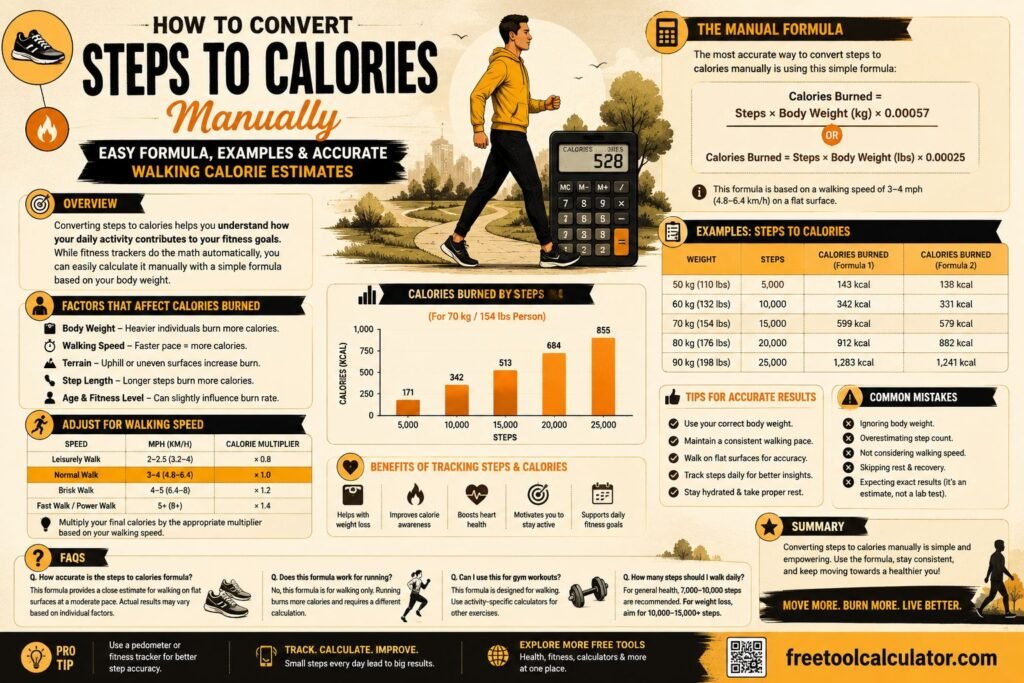
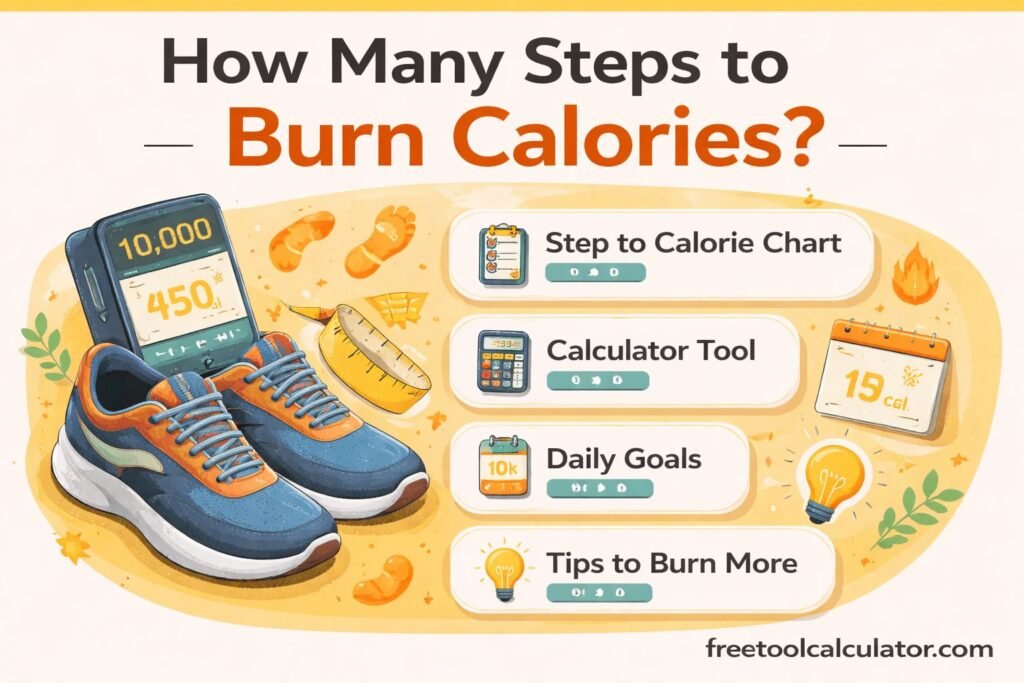
Quick answer: There is no universally accurate “calories per step” number. A better estimate combines your body weight with walking intensity and duration. Step count is useful for tracking movement, but by itself it does not tell you how far, how fast or how long you walked.
If you want the result without doing the math manually, use the Steps to Calories Calculator. This guide focuses on the methodology behind the estimate so you can understand what the number means.
Why Steps Do Not Convert Directly to Calories
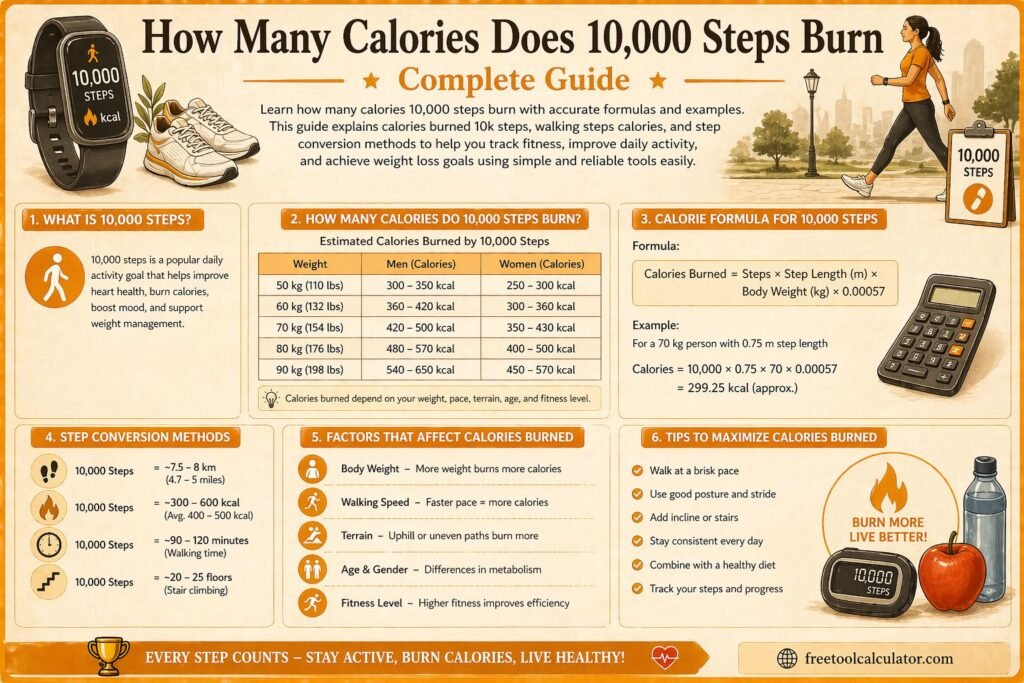
Two people can both record 8,000 steps and burn different amounts of energy. Body weight affects the energy cost of movement. Pace changes exercise intensity. Stride length changes the distance represented by a step count. Hills, stairs and surfaces can also change the effort required.
This is why multiplying every step by one fixed calorie value is only a rough shortcut. It can be useful for a quick estimate, but it should not be presented as an exact physiological conversion.
The MET-Based Calorie Formula
A common way to estimate activity energy expenditure uses a MET value. MET stands for metabolic equivalent. The 2024 Adult Compendium of Physical Activities assigns different MET values to activities according to their intensity.
A commonly used estimate is:
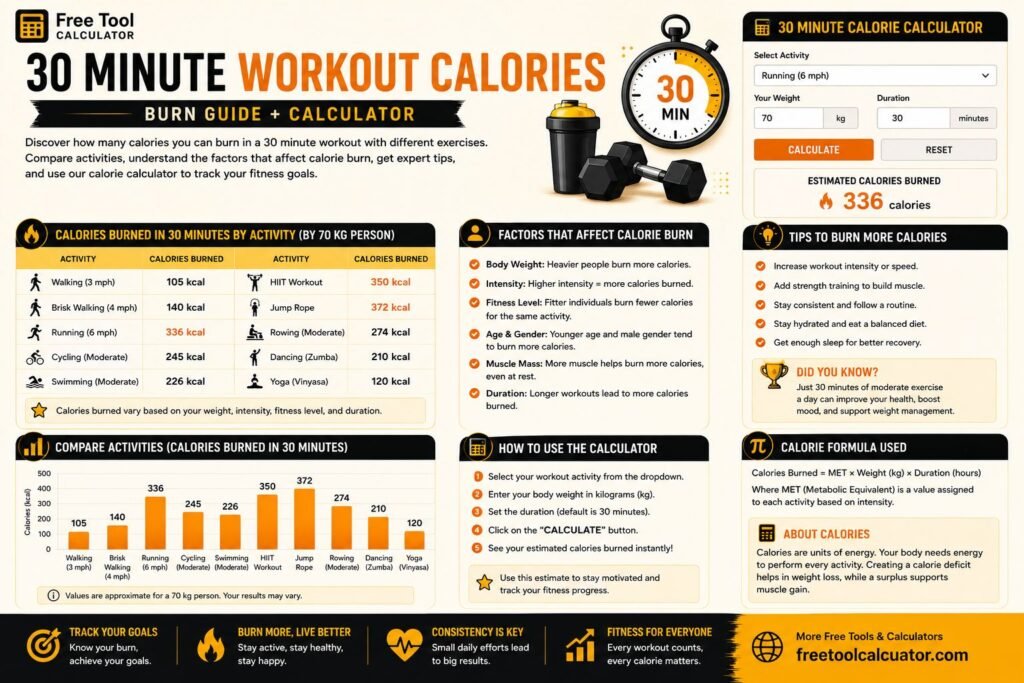
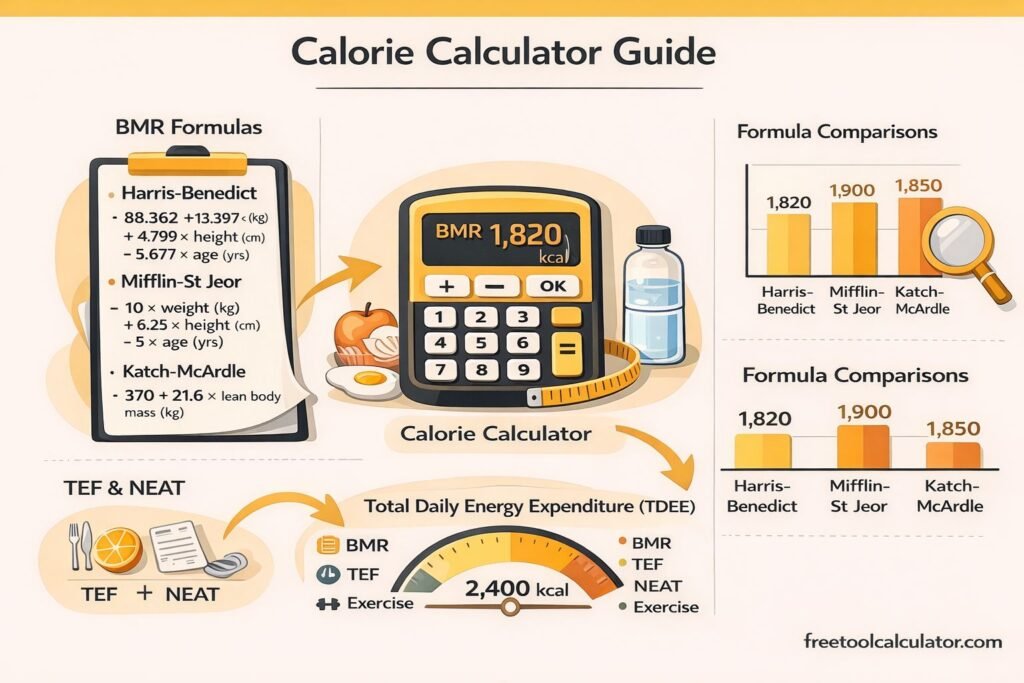
Calories per minute ≈ MET × 3.5 × body weight (kg) ÷ 200
Then multiply the calories-per-minute estimate by the number of minutes spent walking.
Walking Pace Changes the MET Value
The 2024 Adult Compendium lists different values for different walking conditions. Examples include about 3.0 METs for level walking at 2.5 mph, 3.8 METs for a moderate 2.8–3.4 mph pace, and 4.8 METs for brisk walking around 3.5–3.9 mph. Hills and carrying loads can have higher values.
Those values explain why the same number of steps taken during a slow stroll and a brisk walk should not automatically receive the same calorie estimate.
Worked Example: 70 kg at a Moderate Pace
Suppose a 70 kg adult walks for 60 minutes at an intensity represented by 3.8 METs:
3.8 × 3.5 × 70 ÷ 200 ≈ 4.66 calories per minute
Over 60 minutes, the estimate is about 279 calories. This demonstrates the formula; it is not a guarantee that every 70 kg person will burn exactly that amount.
How Step Count Fits Into the Calculation
Step count becomes more useful when paired with another measurement. If your tracker provides walking time, you can use duration and a reasonable intensity estimate. If it provides distance, you can compare step count with distance to understand your average stride. If it provides pace, that can help select a more appropriate walking-intensity category.
Without those details, a steps-to-calories result should be described as an estimate with uncertainty rather than a precise measurement.
What Makes a Steps-to-Calories Estimate More Accurate?
- Your current body weight.
- Actual walking time.
- A realistic walking pace or intensity.
- Whether the route is flat, hilly or includes stairs.
- Distance or stride information when available.
- Consistent measurement from the same device when comparing trends.
Steps, Calories and Health Are Different Metrics
Calories are only one way to describe physical activity. The CDC recommends that adults aim for at least 150 minutes of moderate-intensity aerobic activity each week, or an equivalent amount of vigorous activity, plus muscle-strengthening activity on at least two days. The guidance does not require one universal daily step target.
Research also indicates that health benefits can occur below 10,000 steps per day. So a step goal can be a useful behavior target without being treated as a precise calorie prescription.
When to Use the 10,000-Step Guide
If your question is specifically about a 10,000-step day, read our 10,000 Steps Calories Guide. It focuses on that benchmark. This page is intentionally focused on the conversion method and formula so the two guides serve different search intents.
Frequently Asked Questions
How many calories is one step?
There is no single accurate value for everyone. Energy expenditure varies with weight, pace, distance, terrain and movement efficiency.
Can I calculate calories from steps without my weight?
You can make a rough generic estimate, but body weight is an important variable in common activity-energy equations, so a personalized estimate is better when weight is known.
Are smartwatch calorie estimates exact?
No. Consumer-device and calculator values should be treated as estimates. They can still be useful for observing trends when you use the same method consistently.
Sources and Methodology
- 2024 Adult Compendium of Physical Activities — Walking
- CDC — Adult Physical Activity Recommendations
- NIH — Daily Step Count and Health Outcomes
Last reviewed: October 2026. Calorie expenditure values are estimates for educational use and are not medical measurements.