How To Find Hypotenuse of a Triangle with Simple Formulas and Examples

How To Find Hypotenuse of a Triangle with Simple Formulas and Examples

How To Find Hypotenuse and what this blog will explain

Learning how to find hypotenuse is one of the most important concepts in basic geometry and Algebra I because it forms the foundation for understanding right triangles, trigonometry, and real-life measurement problems. In this blog, you will learn what the hypotenuse is, how to identify it in any triangle, how to calculate it using formulas, how to find it when two sides are known, how to find it using an angle and one side, and how to understand the hypotenuse from an Algebra I perspective. You will also see how a practical tool such as the Hypotenuse Calculator for Right Triangle helps students and professionals verify their answers instantly and avoid calculation errors.

The hypotenuse only exists in a right triangle and is always the longest side. It is the side opposite the right angle, and understanding this basic rule is essential before applying any formulas. Once this concept is clear, solving triangle problems becomes much easier and more systematic.

What is a hypotenuse in Algebra I

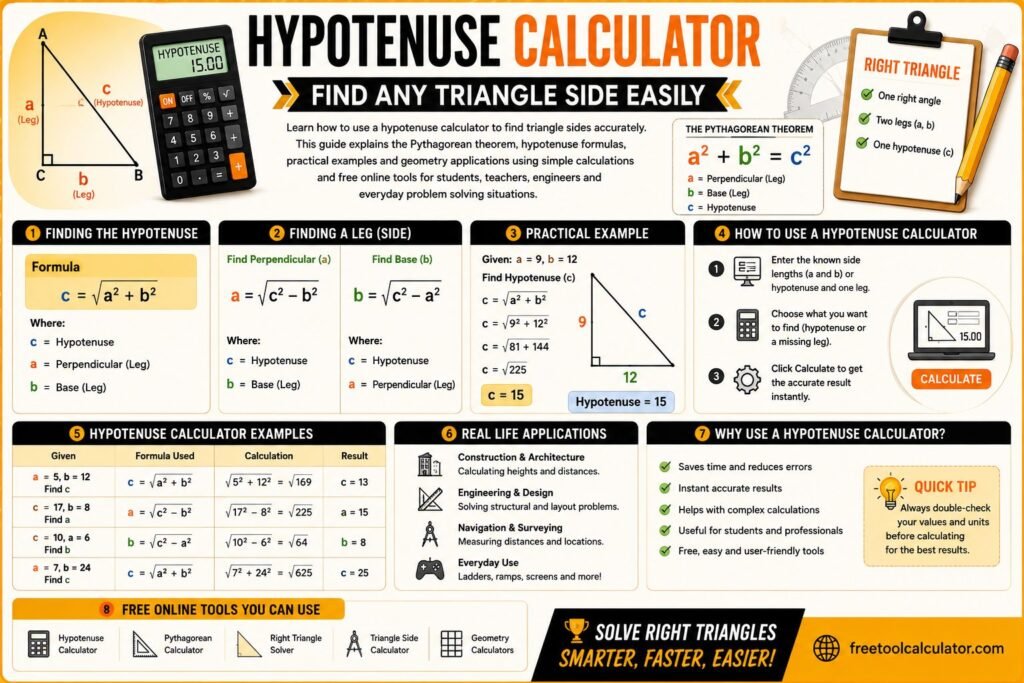
In Algebra I and introductory geometry, the hypotenuse is defined as the side of a right triangle that is opposite the 90-degree angle. A right triangle always has one right angle, two shorter sides called legs, and one longest side called the hypotenuse.

The two shorter sides are usually labeled as “a” and “b,” while the hypotenuse is labeled as “c.” This standard notation is used in formulas and textbooks worldwide. In Algebra I, students first encounter the hypotenuse when learning the Pythagorean Theorem, which connects all three sides of a right triangle through a simple and powerful equation.

Recognizing the hypotenuse visually is an important skill. No matter how a triangle is rotated or drawn, the hypotenuse is always the side opposite the right angle. It is never adjacent to the right angle. This rule alone can help avoid many common mistakes.

How to identify the hypotenuse in any right triangle

Before solving any problem, you must correctly identify the hypotenuse. This step is more important than memorizing formulas.

To identify the hypotenuse:

First, find the right angle in the triangle.
Second, look at the side directly across from that right angle.
That side is the hypotenuse.

The hypotenuse will always be:

The longest side

Opposite the 90-degree angle

The side labeled “c” in most formulas

Even if a triangle is drawn sideways or upside down, these rules never change. Many students incorrectly assume the bottom side is the hypotenuse, but orientation does not matter in geometry.

How to find the hypotenuse of a right triangle using the Pythagorean Theorem

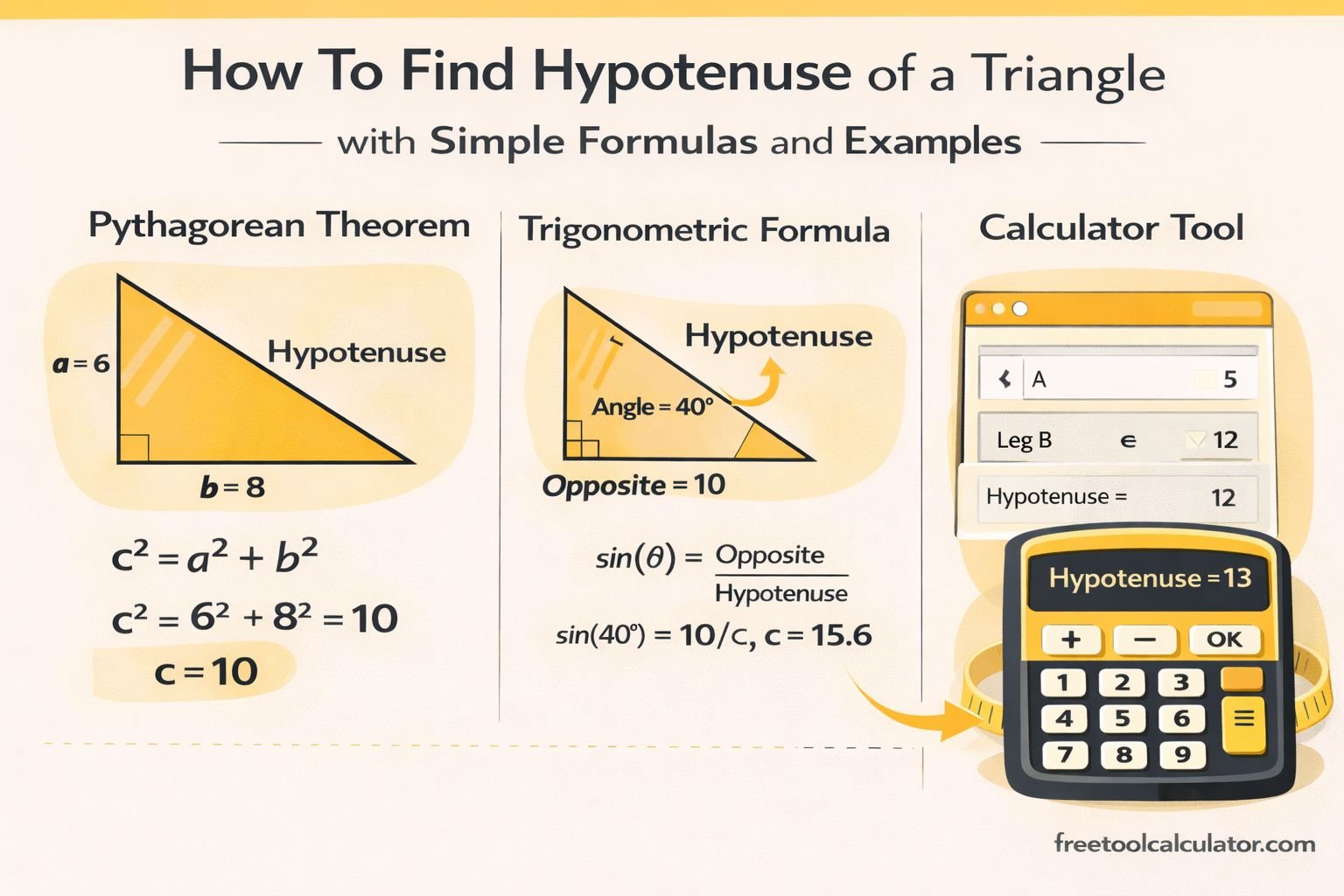
The most famous and reliable method for finding the hypotenuse is the Pythagorean Theorem. It states:

c² = a² + b²

Where:
c = hypotenuse
a and b = the two legs of the triangle

To find the hypotenuse, you follow these steps:

Square the length of each leg.

Add the two squared values.

Take the square root of the result.

That final answer is the length of the hypotenuse.

For example:
If a = 6 and b = 8

c² = 6² + 8²
c² = 36 + 64
c² = 100
c = √100
c = 10

So, the hypotenuse is 10 units.

This formula is used in mathematics, physics, engineering, construction, navigation, and computer graphics. It is one of the most important equations in all of geometry.

How to find the hypotenuse of a triangle given two sides

When the triangle is a right triangle and you know the lengths of both legs, the Pythagorean Theorem is the correct method. This is the most common classroom and exam scenario.

However, if the triangle is not a right triangle, the concept of a hypotenuse does not apply. Only right triangles have a hypotenuse. In acute or obtuse triangles, the longest side is not called a hypotenuse, and different formulas such as the Law of Cosines must be used.

For right triangles, using the Hypotenuse Calculator for Right Triangle allows you to enter the two known sides and instantly compute the hypotenuse, saving time and eliminating arithmetic mistakes.

Why the hypotenuse is always the longest side

The hypotenuse is always the longest side because it lies opposite the right angle, which is the largest angle in the triangle. In geometry, the side opposite the largest angle is always the longest side. Since 90 degrees is larger than any acute angle, the side opposite it must be the longest.

This rule helps in problem-solving. If you calculate a hypotenuse that is shorter than one of the legs, you know immediately that a mistake has occurred.

How to find hypotenuse using an angle and one side

Sometimes you are given one side and one angle instead of two sides. In this case, trigonometric ratios are used.

The two most common ratios are:

sin(θ) = opposite / hypotenuse
cos(θ) = adjacent / hypotenuse

If you know the angle and the opposite side:

hypotenuse = opposite / sin(θ)

If you know the angle and the adjacent side:

hypotenuse = adjacent / cos(θ)

For example:
If θ = 30° and the opposite side is 5 units:

hypotenuse = 5 / sin(30°)
hypotenuse = 5 / 0.5
hypotenuse = 10

This method is extremely useful in trigonometry, physics, and engineering problems where angles are easier to measure than distances.

How calculators help in learning how to find hypotenuse

While learning the formulas is essential, tools play an important role in checking your work and building confidence. The Hypotenuse Calculator for Right Triangle allows students to test multiple examples quickly and confirm whether their manual calculations are correct.

Using a calculator does not replace understanding. Instead, it supports learning by providing instant feedback and reducing frustration caused by arithmetic errors.

How to determine the hypotenuse of an acute triangle

It is important to clarify a common misconception: an acute triangle does not have a hypotenuse. The term “hypotenuse” is reserved strictly for right triangles, meaning triangles that contain one 90-degree angle. In an acute triangle, all three angles are less than 90 degrees, so none of the sides can be called a hypotenuse.

However, many students use the phrase “hypotenuse of an acute triangle” to mean finding the longest side of an acute triangle. In this case, different mathematical methods are required.

For acute triangles, the Law of Cosines is used:

c² = a² + b² − 2ab cos(C)

Here:

c is the side opposite angle C

a and b are the other two sides

This formula generalizes the Pythagorean Theorem. When angle C equals 90 degrees, cos(90°) becomes zero, and the equation reduces to the familiar right-triangle formula. When the angle is acute, the subtraction term is smaller, resulting in a shorter longest side than in a right triangle.

This distinction is crucial because applying hypotenuse formulas to non-right triangles produces incorrect results. The hypotenuse exists only when a right angle is present.

How to find the hypotenuse using an angle and one side

When you know one acute angle and one side of a right triangle, trigonometric ratios allow you to calculate the hypotenuse efficiently.

The two most useful formulas are:

hypotenuse = opposite ÷ sin(θ)
hypotenuse = adjacent ÷ cos(θ)

Where:

θ is the known acute angle

“opposite” is the side across from θ

“adjacent” is the side next to θ

Example using sine:
If θ = 40° and the opposite side is 9 units:

hypotenuse = 9 ÷ sin(40°)
hypotenuse ≈ 9 ÷ 0.643
hypotenuse ≈ 14.0 units

Example using cosine:
If θ = 60° and the adjacent side is 5 units:

hypotenuse = 5 ÷ cos(60°)
hypotenuse = 5 ÷ 0.5
hypotenuse = 10 units

These formulas are fundamental in trigonometry and appear frequently in physics, engineering, surveying, and navigation problems.

When calculations involve decimals and trigonometric values, students often benefit from checking results using the Hypotenuse Calculator for Right Triangle, which confirms accuracy instantly.

How to find the hypotenuse when two sides are known

When two sides of a right triangle are known, there are two possible cases.

Case 1: Both legs are known
Use the Pythagorean Theorem:

c = √(a² + b²)

Case 2: One leg and the hypotenuse are known
Use a rearranged version of the theorem:

a = √(c² − b²)

This allows you to find a missing leg, which is just as important in many problems.

Example:
If c = 13 and b = 5:

a = √(13² − 5²)
a = √(169 − 25)
a = √144
a = 12

These rearrangements demonstrate how flexible the Pythagorean Theorem is in solving triangle problems.

Why calculators are helpful for learning how to find hypotenuse

Manual calculation builds understanding, but calculators strengthen accuracy and efficiency. Students and professionals use tools to:

Verify homework solutions

Check exam practice problems

Explore “what-if” scenarios

Reduce arithmetic mistakes

The Hypotenuse Calculator for Right Triangle allows users to enter side values or angles and instantly see results. This speeds up learning and helps students focus on concepts rather than only computation.

Common mistakes when finding the hypotenuse

One frequent error is misidentifying the hypotenuse. Students sometimes choose the longest side visually rather than locating the side opposite the right angle.

Another mistake is forgetting to take the square root after adding squared values in the Pythagorean formula.

Some students mistakenly apply the hypotenuse concept to non-right triangles. Remember, without a right angle, there is no hypotenuse.

Errors also occur when mixing angle functions:

Using sine instead of cosine

Dividing when multiplication is required

Forgetting that calculators must be in degree mode

Careful attention to these details prevents most calculation errors.

Real-world applications of finding the hypotenuse

The concept of the hypotenuse is not limited to classrooms. It appears in many real-world contexts:

Construction uses hypotenuse calculations to measure diagonal supports and verify right angles in foundations.

Engineering relies on hypotenuse formulas to resolve forces into horizontal and vertical components.

Navigation uses hypotenuse relationships to calculate distances between points using bearings and headings.

Physics uses hypotenuse calculations when determining resultant velocity or force vectors.

Computer graphics uses right triangles constantly to calculate pixel distances, slopes, and rotations.

Understanding how to find the hypotenuse gives mathematical tools that extend far beyond basic geometry.

How to practice finding the hypotenuse effectively

Effective practice involves multiple methods:

Solve problems by hand using the Pythagorean Theorem.
Solve problems using trigonometric ratios.
Verify results with the Hypotenuse Calculator for Right Triangle.
Change numbers and observe how the hypotenuse changes.

This multi-step learning approach deepens understanding and builds confidence.

How to explain hypotenuse in simple terms for Algebra I students

For beginners, the hypotenuse can be explained simply:

“The hypotenuse is the side across from the right angle. It is always the longest side of the triangle.”

Using drawings and color-coding helps reinforce the idea. Teachers often highlight the right angle first and then show that the hypotenuse is the side that does not touch that angle.

Once this visual understanding is clear, introducing formulas becomes much easier.

Why understanding how to find hypotenuse is essential in mathematics

Learning how to find hypotenuse builds foundational reasoning skills in geometry and trigonometry. It teaches:

Logical problem solving

Algebraic manipulation

Spatial reasoning

Application of formulas

Connection between geometry and algebra

This knowledge supports advanced topics such as coordinate geometry, vectors, calculus, and physics.

Final educational conclusion

Understanding how to find hypotenuse is a cornerstone of mathematics education. The hypotenuse exists only in right triangles and is always the side opposite the 90-degree angle. It can be calculated using the Pythagorean Theorem when two sides are known, or using trigonometric ratios when an angle and one side are given. Acute triangles do not have a hypotenuse, and confusing them with right triangles leads to incorrect solutions.

Mastery comes from recognizing the triangle type, choosing the correct formula, and applying it carefully. Tools such as the Hypotenuse Calculator for Right Triangle provide reliable verification and support learning by offering instant confirmation of results.

With practice, understanding, and the correct application of formulas, finding the hypotenuse becomes not only easy but an essential skill that connects classroom mathematics to real-world problem solving.

Share this article:

On This Page

Subscribe to our newsletter

Read the latest articles from our experts

Tools & Resources

Explore our collection of professional tools designed to streamline your workflow