Kilowatts to Amps Conversion and Why It Matters
Understanding kilowatts to amps conversion is extremely important for electricians, engineers, students, technicians, and homeowners working with electrical systems. Electrical devices often display power ratings in kilowatts, while wires, breakers, and electrical circuits are rated in amps. Without understanding the relationship between these units, it becomes difficult to size electrical systems correctly and safely.
Incorrect electrical calculations may lead to overloaded circuits, damaged appliances, overheating wires, and dangerous electrical failures. That is why understanding the kilowatts to amps formula is critical in both residential and commercial environments. Whether you are installing an air conditioner, planning a solar setup, selecting a generator, or managing industrial equipment, accurate conversion ensures safer and more efficient operation.
You can convert kilowatts to amps using this free calculator to instantly calculate current values for different voltages and electrical systems without manual calculations.
What Are Kilowatts in Electrical Systems
Kilowatts measure electrical power. Power represents the amount of energy consumed or produced over time. One kilowatt equals 1000 watts. Electrical appliances, motors, heaters, and generators commonly use kilowatts to describe how much power they require during operation.
For example, a water heater may use 3 kilowatts, while an industrial motor may consume 15 kilowatts or more. Larger systems often use kilowatts because watts become impractical for high power values. Understanding power consumption helps users estimate energy usage, utility costs, and electrical load requirements.
Power measurements are essential for system planning because they determine how much electricity is needed to operate equipment safely and efficiently.
What Are Amps and Why They Matter
Amps, also known as amperes, measure electrical current. Current represents the flow of electricity through a circuit. The higher the amp value, the more electrical current moves through wires and devices.
Circuit breakers, fuses, and electrical cables are all rated based on current capacity. If current exceeds safe limits, electrical components may overheat or fail. This is why converting kilowatts to amps accurately is essential during electrical installation and maintenance.
Understanding current flow also helps users identify energy demand and avoid overloaded systems. Even small appliances can create electrical problems if current requirements are misunderstood.
Relationship Between Kilowatts Volts and Amps
Kilowatts, volts, and amps are closely connected in electrical systems. Voltage represents electrical pressure, current represents electrical flow, and power represents total energy usage.
Higher voltage systems require less current to deliver the same amount of power. For example, a 5 kilowatt appliance running at 240 volts will use fewer amps compared to the same appliance operating at 120 volts. This is why voltage plays such an important role in electrical calculations.
The relationship between these units forms the foundation of electrical engineering and practical power distribution. Understanding this connection makes it easier to calculate safe electrical loads.
Kilowatts to Amps Formula Explained Clearly
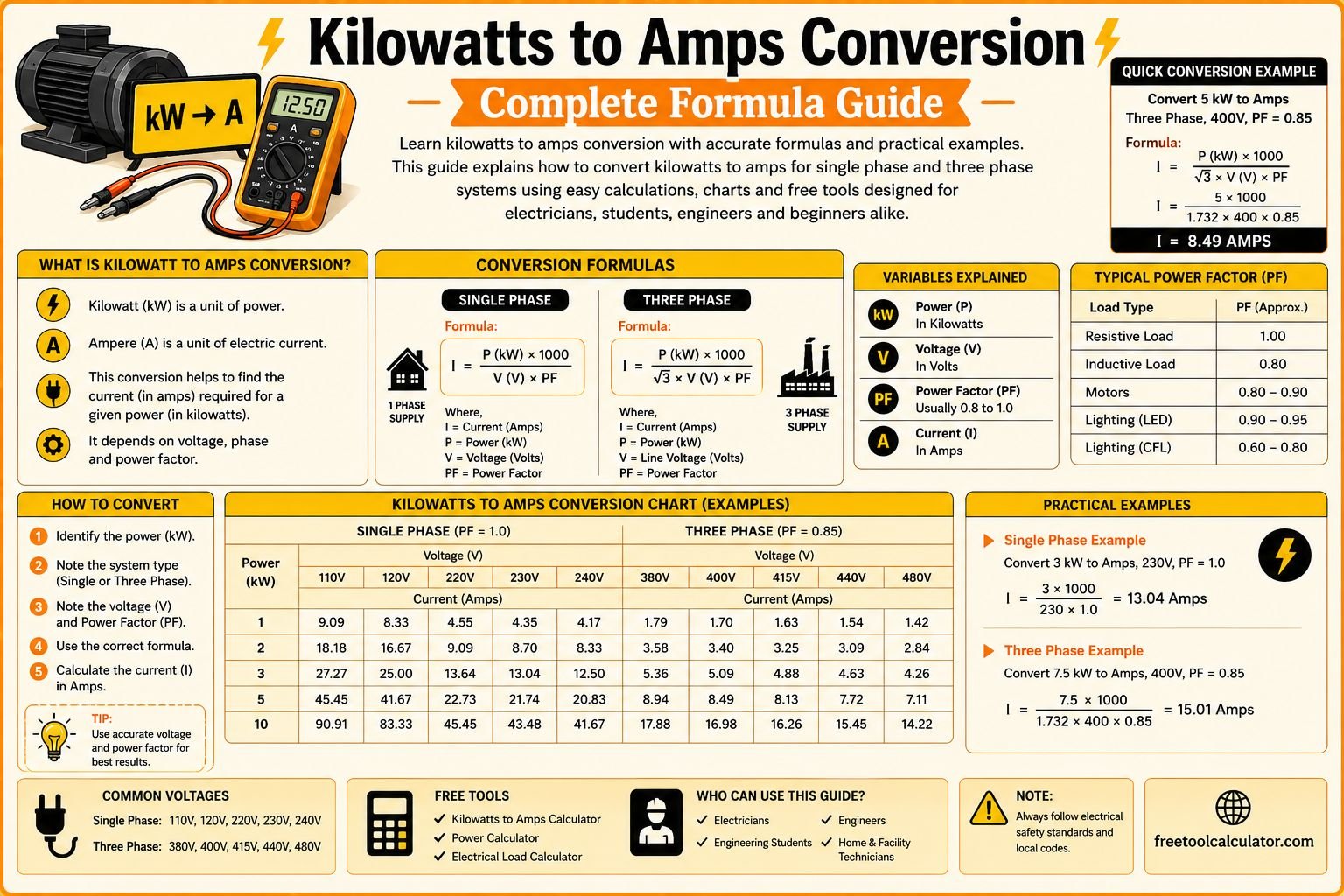
The kilowatts to amps formula depends on whether the electrical system is single phase or three phase. Different systems distribute electricity differently, which changes the formula.
For single phase systems:
Amps = Kilowatts × 1000 ÷ Volts × Power Factor
For three phase systems:
Amps = Kilowatts × 1000 ÷ √3 × Volts × Power Factor
These formulas calculate the amount of electrical current required for a specific power load. The power factor represents efficiency in AC electrical systems and is usually close to 1 for household appliances.
You can avoid manual calculations and potential mistakes by using the kilowatts to amps calculator for instant accurate results.
How to Convert Kilowatts to Amps Step by Step
To convert kilowatts to amps manually, first determine the electrical system type and operating voltage. Then identify the power factor if applicable. Once you have these values, apply the correct formula.
For example, consider a 4 kilowatt single phase heater operating at 230 volts with a power factor of 1.
4000 ÷ 230 = 17.39 amps approximately
In a three phase system, the formula changes because power is distributed across three conductors. This lowers the required current compared to single phase systems.
Understanding this process helps electricians size breakers, cables, and protection devices more accurately.
Single Phase vs Three Phase Systems
Single phase systems are commonly used in homes and small businesses. They are suitable for lighting, household appliances, and general electrical use. Three phase systems are mainly used in industrial environments where larger motors and machinery require stable and efficient power delivery.
Three phase systems distribute electrical load more evenly and efficiently. This allows them to carry higher power with lower current compared to single phase systems. Industrial motors, manufacturing equipment, and commercial HVAC systems often rely on three phase power.
Understanding the difference between these systems is essential when using a kilowatt to amps formula because applying the wrong formula creates incorrect results and unsafe electrical planning.
Importance of Power Factor in Electrical Calculations
Power factor measures how efficiently electrical power is converted into useful work. In AC systems, not all supplied electricity becomes productive energy because some energy is lost due to magnetic and reactive loads.
A power factor closer to 1 means greater efficiency. Household appliances often have high power factors, while motors and industrial systems may have lower values. Lower power factors increase current demand for the same amount of power.
Including power factor in electrical calculations improves accuracy and helps avoid undersized electrical components. It also improves energy efficiency and system reliability.
Why Accurate Conversion Matters for Electrical Safety
Accurate kilowatts to amps conversion is critical for electrical safety. Using incorrect amperage values can result in overloaded circuits, damaged equipment, and overheating wires.
If wires are too small for the current they carry, excessive heat may build up and increase fire risk. Similarly, improperly sized breakers may fail to protect the circuit during overload conditions.
Correct calculations help ensure that all electrical components operate within safe limits. This protects both people and equipment from electrical hazards.
Common Appliances and Their Current Requirements
Different appliances draw different levels of current depending on their power rating and voltage. For example, electric heaters, ovens, and air conditioners often require significant current due to high power consumption.
Smaller appliances such as televisions or laptops consume much lower current. Understanding these differences helps homeowners and technicians manage electrical loads more effectively.
Using a electricity calculator can also help estimate appliance energy usage and overall electrical demand within a home or workplace.
Benefits of Using Online Conversion Tools
Manual electrical calculations can become complicated, especially when dealing with different voltages, power factors, and three phase systems. Online tools simplify the process and reduce errors.
Digital calculators provide instant results and work on phones, tablets, and desktop devices. This makes them highly convenient for electricians, engineers, students, and DIY users.
You can also use related tools such as the amps to kilowatts calculator and the energy unit converter for additional electrical calculations and conversions.
Common Mistakes During Kilowatts to Amps Conversion
One common mistake is forgetting to convert kilowatts into watts before calculation. Since formulas use watts, multiplying kilowatts by 1000 is essential.
Another mistake is ignoring power factor or using incorrect voltage values. This leads to inaccurate current calculations and poor electrical planning.
Applying single phase formulas to three phase systems is another major issue. Many beginners confuse these systems and accidentally produce incorrect results. Careful attention to formulas helps avoid these errors.
How Electricians Use Kilowatt to Amps Calculations
Electricians rely on kilowatt to amps calculations every day when designing, installing, and troubleshooting electrical systems. These calculations help determine wire sizes, breaker ratings, and panel capacities.
For example, before installing an electric water heater or industrial machine, electricians calculate the expected current to ensure the system can handle the load safely. This prevents overload conditions and improves long term reliability.
Accurate calculations are also important for renewable energy systems such as solar panels and backup generators. These systems require careful power planning to operate efficiently.
Electrical Energy Efficiency and Load Planning
Efficient electrical planning reduces energy waste and improves system performance. Understanding current demand helps users balance loads and prevent unnecessary energy losses.
Businesses often monitor electrical loads carefully because inefficient systems increase operating costs. Proper conversion and planning help reduce energy consumption while maintaining performance.
You can also use the energy consumption calculator to estimate electricity usage and the electricity unit calculator to estimate power costs for household appliances and devices.
Conclusion
Understanding kilowatts to amps conversion is essential for safe electrical design, efficient energy management, and proper system installation. Whether working on household appliances, commercial systems, industrial motors, or renewable energy setups, accurate calculations help prevent overloads and improve reliability.
If you want fast and accurate electrical calculations, you can use this free kilowatts to amps calculator along with related tools like the amps to kilowatts calculator, the energy consumption calculator, and the energy unit converter to simplify electrical conversion, load planning, and energy management tasks.