Grams Teaspoons Conversion and Why It Matters in Cooking
Understanding grams teaspoons conversion is extremely important for accurate cooking and baking. Recipes around the world use different measurement systems, and this often creates confusion in the kitchen. Some recipes use grams while others use teaspoons, tablespoons, or cups. Without proper conversion, ingredient quantities may become inaccurate, affecting flavor, texture, consistency, and final results.
Baking especially requires precise measurements because even small mistakes can change how recipes turn out. Too much flour can make baked goods dry, while too much sugar or baking powder can affect structure and taste. Learning how to convert grams to teaspoons properly helps improve accuracy and confidence in the kitchen.
You can convert grams to teaspoons using this free calculator for instant and reliable kitchen measurements without complicated formulas.
What Is the Difference Between Grams and Teaspoons
Before learning grams teaspoons conversion, it is important to understand the difference between these units. Grams measure weight or mass, while teaspoons measure volume. Because they measure different properties, conversion depends on the density of the ingredient being used.
For example, one teaspoon of sugar weighs differently from one teaspoon of flour, butter, or honey. This means there is no universal conversion value for all ingredients. A dense ingredient will weigh more within the same teaspoon volume compared to a lighter ingredient.
Understanding this difference is essential because many beginners assume teaspoons and grams convert equally for every ingredient, which is incorrect and often leads to recipe mistakes.
How to Convert Grams to Teaspoons Correctly
To convert grams to teaspoons accurately, you need to know the ingredient density. Density determines how much a substance weighs within a specific amount of space.
The common conversion formula is:
Teaspoons = Grams ÷ Ingredient Density ÷ 4.928
This formula may look confusing at first, especially for beginners. That is why online kitchen tools are much easier and more practical for everyday cooking. Instead of calculating manually, you can use a grams to teaspoon calculator to instantly get precise measurements.
You can use this grams to teaspoon calculator to simplify kitchen conversions for baking, cooking, and meal preparation.
Why Ingredient Density Changes Conversion Values
Ingredient density is one of the biggest reasons why kitchen conversions vary. Ingredients such as flour, sugar, salt, oil, butter, cocoa powder, and honey all have different densities. This means the same teaspoon volume may contain different gram weights depending on the ingredient.
For example, one teaspoon of table salt weighs significantly more than one teaspoon of flour because salt particles are denser. Similarly, liquids such as oil or honey behave differently from dry ingredients.
Professional bakers often prefer grams because weight measurements remain consistent regardless of ingredient texture or packing style. However, teaspoons remain convenient for small quantities and quick cooking adjustments.
Common Grams to Teaspoons Chart Examples
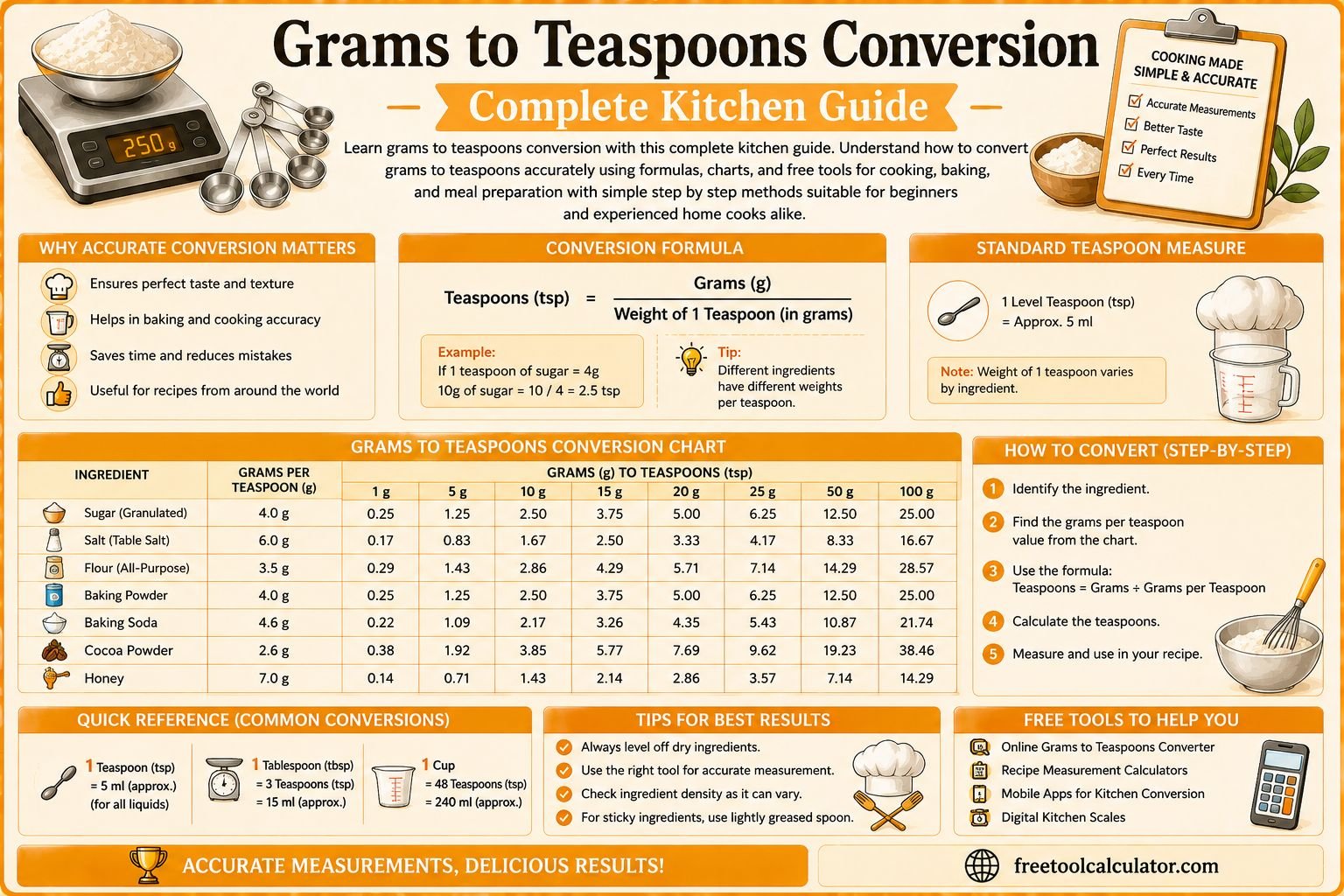
Using a grams to teaspoons chart is one of the easiest ways to understand common ingredient conversions. These charts provide approximate values for frequently used kitchen ingredients and save time during recipe preparation.
Some common examples include:
One teaspoon sugar equals about 4 grams
One teaspoon salt equals around 6 grams
One teaspoon flour equals around 2.5 to 3 grams
One teaspoon butter equals around 4.7 grams
These values are approximate and may vary slightly depending on ingredient type and texture. Online calculators provide more precise conversions when needed.
Why Bakers Prefer Weight Measurements
Professional bakers usually measure ingredients in grams because weight based measurements are more accurate than volume measurements. Teaspoons and cups can vary depending on how ingredients are scooped, packed, or leveled.
For example, packed flour weighs more than loosely spooned flour even if both are measured using the same teaspoon. This difference can affect cakes, bread, cookies, and pastries.
Using grams ensures recipe consistency every time. However, understanding grams teaspoons conversion is still valuable when kitchen scales are unavailable or recipes use mixed unit systems.
How Kitchen Conversion Tools Make Cooking Easier
Kitchen conversion tools simplify recipe preparation and reduce manual calculation errors. Instead of searching through charts or memorizing values, users can instantly convert measurements online.
This is especially useful when following international recipes because some countries use metric measurements while others rely on teaspoons, cups, and ounces. Conversion tools help bridge that gap and improve recipe accuracy.
You can also use related tools such as the kitchen measurement converter for broader unit conversions and the cups to grams converter when working with baking recipes using multiple measurement systems.
Common Mistakes in Grams Teaspoons Conversion
One of the biggest mistakes beginners make is assuming all ingredients convert equally. Since every ingredient has different density, using one conversion value for everything creates inaccurate results.
Another common mistake is using household spoons instead of proper measuring spoons. Standard teaspoons are specifically designed for cooking measurements, while regular spoons vary greatly in size.
Incorrect leveling also causes errors. Ingredients should usually be leveled instead of packed unless the recipe specifically states otherwise. These small details can significantly affect recipe consistency and quality.
How to Measure Dry Ingredients Properly
Dry ingredients such as flour, cocoa powder, and baking powder should be measured carefully for better accuracy. The best method is to spoon the ingredient lightly into the measuring spoon and level it using a flat edge.
Scooping directly from containers often compacts ingredients, leading to higher measurements than intended. This can affect baking texture and consistency.
For maximum precision, kitchen scales remain the best option, especially in professional baking. Still, teaspoons are highly useful for quick everyday cooking tasks.
How to Measure Liquid Ingredients Accurately
Liquid ingredients such as oil, milk, honey, and syrups should be measured at eye level to avoid inaccurate readings. Using transparent measuring tools improves visibility and precision.
Some liquids are denser than others, which affects gram conversion values. Honey, for example, weighs more than water within the same teaspoon volume. This is why ingredient specific conversion values matter.
Online tools simplify these calculations and reduce confusion when working with liquid ingredients in recipes.
Benefits of Using Online Kitchen Conversion Calculators
Online kitchen calculators save time and improve measurement accuracy. Instead of performing manual calculations or memorizing charts, users can instantly convert values using a phone, tablet, or computer.
These tools are especially helpful for beginners who may not fully understand kitchen measurement systems. They also help experienced cooks adapt recipes quickly and efficiently.
You can also use the ml to cups converter for liquid recipes and the ounces to grams converter for international cooking and baking measurements.
How Accurate Measurements Improve Healthy Cooking
Proper kitchen measurements are important not only for taste but also for nutrition and portion control. Excess sugar, oil, or salt can significantly change calorie content and dietary balance.
People following meal plans, fitness diets, or medical nutrition guidelines benefit greatly from precise measurements. Accurate conversion allows better tracking of ingredients and calorie intake.
Cooking with proper measurements also reduces food waste because recipes turn out more consistently and predictably.
Tips for Better Kitchen Measurement Accuracy
Always use standard measuring spoons instead of regular household utensils. Keep dry and liquid measuring tools separate because they are designed differently for accuracy.
Read measurements carefully and avoid estimating ingredient amounts whenever possible. Organizing ingredients before cooking also helps reduce confusion and mistakes during preparation.
Digital kitchen scales remain the most accurate option for baking and professional recipes, while conversion calculators provide excellent support for quick kitchen tasks.
Why Beginners Should Learn Kitchen Conversion Basics
Learning kitchen conversions helps beginners become more confident and independent in cooking. Many people avoid trying recipes because they become confused by unfamiliar units and measurements.
Understanding how to convert grams to teaspoons makes recipes easier to follow and improves overall cooking results. It also allows users to adapt recipes from different countries and cooking styles more comfortably.
This basic kitchen skill becomes increasingly valuable as people experiment with baking, meal prep, and international cuisine.
Conclusion
Understanding grams teaspoons conversion is an essential kitchen skill that improves baking precision, cooking consistency, and recipe confidence. Since grams measure weight and teaspoons measure volume, ingredient density must always be considered for accurate conversion. Learning these basics helps avoid common kitchen mistakes and improves overall recipe quality.
If you want quick and reliable kitchen conversions, you can use this free grams to teaspoon calculator along with related tools like the kitchen measurement converter, the cups to grams converter, and the ml to cups converter to simplify cooking, baking, and food measurement tasks accurately.