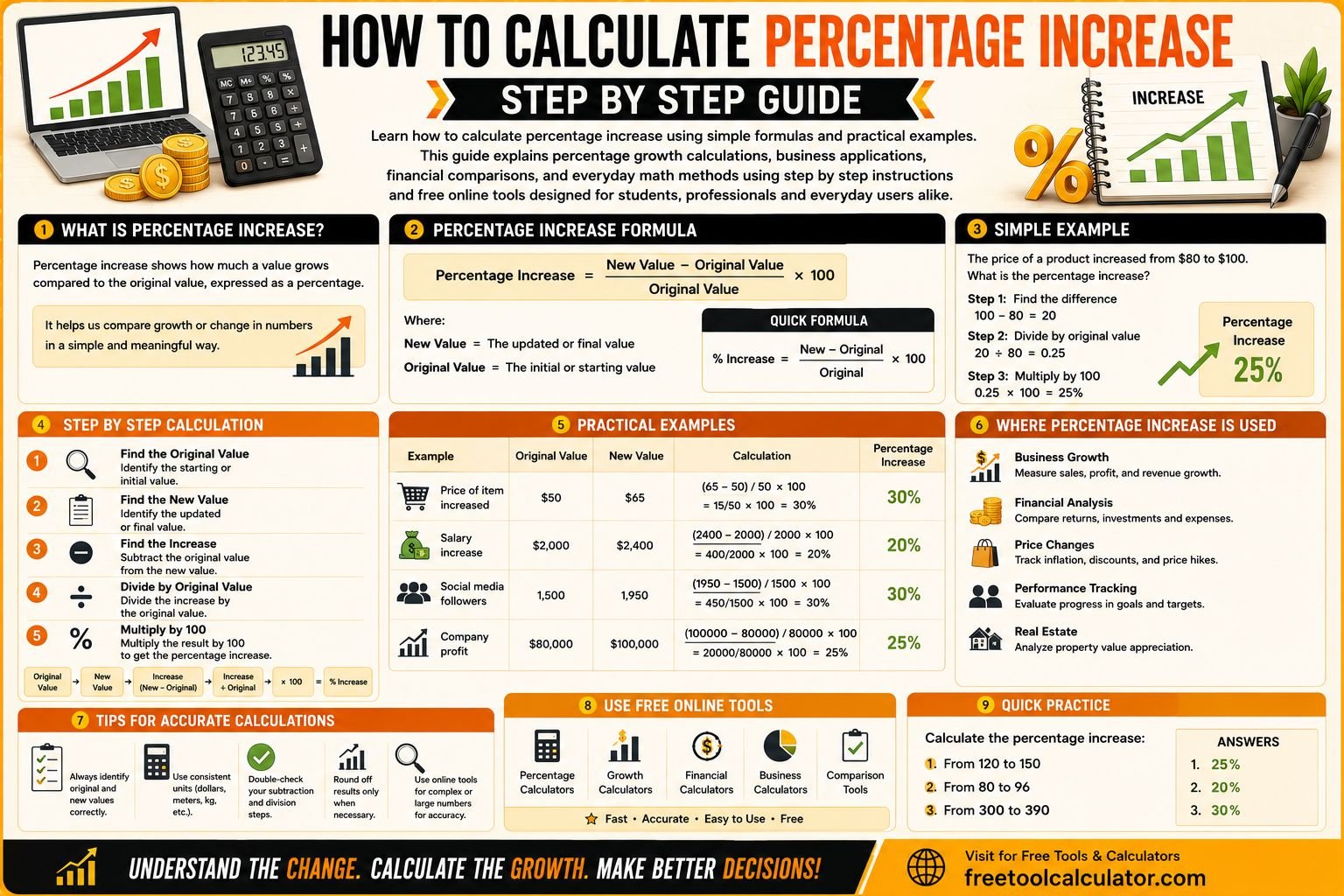
How to Calculate Percentage Increase and Why It Matters
Understanding how to calculate percentage increase is one of the most useful math skills in everyday life. Percentage increases are used in business, finance, education, shopping, investments, salary comparisons, population studies, and personal budgeting. Whenever a value grows from one amount to another, percentage increase helps measure the size of that growth relative to the original amount.
Many people can identify that a number increased, but percentage growth provides a clearer understanding of how significant that increase actually is. For example, a $100 increase may be huge in one situation and minor in another depending on the starting value.
You can calculate percentage increase using this free percentage calculator to get instant and accurate results without performing manual calculations.
What Is Percentage Increase
Percentage increase measures how much a value has grown compared to its original amount. Instead of simply showing the difference between two numbers, percentage increase expresses that change as a percentage of the starting value.
For example, if a product price increases from $50 to $60, the actual increase is $10. However, percentage increase tells us that the growth equals 20 percent relative to the original price.
This method helps compare growth rates across different situations because percentages provide a standardized way to measure change.
Percentage Increase Formula Explained
The percentage increase formula compares the difference between the new value and the original value relative to the original value. The standard formula is:
This formula is widely used in mathematics, finance, economics, business analysis, and statistics. It helps measure percentage growth accurately across many different applications.
How to Calculate Percentage Increase Step by Step
Learning how to calculate percentage increase becomes simple when broken into steps.
Step 1: Find the difference between the new value and the original value.
Step 2: Divide that difference by the original value.
Step 3: Multiply the result by 100.
For example, suppose a salary increases from $2,000 per month to $2,500 per month.
Difference = 2,500 − 2,000 = 500
500 ÷ 2,000 = 0.25
0.25 × 100 = 25%
The salary increased by 25 percent. This method works for almost any percentage growth calculation.
Why We Divide by the Original Value
One of the most important parts of the percentage increase formula is dividing by the original value rather than the new value.
The original value acts as the reference point because percentage growth measures how much change occurred relative to where the value started. Using the new value would produce inaccurate results and distort the growth percentage.
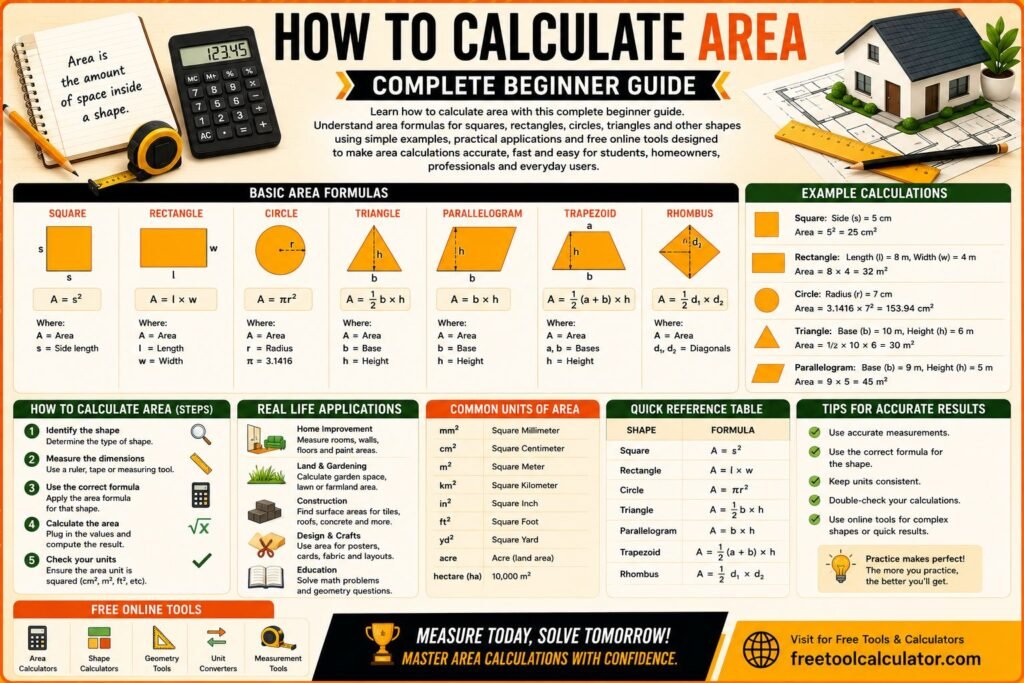
Understanding this concept helps avoid one of the most common mistakes students make when performing area calculations and percentage calculations.
Percentage Growth Example Using Product Prices
Imagine a smartphone costs $400 last year and now costs $520.
Difference = 520 − 400 = 120
120 ÷ 400 = 0.30
0.30 × 100 = 30%
The phone price experienced a 30 percent increase.
This type of percentage growth calculation is commonly used in retail, ecommerce, inflation tracking, and consumer budgeting. Businesses frequently monitor percentage increases to analyze pricing trends and profitability.
How Businesses Use Percentage Increase Calculations
Businesses constantly calculate percentage increase values to evaluate growth and performance. Sales teams measure revenue growth, marketing teams analyze customer growth, and financial departments monitor profits and expenses.
For example, if monthly sales increase from $50,000 to $65,000, percentage growth provides a clearer performance measurement than simply reporting a $15,000 increase.
Companies often use percentage increases when creating reports because percentages allow easier comparisons across different time periods and business sizes.
Percentage Increase in Salary Calculations
Salary growth is one of the most common real world uses of percentage increase calculations.
Suppose an employee earns $40,000 annually and receives a raise to $46,000.
Difference = $6,000
6,000 ÷ 40,000 = 0.15
0.15 × 100 = 15%
The salary increased by 15 percent.
Understanding salary growth percentages helps employees evaluate job offers, promotions, and compensation adjustments more accurately.
How to Calculate Percentage Increase in School and University Grades
Students frequently use percentage increase calculations to measure academic improvement.
For example, if a student scores 60 on one exam and 78 on the next:
Difference = 18
18 ÷ 60 = 0.30
0.30 × 100 = 30%
The student’s score increased by 30 percent.
Tracking academic growth through percentages helps students measure progress more effectively than looking at raw scores alone.
Percentage Increase in Population Growth
Governments and researchers often calculate percentage growth when studying population changes.
For example, if a town grows from 10,000 residents to 12,500 residents:
Difference = 2,500
2,500 ÷ 10,000 = 0.25
0.25 × 100 = 25%
The population increased by 25 percent.
Percentage growth makes it easier to compare changes between cities, countries, and regions regardless of population size.
How Percentage Increase Helps in Investing
Investors frequently calculate percentage increase to evaluate stock performance, asset growth, and investment returns.
If an investment grows from $1,000 to $1,300:
Difference = $300
300 ÷ 1,000 = 0.30
0.30 × 100 = 30%
The investment increased by 30 percent.
Percentage growth allows investors to compare different investments fairly, even when the investment amounts differ significantly.
Common Mistakes When Calculating Percentage Increase
One common mistake is subtracting values in the wrong order. The original value should always be subtracted from the new value.
Another mistake is dividing by the new value instead of the original value. This produces incorrect results and changes the meaning of the calculation.
Some users also forget to multiply by 100 after division, leaving the answer as a decimal rather than a percentage.
Carefully following each calculation step helps avoid these common errors.
Difference Between Percentage Increase and Percentage Decrease
Percentage increase measures growth while percentage decrease measures reduction.
The formula structure remains similar, but percentage decrease focuses on how much a value has fallen relative to its original amount.
Understanding both concepts helps users analyze financial reports, market trends, academic performance, and statistical data more effectively.
Businesses often monitor both increases and decreases simultaneously when evaluating performance metrics.
Why Percentage Growth Is Better Than Absolute Growth
Absolute growth shows only the raw increase amount. Percentage growth provides context by showing how large that increase is relative to the starting value.
For example:
A company grows from $100 to $200.
Another company grows from $10,000 to $10,100.
Both increased by $100, but the first company experienced 100 percent growth while the second experienced only 1 percent growth.
This demonstrates why percentage growth provides more meaningful comparisons.
Benefits of Using a Percentage Calculator
A percentage calculator simplifies calculations and reduces mistakes. Instead of manually performing multiple math operations, users can enter values and receive instant results.
This is especially useful for students, business owners, accountants, marketers, and investors who frequently calculate growth percentages.
You can use this percentage calculator to quickly calculate percentage increase, percentage decrease, percentages of numbers, and many other percentage related calculations.
Useful Financial and Math Tools Related to Percentage Calculations
Percentage calculations often work alongside budgeting, profit analysis, tax calculations, and financial planning.
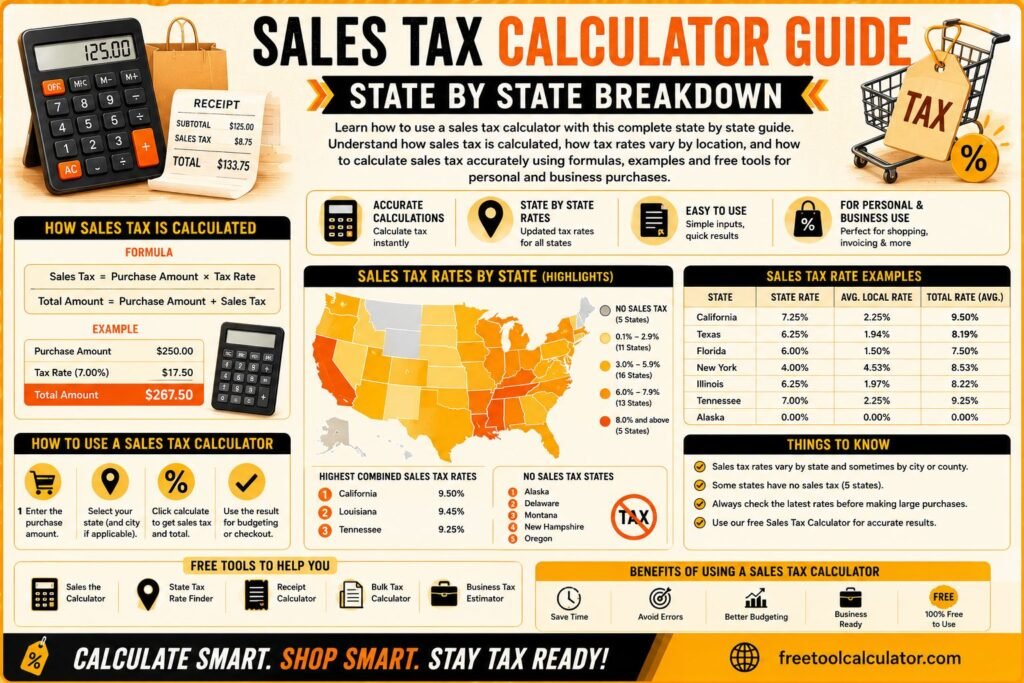
You can also use the sales tax calculator to calculate taxes on purchases and the scientific calculator for more advanced mathematical operations and formulas.
Using multiple calculation tools together helps improve accuracy and makes financial planning much easier.
How Students Can Improve Percentage Calculation Skills
Students improve percentage skills through consistent practice and by understanding concepts rather than memorizing formulas alone.
Working through real world examples such as discounts, grades, salary increases, and business growth makes learning more practical and engaging.
Checking answers with calculators also helps students build confidence and verify calculations.
Strong percentage calculation skills support success in mathematics, economics, finance, and business studies.
Real World Situations Where Percentage Increase Is Used
Percentage increases appear almost everywhere in daily life.
Examples include:
Salary raises
Business revenue growth
Population growth
Inflation rates
Product pricing changes
Investment returns
School grades
Utility bills
Property value increases
Understanding how to calculate percentage increase helps people make better financial and analytical decisions across all these situations.
Conclusion
Learning how to calculate percentage increase is an essential math skill that applies to business, finance, education, investing, and everyday decision making. By comparing growth relative to the original value, percentage increases provide a clearer and more meaningful understanding of change than raw numbers alone.
If you want quick and accurate results, you can use this free percentage calculator along with tools like the sales tax calculator and the scientific calculator to simplify percentage calculations, financial planning, academic work, and everyday math problems.