Budget at Completion Calculation and Why It Matters in Project Management
Budget at completion calculation is a critical concept in project management that helps determine the total planned cost of a project. It represents the estimated budget required to complete a project from start to finish. Understanding how to calculate budget at completion allows project managers to plan resources effectively, control costs, and ensure financial stability throughout the project lifecycle.
When you perform a budget at completion calculation accurately, you gain a clear picture of the financial scope of your project. This helps in making informed decisions, avoiding cost overruns, and maintaining accountability. You can also simplify financial planning by using a budget calculator to track expenses and manage project budgets efficiently.
What Is Budget at Completion and Its Role in Projects
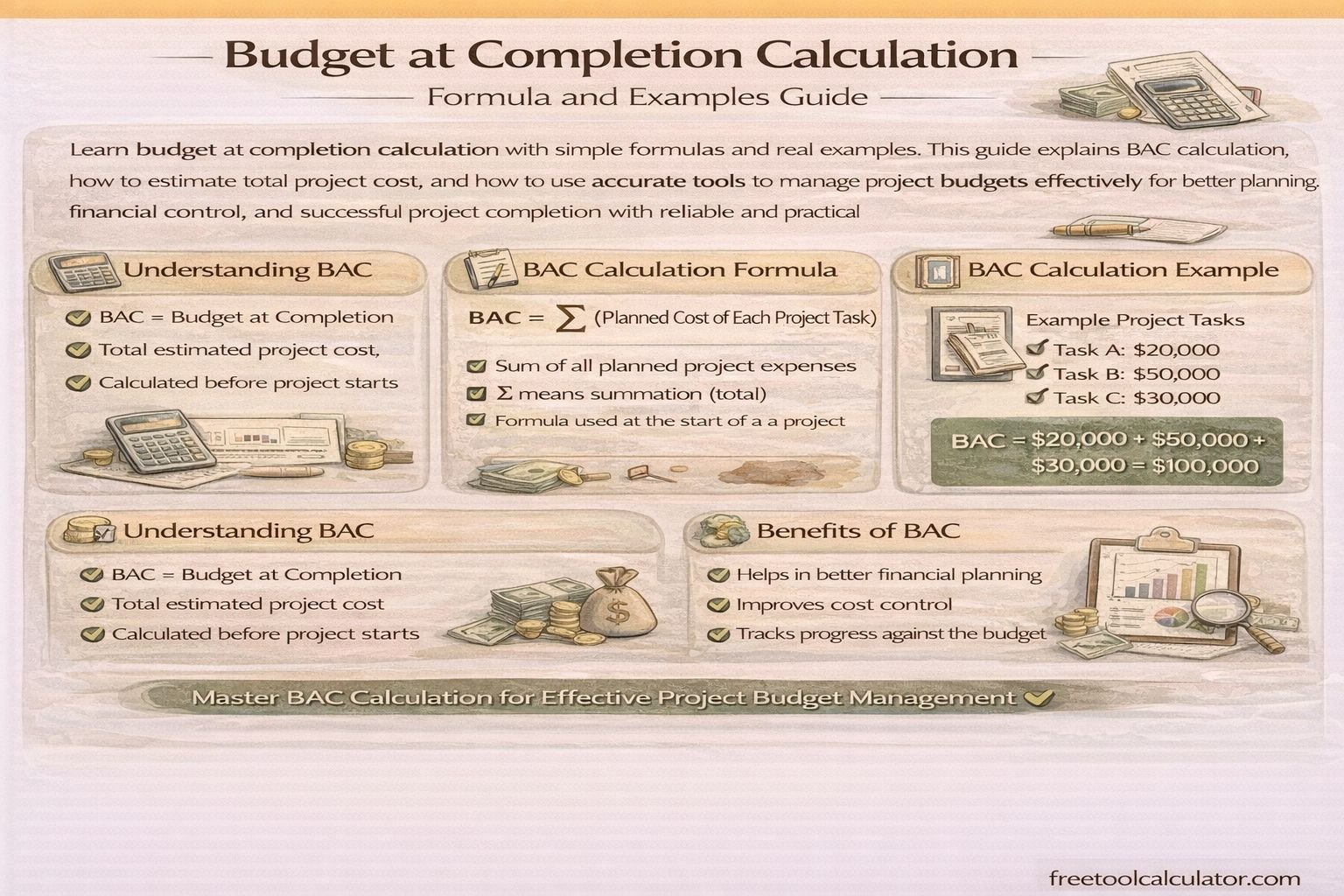
Budget at Completion, commonly known as BAC, is the total approved budget for a project. It includes all costs associated with completing the project, such as labor, materials, and overhead expenses. BAC is a key component of earned value management, a methodology used to measure project performance.
Understanding BAC calculation is essential because it serves as a baseline for evaluating project progress. By comparing actual costs and earned value with BAC, project managers can determine whether the project is on track or facing financial challenges.
This metric is widely used in industries such as construction, IT, and manufacturing, where precise budgeting is crucial. Accurate budget at completion calculation ensures better financial control and improves overall project outcomes.
Budget at Completion Formula Explained
The budget at completion formula is straightforward but powerful. It represents the total planned cost of all project activities. In most cases, BAC is calculated by summing up the estimated costs of all tasks within the project.
Another common formula used in earned value management is based on performance metrics. For example, BAC can be used along with cost performance index to forecast project costs. Understanding these formulas helps in making better financial predictions and adjustments.
To calculate budget at completion effectively, it is important to consider all cost components. This includes direct costs such as materials and labor, as well as indirect costs like administrative expenses.
Step by Step Guide to Calculate Budget at Completion
To calculate budget at completion, start by identifying all project activities. Break down the project into smaller tasks and estimate the cost of each task. This process is known as work breakdown structure.
Next, assign a cost to each activity based on resources required. Add up all these costs to determine the total project budget. This total represents your BAC value.
Once the calculation is complete, review the estimates to ensure accuracy. Adjust the budget if necessary to account for risks and uncertainties. You can also use tools like roi calculator to evaluate the return on investment and ensure your project is financially viable.
Real Examples of BAC Calculation
Understanding budget at completion calculation becomes easier with real examples. Consider a construction project where the estimated cost of materials is 50000, labor is 30000, and overhead is 20000. The total BAC would be 100000.
In another example, a software development project may have costs distributed across different phases such as design, development, and testing. Adding these costs gives the total project budget.
These examples show how BAC calculation helps in determining the overall financial requirement of a project. It also highlights the importance of accurate cost estimation.
Importance of Budget at Completion in Financial Planning
Budget at completion plays a crucial role in financial planning. It provides a clear roadmap for managing project costs and ensures that resources are allocated efficiently.
By understanding how to calculate budget at completion, organizations can avoid unexpected expenses and maintain financial discipline. This is especially important for large projects where even small deviations can lead to significant losses.
Using tools like a break even calculator can help determine when a project will start generating profit, further enhancing financial planning.
Common Mistakes in Budget at Completion Calculation
Many project managers make mistakes when performing BAC calculation. One common error is underestimating costs, which can lead to budget overruns. Another mistake is ignoring indirect costs such as administrative expenses.
Failing to update the budget regularly is another issue. Projects often change over time, and the budget should be adjusted accordingly. Using accurate tools and methods can help avoid these mistakes and ensure reliable results.
Proper planning and regular monitoring are essential for successful budget at completion calculation. This helps maintain control over project finances and reduces risks.
Advanced Concepts Related to BAC Calculation
Advanced project management techniques use BAC in combination with other metrics such as earned value and cost performance index. These metrics provide deeper insights into project performance and help in forecasting future costs.
For example, if a project is over budget, managers can use these metrics to identify the cause and take corrective actions. This approach improves decision making and enhances project efficiency.
Using financial tools like a profit margin calculator can also help in analyzing profitability and ensuring that the project meets financial goals.
Best Practices for Accurate Budget at Completion Calculation
To achieve accurate results, always start with detailed planning. Break down the project into smaller tasks and estimate costs carefully. Use historical data and expert judgment to improve accuracy.
Regular monitoring is also important. Track actual costs and compare them with the planned budget to identify any deviations. This allows you to take corrective actions in time.
Using reliable tools and software can further enhance accuracy. For example, financial calculators and project management tools simplify calculations and provide real time insights.
How Budget at Completion Supports Project Success
Budget at completion calculation is not just a financial metric but a key factor in project success. It helps in setting realistic goals, managing resources, and ensuring accountability.
By understanding BAC calculation, project managers can make informed decisions and avoid financial risks. This leads to better project outcomes and improved stakeholder satisfaction.
Combining BAC with other financial tools, such as a loan emi calculator, can help manage funding and ensure smooth project execution.
Conclusion Mastering Budget at Completion Calculation
Budget at completion calculation is an essential skill for anyone involved in project management. It provides a clear understanding of project costs and helps in effective financial planning.
By learning how to calculate budget at completion and applying best practices, you can ensure accurate budgeting and successful project execution. If you want to simplify your calculations, you can use a budget calculator to manage your project finances efficiently and achieve better results.