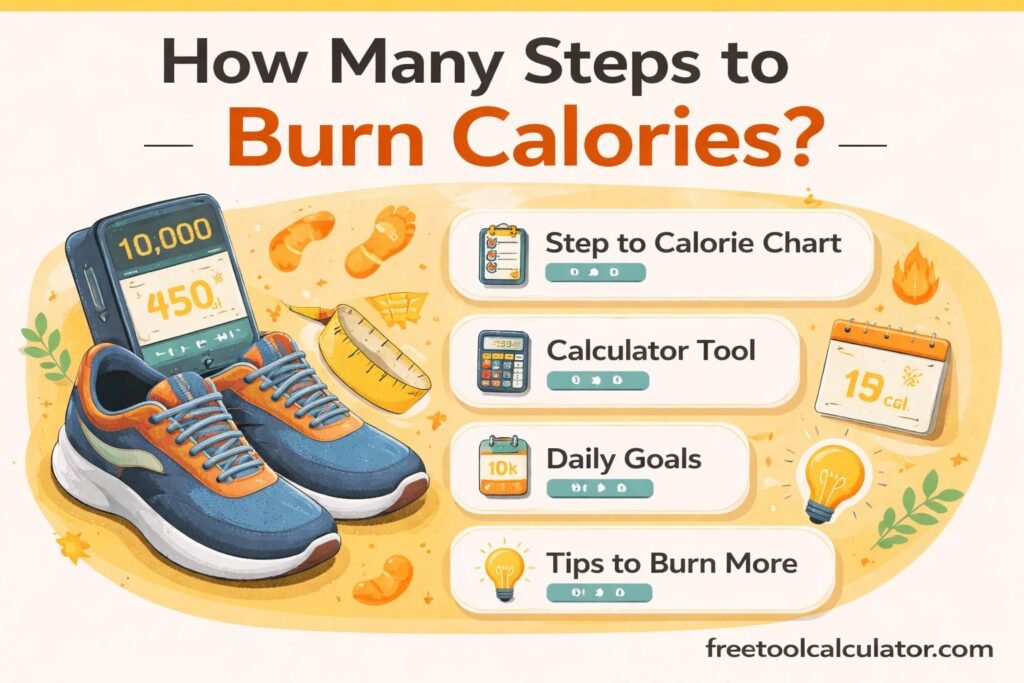
Use our Steps to Calories Converter to estimate how many calories you may burn from walking based on your step count, body weight, walking pace, and step length. The calculator also estimates the distance covered and the approximate time spent walking.
Calories burned from walking can vary between individuals, so the results should be treated as estimates rather than exact measurements. Factors such as body weight, walking speed, terrain, fitness level, movement efficiency, and individual physiology can influence actual energy expenditure.
How to Use the Steps to Calories Converter
Enter a few details about your walk to estimate calories burned, distance, and walking time.
Step 1: Enter Your Steps
Enter the total number of steps you walked.
You can get your step count from a smartphone, smartwatch, fitness tracker, pedometer, or another step-tracking device.
Step 2: Enter Your Body Weight
Enter your body weight in kilograms.
Body weight is used because moving a greater body mass generally requires more energy during the same activity.
Step 3: Select Your Walking Pace
Choose the walking pace that most closely represents your activity.
Walking pace affects both estimated walking time and energy expenditure, so select the option that best matches how you walked.
Step 4: Enter Your Step Length
Enter your estimated step length in meters.
Step length is the approximate distance traveled with each step and is used to calculate total walking distance.
If you do not know your exact step length, you can use a reasonable estimate, but remember that this will make the calculated distance less precise.
Step 5: Calculate Your Results
Select Convert Steps to see your estimated:
- Calories burned
- Walking distance
- Walking time
These values are estimates based on the information you provide and the assumptions used by the calculator.
How Are Steps Converted to Calories?
There is no universal number of calories burned per step.
Two people can walk the same number of steps and burn different amounts of energy because calorie expenditure is influenced by factors such as body weight, pace, walking duration, terrain, and individual movement efficiency.
For this reason, our converter does not simply multiply your step count by a fixed “calories per step” value.
Instead, it uses your step count and step length to estimate distance, uses walking pace to estimate time, and applies a MET-based calculation to estimate energy expenditure.
How the Steps to Calories Calculator Works
The calculation can be understood in three main stages:
- Convert steps into estimated distance
- Estimate walking time from distance and pace
- Estimate calories burned using body weight, walking duration, and a MET value associated with the selected walking pace
Steps to Distance Formula
The calculator estimates distance using:
Distance (meters) = Number of Steps × Step Length (meters)
To convert meters to kilometers:
Distance (km) = Steps × Step Length ÷ 1,000
For example, suppose you walk 10,000 steps with an average step length of 0.75 meters.
10,000 × 0.75 = 7,500 meters
7,500 ÷ 1,000 = 7.5 km
The estimated walking distance would therefore be 7.5 kilometers.
Walking Time Estimate
Once distance has been estimated, walking pace can be used to estimate how long the walk would take.
The general relationship is:
Walking Time = Distance ÷ Walking Speed
Because the calculator uses pace categories, the result is an approximation rather than a measurement of your actual walking time.
Stopping, changes in speed, hills, traffic, and other real-world conditions can affect actual duration.
Calories Burned Formula
The calculator uses a MET-based estimate for walking energy expenditure.
MET stands for Metabolic Equivalent of Task and is a way of describing the energy cost of an activity relative to resting energy expenditure.
A commonly used MET-based calorie equation is:
Calories Burned = MET × 3.5 × Body Weight (kg) ÷ 200 × Duration (minutes)
The MET value changes according to the walking intensity or pace selected.
This means the estimate considers more than just the number of steps taken.
Steps to Calories Calculation Example
Suppose a person records 10,000 steps.
For this example:
- Steps = 10,000
- Body weight = 70 kg
- Step length = 0.75 m
- Walking pace = selected walking pace in the calculator
Step 1: Estimate Distance
10,000 × 0.75 = 7,500 meters
Estimated distance:
7.5 km
Step 2: Estimate Walking Time
The calculator uses the selected walking pace to estimate approximately how long it would take to cover the calculated distance.
A faster pace results in a different walking duration and MET value than a slower pace.
Step 3: Estimate Calories Burned
The calculator then combines:
- Body weight
- Estimated walking duration
- MET value for the selected pace
to estimate calories burned.
Because the final result depends on all of these inputs, 10,000 steps does not equal the same number of calories for everyone.
How Many Calories Do Steps Burn?
There is no single accurate calorie value for a specific number of steps.
You may see general estimates online that assign a fixed number of calories to 1,000, 5,000, or 10,000 steps. These figures can be useful as rough examples, but they should not be treated as universal values.
The number of calories associated with a step count can change according to:
- Body weight
- Walking pace
- Walking duration
- Step length
- Terrain and incline
- Movement efficiency
- Fitness level
- Individual physiology
Using your own weight, pace, and estimated step length provides a more individualized estimate than applying the same calories-per-step number to everyone.
How Many Calories Does 10,000 Steps Burn?
There is no single calorie value that applies to everyone who walks 10,000 steps.
For example, two people may both record 10,000 steps but have different:
- Body weights
- Step lengths
- Walking speeds
- Walking durations
- Routes and terrain
As a result, their estimated calorie expenditure may differ.
Enter 10,000 in the calculator along with your body weight, pace, and step length to get an estimate based on your information.
How Many Calories Does 5,000 Steps Burn?
The calories associated with 5,000 steps depend on the same factors that affect any walking-calorie estimate, particularly body weight and walking intensity.
Instead of assuming a fixed calorie value, enter 5,000 steps into the converter and provide your weight, pace, and step length.
The calculator will estimate calories burned along with approximate distance and walking time.
How Many Calories Does 1,000 Steps Burn?
A fixed calories-per-1,000-steps figure cannot accurately represent every individual.
A person’s weight, pace, stride characteristics, and other factors influence energy expenditure.
For a more personalized estimate, enter 1,000 steps along with your other information in the calculator.
Why Body Weight Affects Calories Burned
Body weight is one of the variables used in MET-based calorie calculations.
In general, moving a greater body mass during the same activity requires more energy. This means two people walking for the same amount of time at a similar intensity may receive different calorie estimates if their body weights differ.
However, body weight alone does not determine energy expenditure. Walking intensity, duration, terrain, movement efficiency, and individual characteristics also matter.
Why Walking Pace Matters
Walking pace influences the intensity of the activity.
A slow walk and a brisk walk are not physiologically identical activities, even when the total step count is the same.
The calculator therefore uses your selected walking pace when estimating energy expenditure.
Keep in mind that a pace category is still an approximation. If your speed changed substantially during your walk, the estimate may not perfectly represent the entire activity.
Why Step Length Matters
Step length helps convert your number of steps into an estimated distance.
For example, two people may each walk 10,000 steps, but a person with a longer average step length may cover a greater distance.
This is why the calculator asks for step length instead of assuming that every step covers exactly the same distance.
How to Estimate Step Length
One practical way to estimate average step length is to:
- Measure a known distance.
- Walk the distance naturally.
- Count the number of steps taken.
- Divide the distance by the number of steps.
For example, if you walk 20 meters in 27 steps:
20 ÷ 27 ≈ 0.74 meters per step
Your estimated average step length would be approximately 0.74 meters.
Because step length can change with speed, terrain, fatigue, and walking style, this should still be treated as an estimate.
Steps vs. Distance vs. Calories
Steps, distance, and calories measure different aspects of physical activity.
Steps
Step count measures how many steps were recorded.
Distance
Distance estimates how far those steps carried you.
In this calculator, distance is estimated using your step count and step length.
Calories
Calories estimate the amount of energy expended during the activity.
The calorie estimate requires additional information because step count alone does not tell us exactly how much energy was used.
This is why two people can record the same number of steps but receive different calorie estimates.
Steps to Calories and Daily Energy Expenditure
Calories burned through walking contribute to your overall daily energy expenditure.
However, walking is only one component of the energy your body uses throughout the day.
Daily energy expenditure also includes energy required for basic physiological functions and other daily activities.
If you want to estimate your broader daily energy expenditure, use our TDEE Calculator.
Your TDEE is an estimate of your total daily energy expenditure rather than only the calories associated with walking.
Steps to Calories and a Calorie Deficit
Walking contributes to energy expenditure, but a walking-calorie estimate should not automatically be treated as the amount of food you should add or subtract from your diet.
Energy balance involves both energy intake and total energy expenditure.
If you already know your estimated maintenance calories and want to explore the mathematical effect of reducing calorie intake by a selected percentage, use our Calorie Deficit Calculator.
The results from both tools are estimates and should not be interpreted as personalized dietary recommendations.
What Factors Affect Calories Burned While Walking?
Several factors can affect actual walking energy expenditure.
Body Weight
Body weight is directly included in the calculator’s MET-based calorie estimate.
Walking Speed
Walking at different speeds changes activity intensity and therefore the MET value associated with the activity.
Walking Duration
Longer periods of activity generally result in greater total energy expenditure when other factors remain similar.
Step Length
Step length affects estimated distance and therefore the estimated duration used by the calculator.
Terrain
Walking uphill, downhill, on trails, on sand, or on uneven ground can require a different amount of energy than walking on a level surface.
Carrying Additional Weight
Walking while carrying a backpack or other load may change energy expenditure.
Individual Differences
Fitness level, movement efficiency, body composition, gait, and other physiological differences can affect actual energy expenditure.
Not every factor can be represented by a simple online calculator.
MET Values and Walking Calories
MET stands for Metabolic Equivalent of Task.
MET values provide standardized estimates of the energy cost of different activities and activity intensities.
A higher MET value generally represents a more energy-demanding activity.
For example, slow walking and faster walking can have different MET values because the activities require different levels of effort.
Our calculator uses a MET associated with the selected walking pace and combines it with body weight and estimated duration to calculate approximate energy expenditure.
MET values represent population-based estimates. They do not directly measure your personal oxygen consumption or metabolism.
Why Your Fitness Tracker May Show a Different Result
Your smartwatch, smartphone, treadmill, pedometer, or fitness app may display a different calorie value from this calculator.
That does not necessarily mean either result is incorrect.
Different devices and calculators may use different information and algorithms, including:
- Heart rate
- Age
- Sex
- Body weight
- GPS distance
- Walking speed
- Elevation
- Step length
- Device-specific algorithms
- Resting energy expenditure
- Activity intensity
This calculator uses the inputs shown on the page and a MET-based estimation method.
Because calculation methods differ, results from different devices should not be expected to match exactly.
Methodology & Limitations
The Steps to Calories Converter estimates walking calories rather than directly measuring them.
Its calculation process uses:
Estimated Distance = Steps × Step Length
Walking pace is then used to estimate duration, and a MET-based equation is applied to estimate calorie expenditure:
Calories Burned = MET × 3.5 × Body Weight (kg) ÷ 200 × Duration (minutes)
Important Limitations
This calculator:
- Does not directly measure energy expenditure
- Does not measure oxygen consumption
- Does not use heart-rate data
- Does not automatically measure terrain or incline
- Cannot account for every individual physiological difference
- Depends on the accuracy of the information entered
- Uses estimated walking pace and MET values
- Provides an estimate rather than an exact calorie measurement
Step length can also vary throughout a walk, particularly when speed or terrain changes.
The results should therefore be used as a general estimate of walking energy expenditure.
Related Walking, Activity & Calorie Calculators
Calories Burned Calculator
Estimate calories burned from different exercises and physical activities using your body weight, activity duration, and MET values.
Use the Calories Burned Calculator
Workout Calorie Burn Calculator
Add multiple exercises to estimate the total calories associated with a complete workout.
Use the Workout Calorie Burn Calculator
TDEE Calculator
Estimate your Total Daily Energy Expenditure based on the information requested by the calculator.
Calorie Deficit Calculator
Use your estimated maintenance calories to calculate a selected daily calorie deficit and target intake.
Calorie Surplus Calculator
Estimate a calorie target above your entered maintenance calories.
Frequently Asked Questions
How do I convert steps to calories?
Converting steps to calories requires more information than step count alone.
This calculator first estimates distance using your steps and step length. It then uses walking pace to estimate duration and applies a MET-based equation using your body weight to estimate calorie expenditure.
How many calories does 10,000 steps burn?
There is no single calorie value for 10,000 steps.
Calories burned depend on factors such as body weight, walking pace, duration, step length, terrain, and individual physiology.
Enter 10,000 steps into the calculator with your information to receive an individualized estimate based on the calculator’s methodology.
How many calories does 5,000 steps burn?
The calorie estimate for 5,000 steps varies between individuals.
Enter 5,000 steps, your body weight, walking pace, and step length into the calculator to estimate calories burned, distance, and walking time.
How many calories does 1,000 steps burn?
There is no universal calories-per-1,000-steps value.
Body weight, walking intensity, step length, duration, and other factors can change energy expenditure.
Use the calculator with 1,000 steps and your own information for an estimate.
Does walking speed affect calories burned?
Yes. Walking speed affects activity intensity and is one of the factors considered when estimating energy expenditure.
The calculator uses the walking pace you select to determine the appropriate calculation inputs.
Does body weight affect calories burned while walking?
Body weight is included in the MET-based calorie formula. People with different body weights can therefore receive different calorie estimates even when walking for a similar duration and intensity.
Why does my smartwatch show a different calorie result?
Fitness trackers and online calculators can use different algorithms and inputs.
A wearable device may incorporate heart rate, GPS, age, elevation, or other information that this calculator does not use.
For that reason, calorie estimates from different tools may not match exactly.
Are calories burned from steps accurate?
They are estimates.
Accurately measuring individual energy expenditure requires methods that an online calculator cannot reproduce. This tool uses your entered information and a MET-based calculation to provide a practical estimate.
Can walking help create a calorie deficit?
Walking contributes to daily energy expenditure and can therefore influence overall energy balance.
However, whether someone is in a calorie deficit depends on total energy intake compared with total energy expenditure, not step count alone.
If you know your estimated maintenance calories, you can use our Calorie Deficit Calculator to explore the mathematical relationship between maintenance calories and a selected deficit.
Should I eat back the calories shown by this calculator?
The calorie result is an estimate and should not automatically be treated as an exact amount of additional food to consume.
Exercise energy expenditure and total daily energy needs can both be difficult to estimate precisely. If you need individualized dietary guidance, consult an appropriately qualified healthcare professional or registered dietitian.
Health & Fitness Disclaimer
The Steps to Calories Converter and its supporting information are provided for general informational and educational purposes only.
The calculator estimates calories burned using the information entered and the calculation assumptions described above. It does not directly measure your metabolism or actual energy expenditure.
Results may differ from actual calorie expenditure and from values displayed by fitness trackers, smartwatches, exercise equipment, or other calculators.
The information provided by this calculator is not medical advice, a diagnosis, an exercise prescription, or an individualized nutrition recommendation.
If you have a medical condition, take medication, are pregnant or breastfeeding, have concerns about exercise or nutrition, or need advice tailored to your circumstances, consult an appropriately qualified healthcare professional.