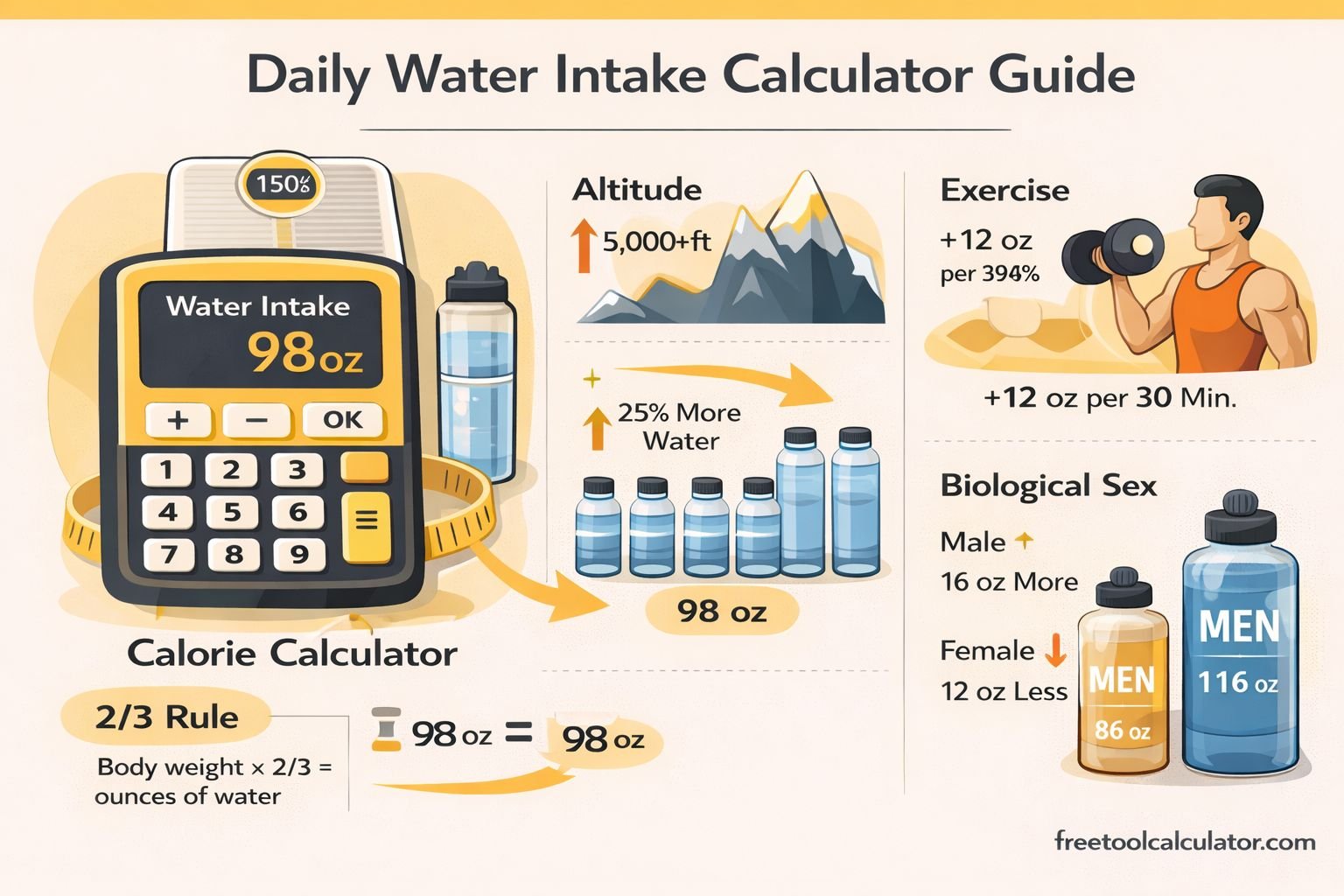
Daily Water Intake Calculator and what this blog will explain
A Daily Water Intake Calculator is a practical tool for determining individualized fluid requirements that support metabolic function, temperature regulation, digestion, and performance. In this blog, you will learn how body weight determines the exact number of ounces of water you should drink, what the “2/3 of your weight” rule means for baseline hydration, whether water calculators adjust for altitude and why hydration needs increase in mountainous regions, how much extra water to add for every 30 minutes of intense exercise, and how biological sex affects hydration needs according to the National Academies of Sciences. The goal of this medically accurate guide is to help you understand the science behind hydration recommendations and how to apply them using validated tools.
To estimate your daily fluid requirement based on your weight, activity, and environment, you can use our free and easy Daily Water Intake Calculator to receive personalized guidance instantly.
How body weight determines the exact number of ounces you should drink
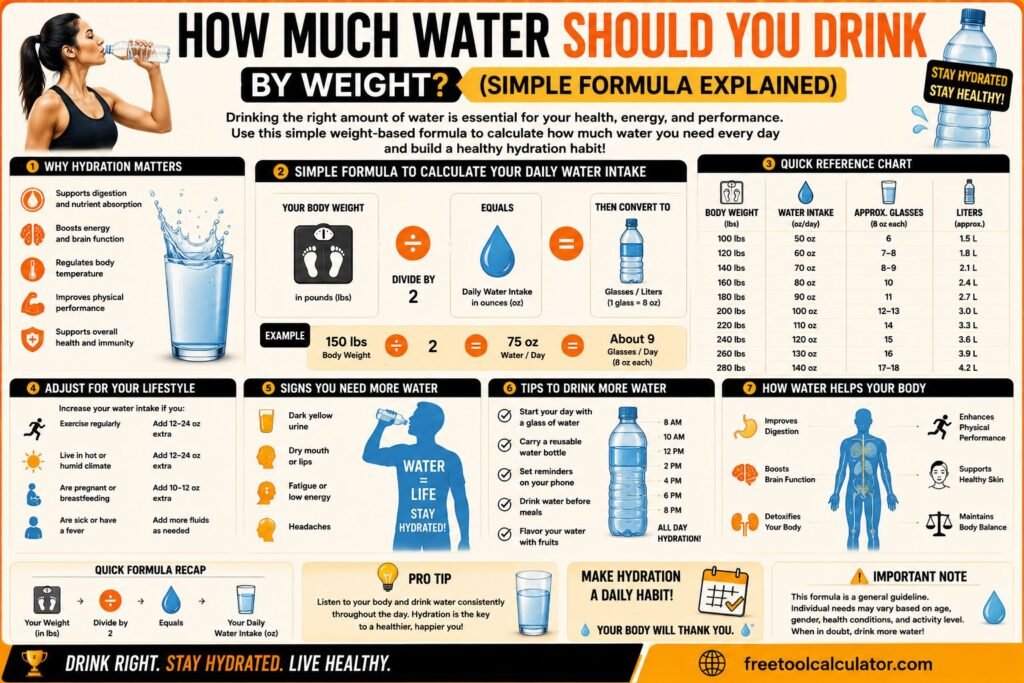
Hydration needs are tied to overall body mass because a larger body has a greater volume of tissues, higher total metabolic activity, and often greater surface area for evaporative water loss. Scientific hydration formulas use body weight as a foundational variable because it correlates with total body water (“TBW”), which includes intracellular and extracellular fluid compartments essential for homeostasis.
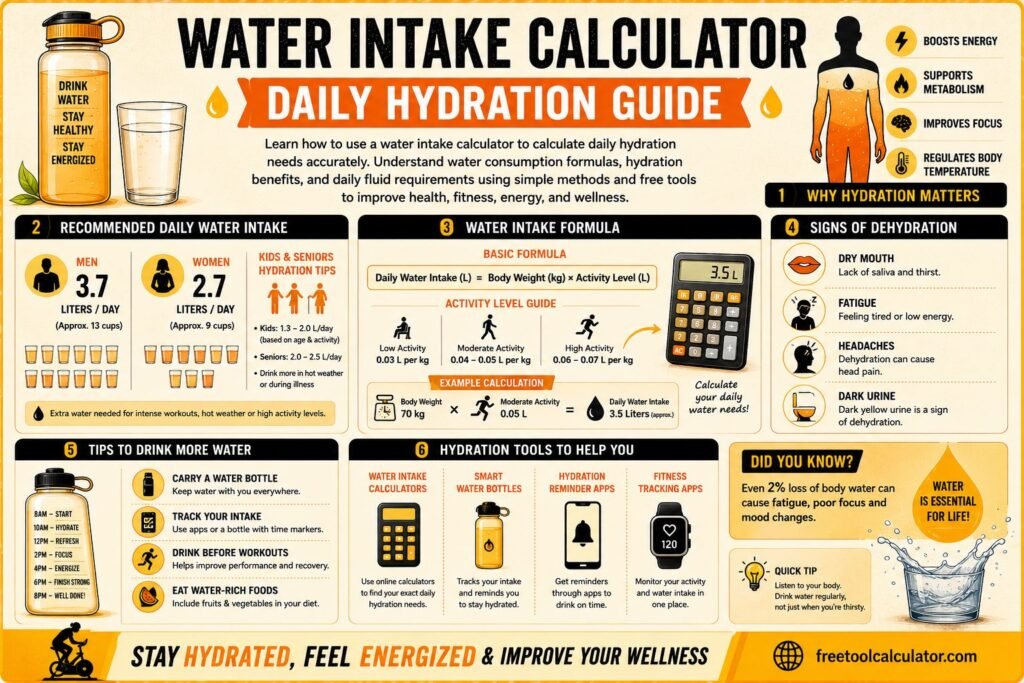
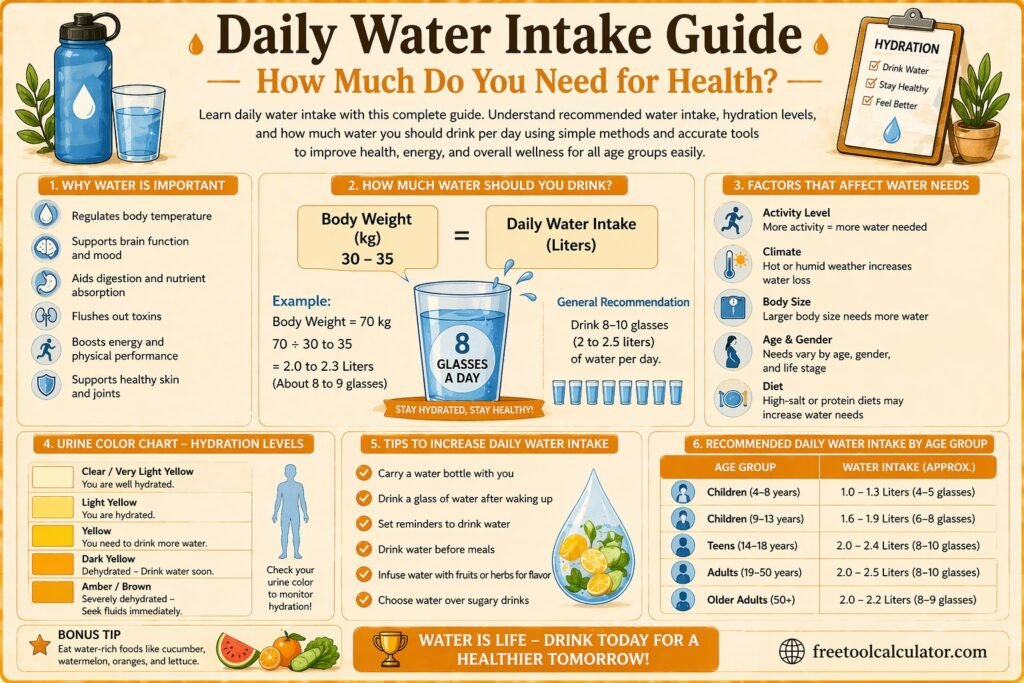
The most common clinical approach estimates baseline fluid needs using a weight-based formula. As an example, one widely referenced hydration target suggests that people drink approximately 30 to 35 milliliters of water per kilogram of body weight per day. When converted to ounces, this roughly aligns with the rule of thumb that hydration volume increases proportionally with body mass.
In practice, this means that someone weighing 70 kilograms (154 pounds) might require a baseline target near 70 × 30–35 mL = 2100–2450 mL daily, which is about 71–83 ounces of fluid per day. A Daily Water Intake Calculator refines this baseline by incorporating other individual factors such as activity and environment.
What is the “2/3 of your weight” rule for calculating baseline hydration
The “2/3 of your weight” rule is a simple heuristic sometimes used to give a quick estimate of daily fluid needs. It states that you can calculate baseline daily water intake in ounces by multiplying your weight in pounds by two-thirds (0.67).
For example:
Weight in pounds × 0.67 = ounces of water per day
If a person weighs 150 pounds:
150 × 0.67 ≈ 100 ounces of water per day
This rule is not derived from formal physiology but offers a reasonable approximation for many individuals in typical temperate environments with moderate activity. It simplifies the translation of weight to fluid volume by using a factor that aligns closely with empirical hydration ranges recommended by clinical guidelines when converted from milliliters per kilogram.
It is important to recognize that the 2/3 rule provides an approximation, and precise needs vary based on individual metabolism, body composition, activity level, climate, and health conditions. The advantage of using a Daily Water Intake Calculator is that it integrates weight with other factors to generate a tailored hydration target rather than relying on a single conversion factor.
Do water calculators account for altitude, and why do you need more water in the mountains?
Yes — many validated water requirement models and hydration calculators adjust for altitude because physiological demands change significantly at higher elevations.
Physiological effects of altitude on hydration
At altitudes above approximately 2,500 feet (760 meters), barometric pressure decreases, which leads to:
Increased respiratory water loss due to higher ventilation rates
Greater urine output (altitude diuresis)
Accelerated dehydration risk from dry air and increased metabolic stress
These factors increase total water loss independent of activity level.
How altitude is integrated in hydration estimation
Water intake recommendations at altitude often suggest adding additional ounces per day based on the elevation of residence or activity. For example, a modest adjustment might call for an extra 8–16 ounces (240–480 mL) of water daily when above 5,000 feet (1,520 meters), especially if combined with increased respiration or sun exposure.
Because fluid balance is influenced by both insensible losses (breathing and skin evaporation) and physical exertion, a Daily Water Intake Calculator that accounts for altitude provides a more accurate daily fluid recommendation than a weight-only rule.
How much extra water should I add for every 30 minutes of intense exercise?
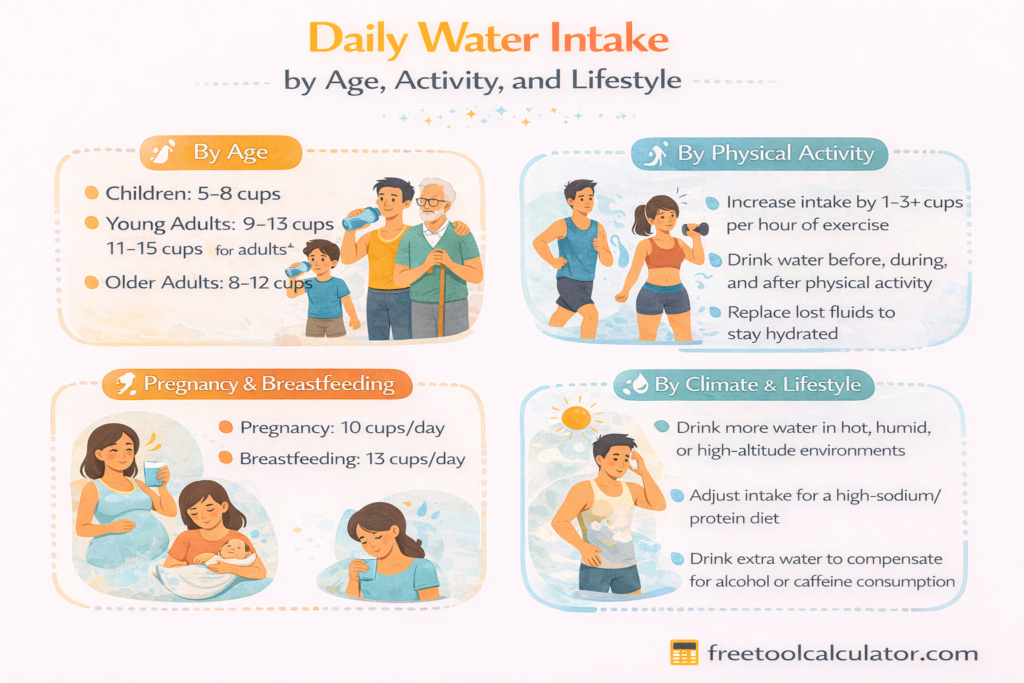
Physical activity increases fluid loss through sweating and elevated respiration. The precise additional water needed depends on the intensity of exercise, ambient temperature, humidity, and individual sweat rate. However, clinical hydration guidance commonly estimates that individuals lose approximately 12–20 ounces (350–600 mL) of fluid for every 30 minutes of vigorous exercise.
Intensity, temperature, and sweat rate
In hot and humid conditions, sweat rates increase further, and fluid losses may exceed 1 liter per hour.
In cooler environments, sweat rates remain lower but still add measurable fluid losses beyond baseline.
Because fluid needs accumulate throughout a day, it is recommended to add the exercise-related volume to your baseline water goal. For example, if your baseline need is 80 ounces and you engage in 60 minutes of intense exercise, you might add 24–40 ounces for that activity session.
Daily Water Intake Calculator models this by allowing you to specify exercise duration and intensity, which improves the accuracy of your personalized hydration plan.
How biological sex affects hydration needs according to the National Academies of Sciences
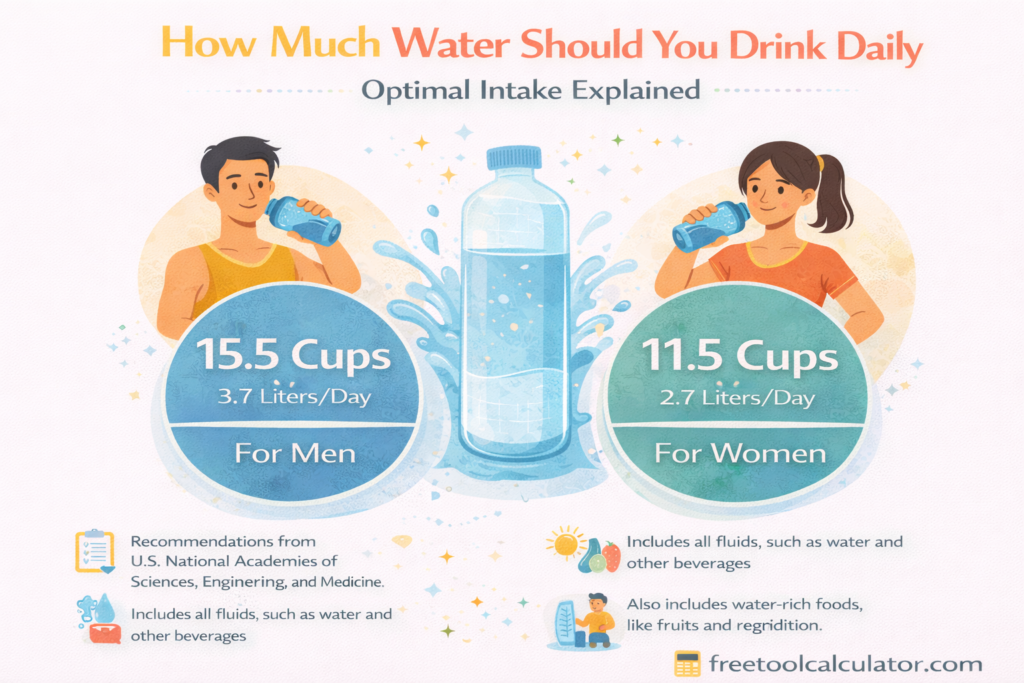
The National Academies of Sciences, Engineering, and Medicine (NASEM) provides evidence-based daily water intake recommendations that differ by biological sex due to differences in average body composition, metabolic rate, and hormonal influences on fluid balance.
General daily fluid intake recommendations
In standard adult populations under temperate climate conditions:
Men are advised to consume roughly 3.7 liters (125 ounces) of total water per day
Women are advised to consume roughly 2.7 liters (91 ounces) of total water per day
These totals include water from beverages as well as water contained in food.
Physiological reasons for differences
Men typically have greater lean body mass, which is associated with higher metabolic water turnover
Women tend to have proportionally more adipose tissue, which contains less water than lean tissue
Hormonal shifts across the menstrual cycle can influence fluid retention and thirst responsiveness, although these effects are variable
These differences are reinforced by evidence that metabolic rate and average energy expenditure (and therefore fluid turnover) are, on average, higher in males than in females, necessitating a higher baseline water requirement.
A Daily Water Intake Calculator incorporates sex as a key variable, ensuring that the personalized recommendation reflects these physiological differences rather than assuming a one-size-fits-all target.
How to use a Daily Water Intake Calculator effectively
A reliable Daily Water Intake Calculator guides you through entering:
Body weight
Biological sex
Age
Activity level and exercise duration
Altitude or environmental conditions
The tool then integrates these variables into a mathematically grounded recommendation that reflects personalized hydration needs for health, performance, and metabolic stability.
Using this tailored approach reduces guesswork, prevents both dehydration and unnecessary overhydration, and supports daily planning that aligns with your lifestyle and environment.
Final medical conclusion
Personalized hydration recommendations are rooted in established physiology. Body weight serves as a primary determinant of fluid requirements because it correlates with total body water and metabolic activity. The “2/3 of your weight” rule provides a simple estimate, but it does not account for individual variability due to altitude, exercise intensity, or biological sex. Altitude increases respiratory water loss, exercise raises sweat-related fluid losses, and sex-specific differences in composition and metabolism affect baseline needs. Validated tools like the Daily Water Intake Calculator integrate these factors to produce accurate, individualized hydration targets that support overall health, physical performance, and metabolic balance.