Summary
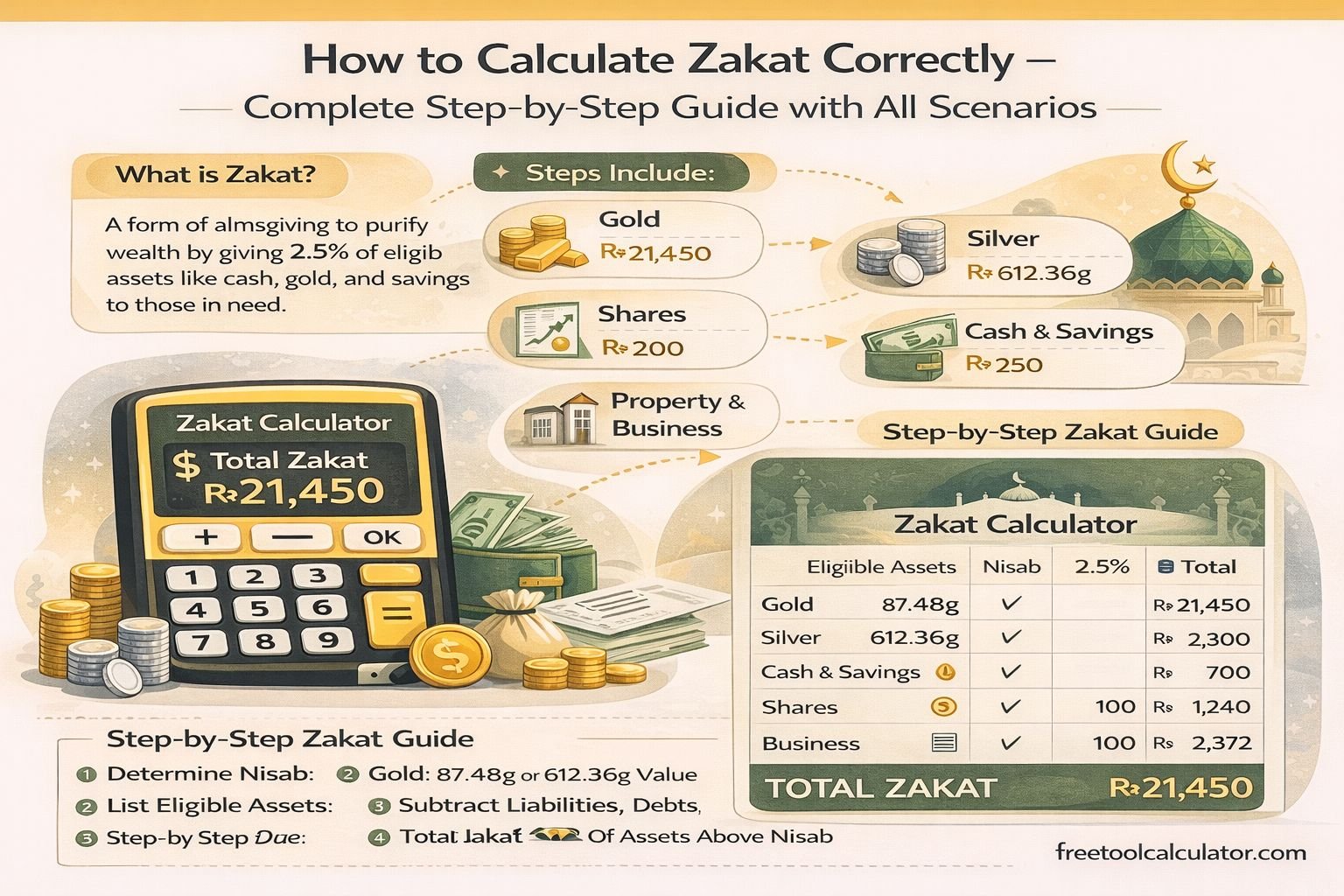
This guide explains how to calculate Zakat in a correct and simple way using proper scholarly rules and easy examples. It covers Nisab, Zakat formula, and all major asset types like cash, gold, silver, shares, savings, business stock, property, and loans. It is written so even a young student can understand and use a Zakat Calculator confidently.
What Is Zakat and Why It Must Be Calculated Correctly
Zakat is one of the five pillars of Islam and a compulsory duty on eligible Muslims. It is not optional charity — it is an obligation on wealth that reaches Nisab and remains for one lunar year. Zakat purifies your wealth and supports the needy. A correct Zakat calculation ensures your duty is fulfilled and your worship is valid. Think of it as a yearly purification of savings and growth assets.
Basic Rule of Zakat Calculation
Zakat is charged at 2.5% on net zakatable wealth.
Zakat Formula
Total Zakatable Assets − Immediate Debts = Net Assets
Net Assets × 2.5% = Zakat Payable
In simple words: add your savings-type wealth, subtract what you must pay now, then take 2.5%.
What Is Nisab (Minimum Threshold)
Nisab is the minimum wealth level before Zakat becomes obligatory.
Nisab Standards
Gold Nisab = 87.48 grams
Silver Nisab = 612.36 grams
Nisab Calculation Formula
Nisab Value = Metal price per gram × Nisab grams
If your net wealth is above Nisab for one lunar year, Zakat is due. Many scholars recommend using silver Nisab to help more poor people qualify for support.
Which Assets Are Subject to Zakat
Zakatable Assets List
Cash at home, bank balances, gold and silver, trade goods and shop stock, business cash, shares bought for trading, receivable loans, saved rental income, investment funds. Rule to remember: personal use items are not zakatable but savings and growth assets are.
Non-Zakatable Personal Items
Primary house, personal car or bike, clothes and furniture, personal electronics, daily living items. These are necessities and are exempt from Zakat.
How to Calculate Zakat on Cash and Savings
All cash and bank balances are fully zakatable. Use your balance on your Zakat due date, not the yearly average.
Example
Cash = 2,000
Bank = 8,000
Total = 10,000
Zakat = 10,000 × 2.5% = 250
How to Calculate Zakat on Gold
Gold is zakatable at current market value, not purchase price. Include bars, coins, and according to some scholars, jewelry.
Gold Zakat Formula
Gold grams × current price × 2.5%
Example
120g × $60 = 7,200
Zakat = 180
How to Calculate Zakat on Silver
Silver follows the same method as gold and is fully zakatable.
Silver Formula
Silver grams × market price × 2.5%
Example
900g × $1 = 900
Zakat = 22.5
Zakat on Jewelry – Scholarly View
There is a valid difference among scholars. Many say personal jewelry is exempt if it is in normal use. Hanafi scholars say gold and silver jewelry is zakatable even if worn. A careful and rewarding approach is to include it in your Zakat Calculator unless you follow a specific opinion.
How to Calculate Zakat on Shares and Stocks
Treatment depends on intention.
If Bought for Trading
Pay Zakat on full market value. Shares value × 2.5%.
If Long-Term Investment
Pay on zakatable asset portion of the company or on saved dividends using the simplified method many scholars allow.
How to Calculate Zakat on Business Assets
Business inventory is zakatable at current selling price, not cost price. Include stock, business cash, and receivables.
Business Zakat Formula
Stock + business cash + receivables − payables = Net
Net × 2.5% = Zakat
Example
Stock = 15,000
Cash = 3,000
Receivable = 2,000
Payable = 5,000
Net = 15,000
Zakat = 375
Zakat on Property, House, Car, and Bike
Primary Residence
No Zakat because it is a necessity for living.
Personal Car or Bike
No Zakat because it is for personal transport.
Property Scenarios
House for living has no Zakat. House for resale has Zakat on full market value. Rental property has Zakat only on saved rental income, not on the building value.
How to Calculate Zakat on Rental Income
Only saved profit from rent is zakatable after expenses are deducted.
Saved rental money × 2.5%
Example: saved rent = 4,000 → Zakat = 100
Zakat on Loans You Gave
If you expect repayment, it is zakatable wealth.
Strong loan likely returned is counted yearly. Weak loan is paid when received. Bad debt has no Zakat unless recovered. Formula is loan amount × 2.5%.
Zakat on Savings for Hajj, Marriage, or Education
Purpose does not remove Zakat duty. If the savings stay above Nisab for one lunar year, Zakat applies even if you are saving for Hajj or marriage.
Debts You Can Deduct Before Zakat
Allowed Deductions
Bills due now, short-term loans, credit card balances, supplier invoices.
Not Deducted
Long mortgages, future installments, long-term structured debt. Only subtract what is immediately payable.
Full Zakat Calculation Example (Combined Scenario)
Cash = 3,000
Bank = 6,000
Gold = 5,000
Shares = 4,000
Saved rent = 2,000
Loan given = 1,000
Total = 21,000
Immediate debts = 3,000
Net = 18,000
Zakat = 18,000 × 2.5% = 450
When Zakat Should Be Paid
Zakat becomes due after one lunar year above Nisab. Fix a yearly Islamic date as your Zakat date and calculate every year on that date. Pay promptly once due. Advance payment is also allowed.
Simple Memory Method for Students
If you use it daily there is no Zakat. If you save it there is Zakat. If you trade it there is Zakat. If it is gold or silver there is Zakat. If it is business stock there is Zakat. Using a Zakat Calculator makes the process easier and reduces mistakes.