What is a Pythagorean theorem calculator
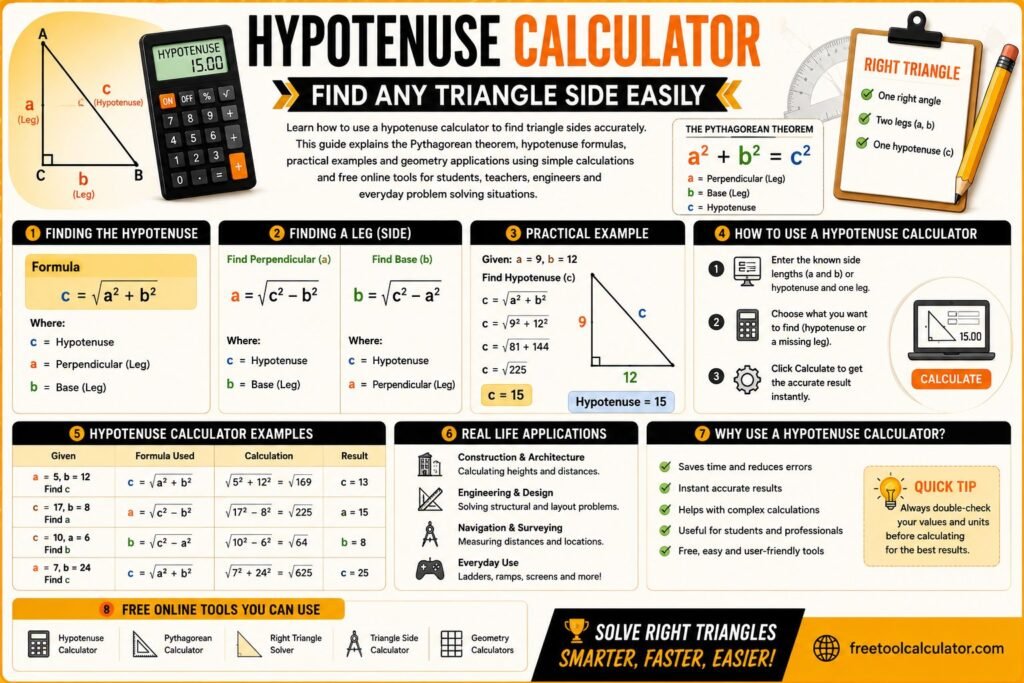
A Pythagorean theorem calculator is a math tool used to calculate the missing side of a right angled triangle. It is based on the Pythagorean theorem which relates the three sides of the triangle. This calculator automates the formula to give instant and accurate results. It is commonly used in geometry mathematics and engineering.
What is the Pythagorean theorem
The Pythagorean theorem states that in a right angled triangle the square of the hypotenuse equals the sum of the squares of the other two sides. It is written as a squared plus b squared equals c squared. This theorem applies only to right triangles. It is one of the most fundamental rules in geometry.
How does a Pythagorean theorem calculator work
The calculator takes the values of any two sides of a right triangle. It then applies the Pythagorean formula to calculate the missing side. If the hypotenuse is unknown it calculates c using a and b. If a leg is unknown it rearranges the formula automatically.
What information do I need to use this calculator
You need to enter the length of any two sides of a right triangle. These can be the base and height or one side and the hypotenuse. All values should be in the same unit. The calculator handles the rest automatically.
Can I calculate the hypotenuse using this calculator
Yes calculating the hypotenuse is the most common use. By entering the two perpendicular sides the calculator finds the longest side. This is useful in construction navigation and geometry problems. Results are precise and instant.
Can this calculator find a missing side other than the hypotenuse
Yes if the hypotenuse and one side are known the calculator can find the remaining side. It rearranges the formula internally to compute the answer. This flexibility makes it useful for a wide range of problems. No manual algebra is required.
Does the calculator support decimal values
Yes the calculator supports decimal and fractional values. This allows accurate calculations for real world measurements. Precision is maintained regardless of input size. It is suitable for both academic and professional use.
Where is the Pythagorean theorem used in real life
The Pythagorean theorem is used in construction architecture surveying navigation and physics. It helps calculate distances heights slopes and diagonals. Students also use it extensively in geometry classes. The calculator simplifies these applications.
Is this Pythagorean theorem calculator useful for students
Yes students benefit from instant verification of homework answers. It helps reinforce understanding of right triangle relationships. Teachers also use it for demonstrations and examples. It supports faster learning and confidence.
Can professionals use this calculator
Engineers architects designers and surveyors frequently use right triangle calculations. This tool saves time and reduces calculation errors. It is useful for quick checks and planning. The calculator works as a reliable reference.
Is this Pythagorean theorem calculator free to use
Yes this Pythagorean theorem calculator is completely free. No registration or payment is required. You can use it unlimited times. Results are instant and private.
Complete Guide to the Pythagorean Theorem Calculator
The Pythagorean theorem calculator is designed to find a missing side of a right triangle when two side lengths are known. It is most useful for students, teachers, DIY planners and anyone working with right-angle geometry. A good calculator or online utility should do more than return an output: it should make the inputs understandable, show what the result represents, and help you recognize when the result needs additional context.
This guide explains how to use the tool carefully, how to check your inputs, how to interpret the result, and what limitations matter. The goal is to make the page useful even if you are new to the subject rather than presenting a calculator with little explanation.
How to Use This Tool Step by Step
- Start with the source information. Gather the values, text or settings you actually want to work with instead of guessing.
- Choose the correct options. Pay attention to units, formats, modes and labels because a correct calculation with the wrong setting can still produce an unusable answer.
- Enter the information carefully. Check decimal points, signs, spacing and copied text before running the tool.
- Generate the result. Use the calculate, convert, format or generate control provided by the tool.
- Review the output. Ask whether the result is reasonable for the information entered. If it looks surprising, recheck the inputs before relying on it.
- Use the result in context. Copy, download or apply the output only after checking any assumptions described on this page.
What the Result Means
The output is based on the information you provide and the logic built into the tool. It should be treated as a transparent aid to a task, not as proof that the underlying input was correct. For numerical tools, keep units consistent and avoid rounding important intermediate values too early. For text and developer tools, review the transformed output before putting it into production. For generators, treat the result as a starting point that can be edited for your actual purpose.
When This Tool Is Useful
- Getting a quick result without building a spreadsheet or writing code.
- Checking a manual calculation or transformation.
- Exploring how changing an input affects the output.
- Preparing examples for study, documentation or planning.
- Reducing repetitive work when the same type of task occurs frequently.
Accuracy, Assumptions and Limitations
The theorem applies to right triangles. Measurements must use compatible units, and real-world construction work should account for measurement tolerance.
For the most reliable result, use current and correctly formatted source data. If the output will affect money, health, safety, legal compliance, academic assessment or production systems, verify it against the authoritative source or professional guidance relevant to that decision.
Common Mistakes to Avoid
- Using the wrong unit, format, mode or option.
- Copying incomplete source data into the tool.
- Assuming every online tool uses exactly the same method.
- Rounding or editing an input before the calculation is complete.
- Using an output without checking whether it is realistic.
- Treating an estimate as an exact measurement.
How to Check Your Result
A simple verification process improves reliability. First, repeat the task with a small example whose answer you already know. Second, change one input and confirm the output changes in the expected direction. Third, compare an important result with an independent method or authoritative reference. These checks can reveal unit mistakes, copied characters, incorrect settings and unrealistic assumptions.
Related Search Questions and Topics
People looking for this tool also commonly search for topics such as right triangle calculator, hypotenuse calculator, find hypotenuse, calculate triangle side, a squared plus b squared, Pythagorean calculator online, right angle triangle calculator, missing side calculator. Closely related needs include triangle side length, hypotenuse formula, leg of triangle calculator, geometry calculator, right triangle formula, calculate c squared, Pythagorean theorem formula. These phrases describe related user questions; the page uses them naturally rather than repeating the same keyword unnecessarily.
Frequently Asked Questions
The tool is provided for convenient online use. You can enter your information, generate a result and use the explanatory guidance on this page without needing to perform the process manually.
How accurate is the result?
Accuracy depends on correct inputs and on whether the tool’s method fits your use case. Mathematical transformations can be exact for valid inputs, while estimates and planning tools naturally have more uncertainty.
Why did I get a different result from another website or app?
Different tools may use different defaults, rounding rules, data sources, assumptions or software engines. Compare the inputs and methodology before deciding that either result is wrong.
Can I use the result for professional decisions?
Use the tool as an aid. For decisions with significant financial, health, safety, legal or technical consequences, verify the result using the standards and authoritative sources applicable to your situation.
What should I do if the tool gives an unexpected answer?
Recheck every input, confirm the selected units or mode, remove accidental spaces or symbols where relevant, and test a simple known example. If the issue remains, report the example through the site contact page so it can be reviewed.
Editorial and Quality Approach
FreeToolCalculator aims to pair interactive tools with enough explanation for users to understand what they are doing. Pages are reviewed for clarity, usability and consistency, and important limitations are stated rather than hidden. We avoid presenting estimates as guarantees. If you notice an error, outdated instruction or unclear result, you can report it so the page or tool can be checked.
Last reviewed: October 2026.
Practical Tips for Better Results
- Keep the original source information available so you can compare it with the processed result instead of relying on memory.
- When a field accepts a number, distinguish between a missing value and zero. They can have very different meanings in a calculation.
- If you are comparing several scenarios, change one variable at a time. This makes it easier to understand which input caused the difference.
- Save or record important inputs together with the result. A number without its assumptions can be difficult to reproduce later.
- For repeated work, use a consistent input format. Consistency reduces avoidable mistakes and makes comparisons more meaningful.
- Do not assume more decimal places automatically mean more accuracy. Precision in the displayed result cannot compensate for uncertain source data.
- On mobile devices, double-check fields after using autofill or copy and paste because formatting characters can sometimes be carried into an input.
- If a tool has reset or clear controls, use them before starting a completely new scenario so values from the previous calculation are not overlooked.
- For teaching or learning, work through one example manually before using the automated result. This helps you understand the relationship between inputs and output.
- For business or technical documentation, note the date of the calculation and the method used so another person can reproduce the result later.
This guide supports the existing Pythagorean Theorem Calculator with practical instructions, interpretation guidance, common mistakes and verification steps. The interactive tool remains the primary feature of the page, while the additional content helps users understand what the output represents and how to use it responsibly.
Understanding Using The Pythagorean Theorem Calculator
The Pythagorean Theorem Calculator is an online utility whose usefulness depends on correct input and interpretation. Keep the source values or text available so the output can be checked and reproduced.
For dependable use, keep the original source information beside the result and recheck any value that appears unexpected. A clear, reproducible calculation is more useful than an unexplained output with many decimal places.
Check the Input Before Calculating
Verify spelling, decimal points, signs, dates, separators, units and selected options. A calculator can process the data supplied, but it cannot know that a source measurement or copied value was wrong.
How to Verify the Result
Test a simple example whose answer you can calculate or inspect independently. If the tool handles that example as expected, repeat the process with your real input. This is a practical way to identify misunderstandings about format or calculation direction.
Precision, Rounding and Assumptions
Displayed precision should not be confused with real-world accuracy. When inputs are measured or estimated, the output inherits those limitations. Use sensible rounding and note any assumptions that materially affect interpretation.
Why Similar Tools Can Differ
Different utilities can use different defaults, reference data, definitions, rounding rules or conventions. Compare the underlying inputs and assumptions before concluding that one result is incorrect.
Responsible Use
Use the result for the purpose the tool is designed to support. Where an output affects health, safety, money, legal rights, employment, engineering or another consequential decision, confirm the relevant facts with the appropriate authoritative source or qualified professional.