CSS Gradient Generator for Linear and Radial Backgrounds
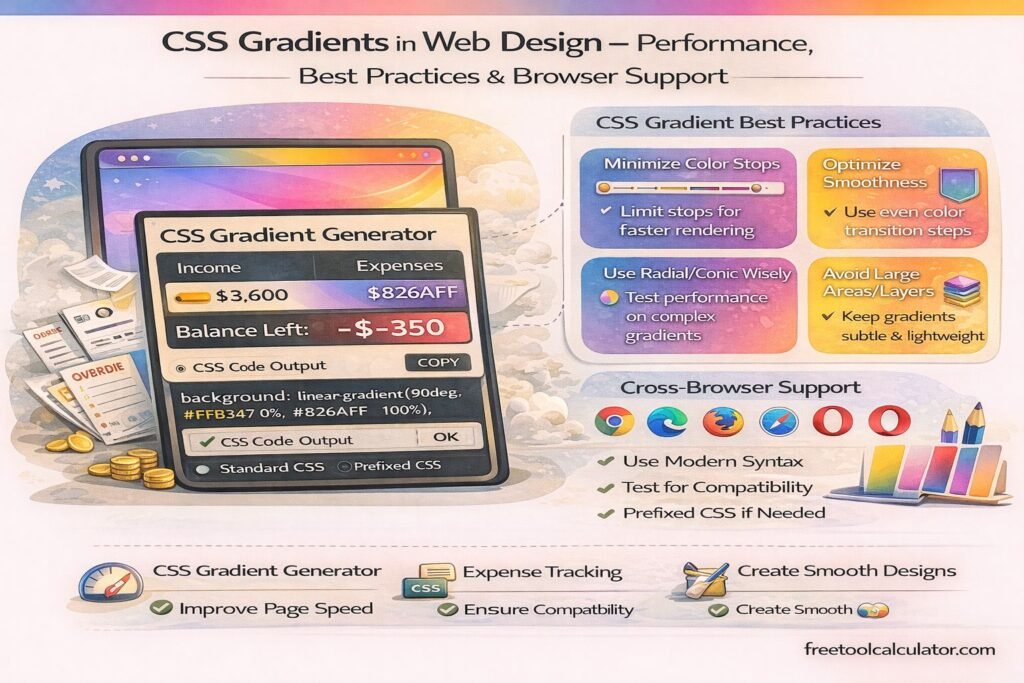
A CSS Gradient Generator is a handy tool for creating modern, eye-catching backgrounds without using images. Whether you’re designing a landing page, button background, hero section, or UI card, gradients help add depth and style while keeping your site fast and lightweight. With a generator, you can quickly build linear and radial gradients and copy clean CSS code in seconds.
What Is a CSS Gradient?
A CSS gradient is a background effect created purely with CSS. Instead of a single flat color, it blends two or more colors smoothly. Gradients are responsive by default, scale perfectly on all screen sizes, and reduce page load time compared to background images.
Linear vs Radial Gradients
Linear Gradients
A linear gradient blends colors in a straight line. You can control the direction (top, bottom, left, right, diagonal) or use angle values like 45deg or 180deg. Linear gradients are ideal for hero sections, headers, buttons, and modern UI panels.
Radial Gradients
A radial gradient blends colors outward in a circular or elliptical shape from a center point. You can control the shape, size, and position, making it perfect for spotlight effects, subtle depth, and creative backgrounds.
How a CSS Gradient Generator Works
A CSS Gradient Generator lets you select:
- Gradient type (linear or radial)
- Colors and their positions (stops)
- Angle or direction (for linear)
- Shape and position (for radial)
The tool then generates the exact CSS background code you can copy and paste into your website.
Why Use a Gradient Generator?
A generator saves time and eliminates manual trial and error. It helps you:
- Create professional gradients instantly
- Preview the background in real-time
- Adjust color stops for smoother blending
- Copy clean CSS code for fast implementation
- Build consistent brand-friendly gradients across your site
Best Uses for CSS Gradients
- Website hero backgrounds
- Call-to-action buttons
- Cards and panels
- Sections and banners
- UI highlights and overlays
- Branding and theme styling
CSS Gradient Generator for Linear and Radial Backgrounds
A CSS Gradient Generator is a practical design tool that helps developers, designers, and website owners create beautiful gradient backgrounds without manually writing complex CSS code. Whether you need a simple linear gradient CSS background, a colorful radial gradient CSS effect, a gradient border CSS style, or a modern gradient text CSS design, this tool allows you to generate professional-looking gradients instantly.
Gradients have become one of the most widely used visual elements in modern web design. They can add depth, improve visual hierarchy, create attractive buttons, enhance typography, and make backgrounds more engaging. Instead of relying on static images, CSS gradients provide lightweight, scalable, and responsive design solutions that work across different screen sizes and devices.
This CSS Gradient Generator enables users to create linear gradients, radial gradients, conic gradients, gradient overlays, gradient text effects, animated gradient backgrounds, and custom color transitions. With adjustable color stops, angle controls, live previews, and clean copy-ready code, the tool simplifies the process of generating production-ready CSS.
What Is a CSS Gradient?
A CSS gradient is a smooth transition between two or more colors generated directly through CSS. Unlike image-based backgrounds, gradients are rendered by the browser, making them lightweight and scalable. They are commonly used for website backgrounds, buttons, cards, typography, borders, overlays, and user interface elements.
CSS supports several gradient types, including linear gradients, radial gradients, and conic gradients. Each type creates a unique visual effect and serves different design purposes. By adjusting colors, directions, and positions, developers can create countless design variations without using image editing software.
Gradients are particularly popular in modern user interfaces because they help create depth, visual interest, and brand consistency while maintaining excellent performance.
How the CSS Gradient Generator Works
Step 1: Choose a Gradient Type
Select the type of gradient you want to create. Options typically include linear gradient CSS, radial gradient CSS, and CSS conic gradient styles. Each gradient type produces a different visual effect and can be customized independently.
Step 2: Select Colors
Choose two or more colors for the gradient transition. The tool allows you to add multiple color stops to create complex and visually appealing designs.
Step 3: Adjust Angle and Position
For linear gradients, users can modify the angle to control the direction of the color transition. For radial gradients, users can customize the center position and spread of the gradient effect.
Step 4: Preview and Copy CSS Code
The gradient preview updates instantly as changes are made. Once satisfied, users can copy clean CSS background code and paste it directly into their website or application.
What Is Linear Gradient CSS?
Linear gradient CSS creates a color transition along a straight line. The colors can flow horizontally, vertically, diagonally, or at any custom angle. This is one of the most commonly used gradient styles in web design because it is versatile and easy to implement.
A typical CSS linear-gradient example might look like:
background: linear-gradient(90deg, #ff6b6b, #4ecdc4);
This code creates a smooth horizontal transition between two colors. Designers often use background linear gradient CSS effects for hero sections, buttons, banners, cards, and navigation bars.
What Is Radial Gradient CSS?
Radial gradient CSS creates a color transition that radiates outward from a central point. Unlike linear gradients, radial gradients form circular or elliptical patterns, making them useful for spotlight effects, glowing elements, and decorative backgrounds.
A common radial-gradient CSS example is:
background: radial-gradient(circle, #ffffff, #3498db);
Radial gradients are frequently used in landing pages, user interfaces, product showcases, and creative visual effects.
Understanding Conic Gradient CSS
CSS conic gradient effects create color transitions around a central point in a circular pattern. Conic gradients are useful for charts, progress indicators, color wheels, and unique background designs.
A basic example is:
background: conic-gradient(red, yellow, green, blue);
Modern browsers support conic gradients, making them an increasingly popular choice for advanced user interface components.
Why This Tool Is Useful
Creates Professional Designs Quickly
Instead of manually experimenting with color combinations and CSS syntax, users can generate gradients visually and obtain production-ready code within seconds.
Improves Website Appearance
Gradients add depth, visual interest, and modern aesthetics to websites, applications, dashboards, portfolios, and landing pages.
Reduces Development Time
The generator automatically creates valid CSS code, helping developers focus on design rather than syntax details.
Common Uses of CSS Gradients
- Gradient backgrounds
- Hero section backgrounds
- Gradient buttons
- Gradient text effects
- Gradient borders
- Image overlays
- Cards and panels
- Navigation bars
- Call-to-action sections
- Modern dashboard interfaces
CSS Gradient Background Examples
Simple Linear Gradient Background
background: linear-gradient(to right, #ff7e5f, #feb47b);
This style creates a smooth horizontal transition between two colors and works well for headers and banners.
Dark Gradient Background CSS
background: linear-gradient(135deg, #1f2937, #111827);
Dark gradients are commonly used for modern dashboards, technology websites, and premium user interfaces.
Animated Gradient Background CSS
background: linear-gradient(-45deg, #ff6b6b, #4ecdc4, #45b7d1, #96ceb4);
background-size: 400% 400%;
animation: gradient 10s ease infinite;
Animated gradient backgrounds create dynamic visual effects and are frequently used in creative websites and landing pages.
Gradient Text CSS
Gradient text CSS allows developers to apply color transitions directly to text elements. This technique creates eye-catching headings and branding elements without requiring image assets.
A common CSS gradient text example is:
background: linear-gradient(90deg, #ff6b6b, #4ecdc4);
-webkit-background-clip: text;
-webkit-text-fill-color: transparent;
Users often search for CSS text gradient, text gradient in CSS, CSS gradient for text, CSS font gradient, gradient text generator CSS, and text gradient CSS generator because gradient typography is increasingly popular in modern design systems.
Gradient Border CSS
Gradient border CSS techniques allow developers to create colorful borders around buttons, cards, and content sections. Traditional CSS borders do not support gradients directly, so developers often use border-image properties or pseudo-elements.
Gradient borders are widely used for premium design effects, product highlights, and interactive components.
Common searches include border gradient CSS, CSS border gradient, border with gradient CSS, gradient border in CSS, and CSS border linear gradient.
Gradient Button CSS
Gradient button CSS styles help create attractive call-to-action buttons that stand out from the rest of the interface. By combining gradients with shadows, hover effects, and animations, designers can improve visual engagement.
Button gradient CSS designs are frequently used in landing pages, e-commerce websites, mobile applications, and SaaS platforms.
Gradient Overlays on Images
CSS allows developers to combine gradients with images to improve readability and visual impact. Gradient overlays are commonly applied to hero sections, banners, and featured content areas.
Examples include:
- CSS background image gradient
- CSS add gradient overlay to image
- Gradient and image background CSS
- Gradient background with image CSS
These techniques improve text contrast while preserving image quality.
Animated Gradient CSS Effects
Animated gradients create motion by continuously shifting colors or positions over time. Users frequently search for CSS gradient animation, animate gradient CSS, CSS animated gradient, CSS animate gradient, and animated gradient background CSS because motion design has become a major trend in modern interfaces.
Animated gradients can be applied to backgrounds, buttons, text, cards, and loading screens. When used carefully, they can improve user engagement without affecting performance significantly.
Tailwind CSS Gradients
Tailwind CSS gradients provide utility classes that simplify gradient creation. Developers using Tailwind CSS can quickly generate gradient backgrounds using predefined classes instead of writing custom CSS.
Popular searches include Tailwind CSS gradient and Tailwind CSS gradients because utility-first frameworks have become common in modern web development workflows.
CSS Gradient Generator Applications
- Website design
- Landing pages
- Portfolio websites
- Mobile app interfaces
- Dashboard designs
- E-commerce stores
- SaaS products
- Marketing pages
- Brand identity systems
- User interface components
Who Uses This Tool?
- Web designers
- Front-end developers
- UI/UX designers
- WordPress developers
- Shopify developers
- Marketing professionals
- Freelancers
- Students learning CSS
- Graphic designers
- Agency teams
Benefits of Using a CSS Gradient Generator
- Instant gradient previews
- Clean CSS code generation
- Support for linear gradients
- Support for radial gradients
- Support for conic gradients
- Easy color customization
- Responsive design compatibility
- No image files required
- Faster design workflow
- Modern visual effects
Common Mistakes When Using CSS Gradients
Using Too Many Colors
Excessive color stops can make gradients appear cluttered. In many cases, two to four carefully chosen colors produce better results.
Ignoring Contrast
When using gradient backgrounds behind text, always ensure sufficient contrast to maintain readability.
Overusing Animation
Animated gradients can be visually appealing, but excessive motion may distract users and affect user experience.
Using Inconsistent Branding Colors
Gradients should align with the overall brand color palette to maintain consistency across the website.
Frequently Asked Questions
How do I add a gradient in CSS?
You can use linear-gradient(), radial-gradient(), or conic-gradient() functions within the CSS background property.
What is the difference between linear gradient and radial gradient CSS?
Linear gradients transition along a straight line, while radial gradients transition outward from a central point.
Can I create gradient text in CSS?
Yes. CSS gradient text uses background gradients combined with background clipping and transparent text fill properties.
How do I create a gradient border CSS effect?
Gradient borders can be created using border-image properties, pseudo-elements, or layered backgrounds.
Can I animate CSS gradients?
Yes. CSS animations can be used to change gradient positions, colors, and directions over time.
What is a CSS mesh gradient generator?
A mesh gradient generator creates complex multi-point color transitions that produce soft, organic background effects.
Can I combine gradients and images?
Yes. CSS supports layering gradients over images to improve contrast and create visually appealing overlays.
Do gradients affect website performance?
CSS gradients are generally lightweight and often perform better than large background images because they are rendered directly by the browser.
Why Trust This Tool?
This CSS Gradient Generator uses standard CSS specifications supported by modern browsers. The generated code follows accepted web development practices and produces clean, readable, production-ready CSS. Whether you need a linear gradient CSS background, radial gradient CSS effect, gradient text CSS style, or gradient border CSS design, the tool generates code that aligns with current web standards.
The generator is intended for educational, development, and design purposes. It provides instant visual feedback, transparent code output, and flexible customization options, helping users create professional gradient designs efficiently.
Get Started Today
Create beautiful linear gradients, radial gradients, conic gradients, gradient text effects, gradient borders, and animated backgrounds in seconds. Adjust colors, angles, and stops, preview the results instantly, and copy clean CSS code ready for your website, application, or design project. Whether you are a beginner learning CSS gradients or an experienced developer building modern interfaces, this CSS Gradient Generator simplifies the entire process.
Final Thoughts
A CSS Gradient Generator for Linear and Radial Backgrounds makes it easy to design stylish, modern backgrounds with perfect CSS output. Whether you want subtle gradients for clean UI or bold gradients for standout sections, this tool helps you generate and apply gradients quickly with confidence.