How to Calculate Area and Why It Is Important
Understanding how to calculate area is one of the most useful math skills in everyday life. Area calculations are used in construction, home improvement, landscaping, architecture, engineering, education, interior design, and many other fields. Whether you are measuring a room for flooring, estimating paint requirements, buying carpet, or solving geometry problems, knowing how to calculate area helps you make accurate decisions.
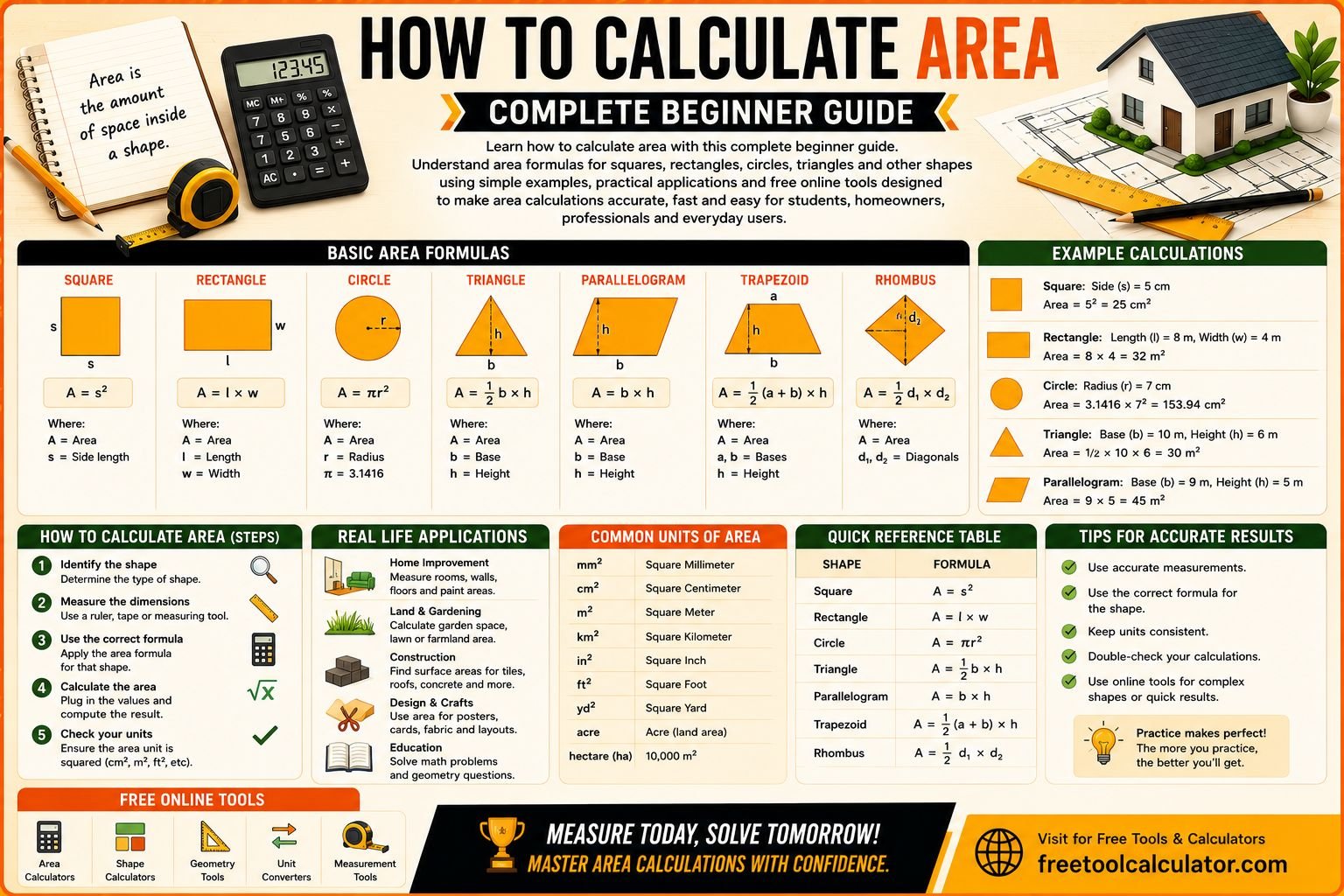
Area represents the amount of space inside a two dimensional shape. Unlike perimeter, which measures the distance around a shape, area measures the surface covered by that shape. Learning area calculations can save time, money, and effort when working on projects that require accurate measurements.
You can calculate area using this free area calculator for instant results without performing manual calculations.
What Is Area in Mathematics
Area is the measurement of the surface enclosed within a boundary. It is expressed in square units such as square feet, square meters, square inches, or square centimeters.
For example, if a floor measures 10 feet long and 8 feet wide, the area represents the amount of floor space contained within those dimensions. Understanding area helps people determine how much material is required for a project, such as tiles, carpet, paint, grass seed, or concrete.
Area calculations are fundamental concepts taught in mathematics because they apply directly to real world situations.
Why Learning Area Calculations Matters
Many people use area calculations without realizing it. Homeowners calculate room sizes before purchasing flooring. Gardeners measure planting areas before buying soil or fertilizer. Contractors calculate wall and floor areas before estimating materials and labor costs.
Students also use area formulas regularly in geometry and other math subjects. Understanding how area works improves problem solving skills and builds a strong foundation for more advanced mathematical concepts.
Area calculations become especially important when accuracy affects project costs or material requirements.
How Do You Calculate Area of a Rectangle
The rectangle is one of the easiest shapes for area calculating because it uses a simple formula.
Area equals Length multiplied by Width.
For example, if a room is 12 feet long and 10 feet wide:
Area = 12 × 10
Area = 120 square feet
Rectangles are common in homes, buildings, and construction projects, making this formula one of the most frequently used area calculations.
Many online tools can instantly calculate rectangular areas when dimensions are entered.
How to Calculate Area of a Square
A square is a special rectangle where all sides have equal length. The formula for finding its area is:
A=s2
If a square has sides measuring 6 feet:
Area = 6 × 6
Area = 36 square feet
Squares are commonly used in geometry lessons because their calculations are simple and easy to understand.
Learning square area calculations provides a strong foundation for understanding more complex shapes.
How to Calculate Area of a Triangle
Triangles require a different formula because their shape is not rectangular.
For example, if a triangle has a base of 10 feet and a height of 8 feet:
Area = 0.5 × 10 × 8
Area = 40 square feet
Triangle area calculations are commonly used in construction, roofing, architecture, and engineering projects.
Understanding the relationship between base and height helps students solve geometry problems more effectively.
How to Calculate Area of a Circle
Circles use a different formula because they have no straight sides.
The radius is the distance from the center of the circle to its edge.
For example, if a circle has a radius of 5 feet:
Area = 3.1416 × 5²
Area = 78.54 square feet approximately
Circle area calculations are useful when measuring round gardens, tables, pools, and other circular objects.
How to Calculate Area of a Parallelogram
A parallelogram resembles a slanted rectangle. Its area formula is:
Area = Base × Height
Although the shape appears different from a rectangle, the calculation remains similar because area depends on the base and vertical height.
Parallelogram calculations are frequently used in geometry and engineering applications.
Understanding these formulas expands your ability to solve more advanced area problems.
How to Calculate Area of a Trapezoid
A trapezoid contains two parallel sides of different lengths.
The formula is:
Area = One Half × Sum of Parallel Sides × Height
This shape appears in many architectural and engineering designs. Understanding trapezoid calculations helps when working with irregular structures and layouts.
Many students initially find trapezoids challenging, but breaking the formula into simple steps makes calculations easier.
Common Units Used in Area Measurements
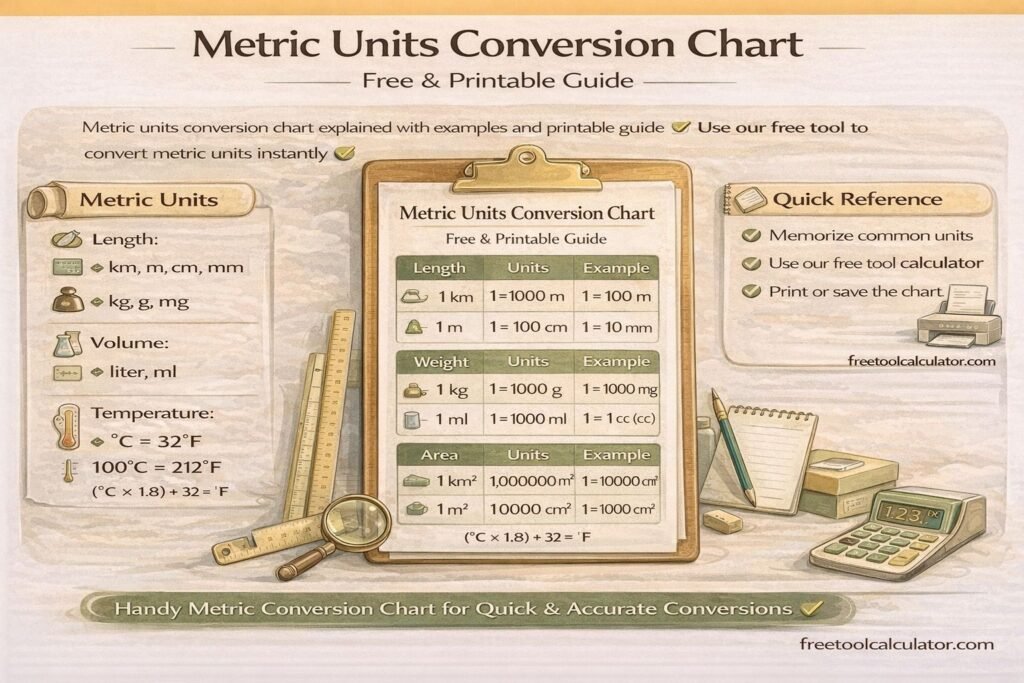
Area measurements always use square units because they represent two dimensional space.
Common examples include:
Square feet
Square meters
Square inches
Square centimeters
Square yards
Acres
The unit used depends on the project size and measurement system.
For example, room measurements often use square feet, while land measurements frequently use acres or square meters.
Choosing the correct unit helps avoid costly mistakes during planning and purchasing.
Real World Examples of Area Calculations
Area calculations appear in countless everyday situations.
A homeowner measuring a room before installing carpet must calculate floor area accurately. A painter estimating paint requirements must calculate wall area. A landscaper planning a garden must determine planting space.
Construction companies use area calculations for flooring, roofing, concrete, drywall, and tile estimates. Engineers use them during design and planning processes.
Because area calculations are so common, learning them provides practical benefits beyond the classroom.
Common Mistakes People Make When Calculating Area
One common mistake is confusing area with perimeter. Perimeter measures distance around a shape, while area measures space inside it.
Another mistake is using incorrect units. Mixing feet with inches or meters with centimeters can produce inaccurate results.
Some people also forget to square measurement units when expressing area. Since area represents two dimensional space, square units must always be used.
Carefully checking formulas and units helps avoid these common errors.
Benefits of Using an Online Area Calculator
Manual calculations are useful for learning, but online calculators provide faster and more convenient results.
An area calculator reduces the risk of mathematical mistakes and instantly handles multiple shapes. It also saves time when working with larger dimensions or more complicated projects.
Students, homeowners, builders, and professionals all benefit from automated calculation tools.
You can use an online area calculator to simplify measurements and improve accuracy.
Area Calculations for Home Improvement Projects
Home improvement projects frequently require accurate area measurements. Flooring, tile installation, painting, wallpapering, and landscaping all depend on knowing exact dimensions.
Calculating area before purchasing materials helps prevent overspending and reduces waste. It also improves project planning and budgeting.
Many contractors recommend measuring twice and calculating carefully before ordering materials.
Accurate area calculations can save significant money on larger renovation projects.
How Students Can Improve Area Calculation Skills
Students improve area calculation skills through regular practice and understanding formulas rather than memorization alone.
Drawing shapes and labeling dimensions helps visualize problems more effectively. Breaking larger shapes into smaller sections can also simplify difficult calculations.
Using educational tools and calculators allows students to verify answers and build confidence.
Strong geometry skills support success in mathematics, science, engineering, and technical careers.
Useful Math Tools Related to Area Calculations
Area calculations often work alongside other mathematical concepts such as percentages, geometry, and scientific calculations.
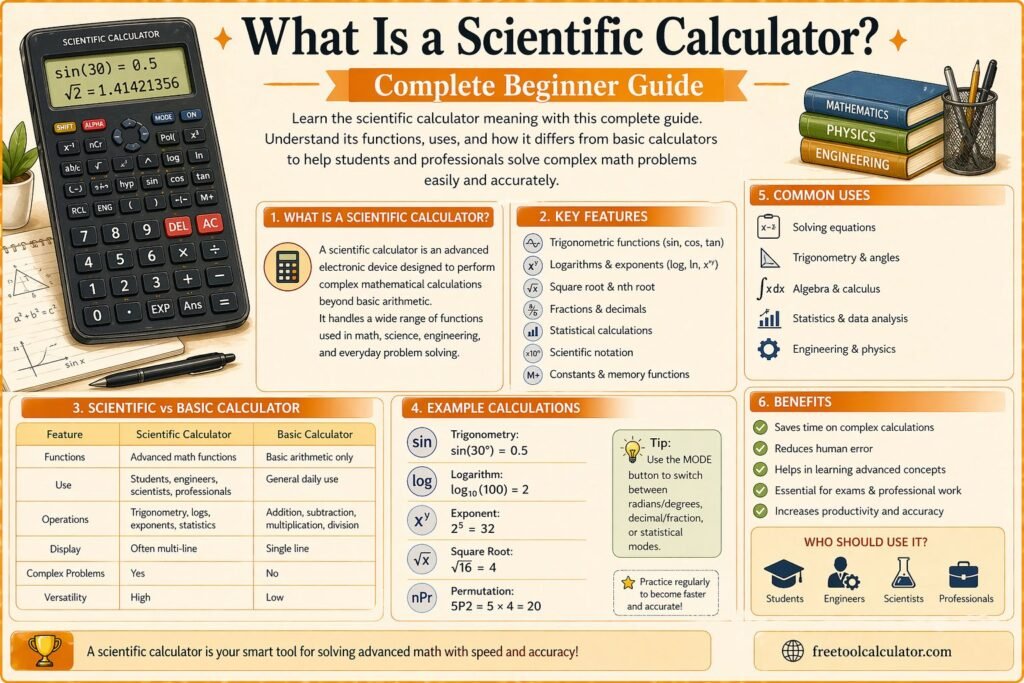
You can also use the scientific calculator for advanced mathematical operations and the percentage calculator for solving percentage based problems that frequently appear in academic and real world projects.
Using multiple math tools together improves accuracy and efficiency when solving complex calculations.
Why Understanding Area Is a Valuable Life Skill
Learning how to calculate area provides practical knowledge that remains useful throughout life. From home improvement projects to academic studies and professional careers, area calculations appear in many situations.
Understanding area improves decision making, budgeting, planning, and problem solving. It also helps people evaluate spaces more accurately and work more confidently with measurements.
The ability to perform area calculations is one of the most practical mathematical skills anyone can learn.
Conclusion
Understanding how to calculate area is essential for students, homeowners, contractors, engineers, and anyone working with measurements. Whether calculating rectangles, squares, circles, triangles, or more complex shapes, area formulas help determine the amount of space within a surface accurately.
If you want quick and reliable results, you can use this free area calculator along with tools like the scientific calculator and the percentage calculator to simplify area calculations, geometry problems, and everyday measurement tasks.