Quick answer: For a right triangle with legs a and b, the hypotenuse c is:
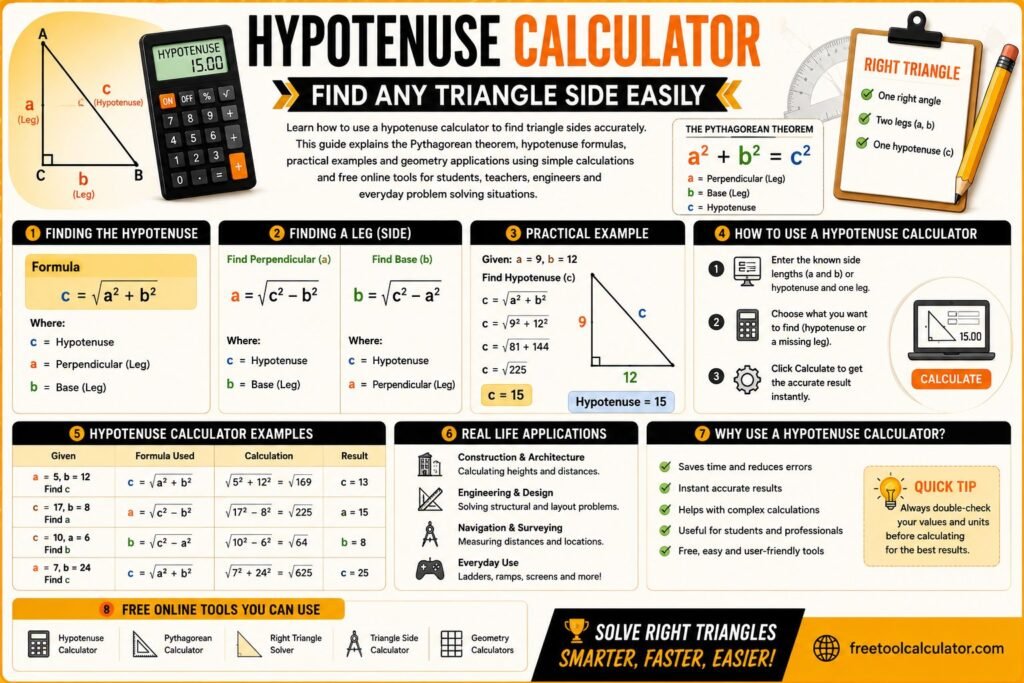
c = √(a² + b²)
The hypotenuse is the side opposite the 90° angle and is the longest side of a right triangle.
Hypotenuse Formula
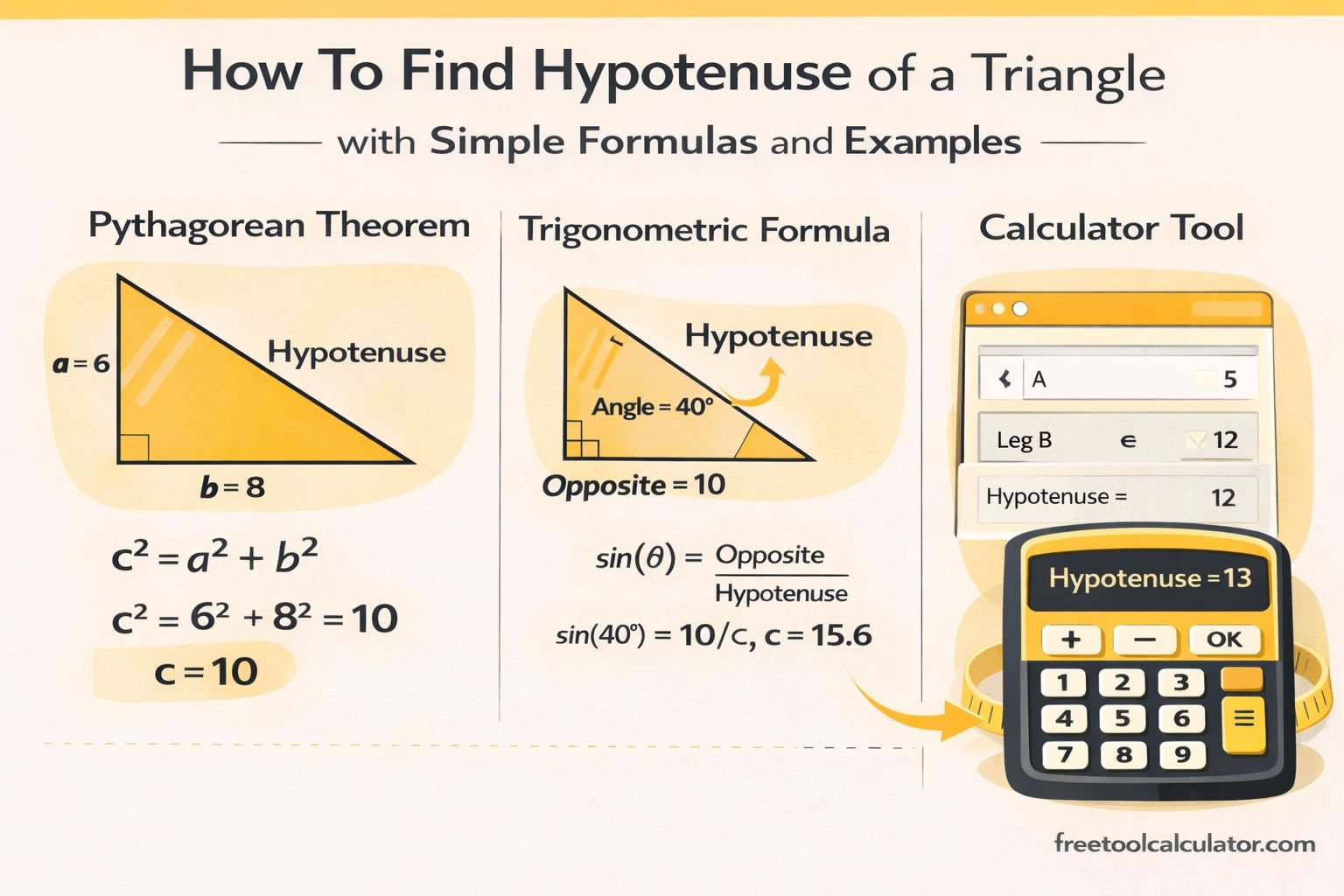
The Pythagorean theorem states:
a² + b² = c²
To solve specifically for the hypotenuse, take the square root of both sides:
c = √(a² + b²)
Example 1: 3-4-5 Right Triangle
- Let a = 3 and b = 4.
- Square both legs: 3² = 9 and 4² = 16.
- Add them: 9 + 16 = 25.
- Take the square root: √25 = 5.
Answer: c = 5.
Example 2: Legs of 5 and 12
c = √(5² + 12²) = √(25 + 144) = √169 = 13
So the hypotenuse is 13 units.
Example 3: When the Answer Is Not a Whole Number
If the legs are 6 and 8.5:
c = √(6² + 8.5²) = √108.25 ≈ 10.40
Round only at the end of the calculation so intermediate rounding does not reduce accuracy.
How to Find a Missing Leg Instead
If you know the hypotenuse and one leg, rearrange the theorem. To find leg a:
a = √(c² − b²)
To find leg b:
b = √(c² − a²)
When Can You Use the Pythagorean Theorem?
This formula applies to right triangles. If the triangle does not contain a 90° angle, use a method appropriate to the known sides and angles, such as the law of cosines.
Common Mistakes
- Using the formula on a triangle that is not right-angled.
- Calling one of the shorter legs the hypotenuse.
- Adding a and b before squaring instead of adding a² and b².
- Forgetting the final square root.
- Rounding intermediate values too early.
- Mixing units, such as centimeters and meters, without converting them first.
Frequently Asked Questions
What is the hypotenuse?
It is the side opposite the right angle in a right triangle. It is also the triangle’s longest side.
Can the hypotenuse be shorter than a leg?
No. In a right triangle, the hypotenuse is longer than either leg.
What if I know an angle and one side?
You can use trigonometric relationships such as sine, cosine or tangent, depending on which side and angle are known.
Last reviewed: October 2026.