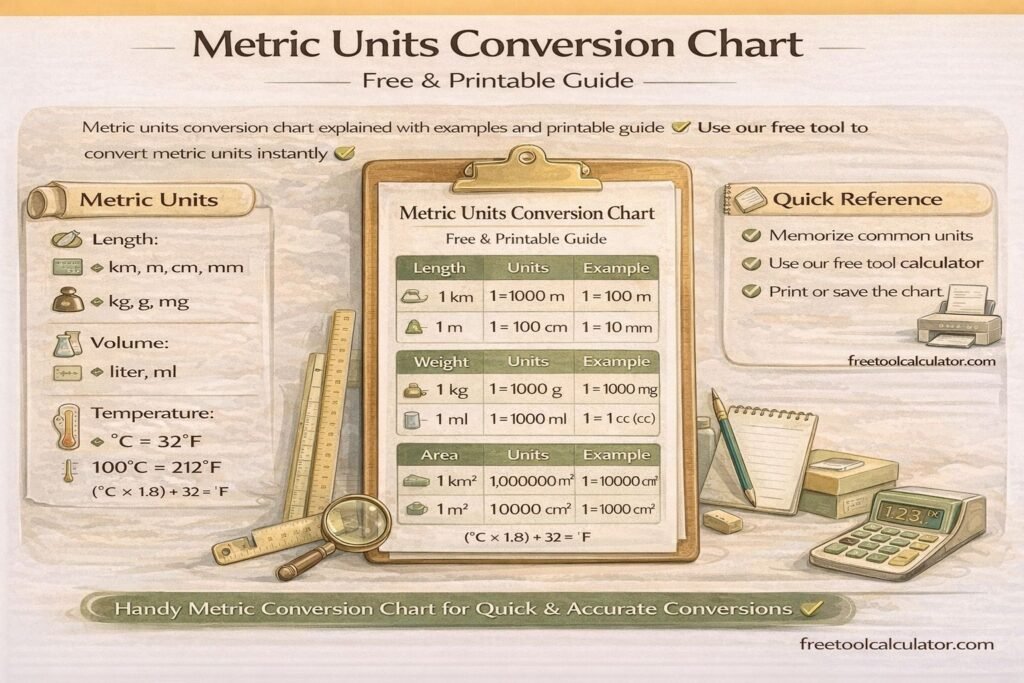
Quick answer: Metric conversions are based largely on powers of ten. Prefixes such as kilo-, centi- and milli- indicate how a unit relates to its base unit, making many conversions possible by multiplying or dividing by 10, 100 or 1,000.
Common Metric Prefixes
| Prefix | Symbol | Factor | Example |
|---|---|---|---|
| kilo | k | 1,000 | 1 km = 1,000 m |
| centi | c | 0.01 | 1 cm = 0.01 m |
| milli | m | 0.001 | 1 mm = 0.001 m |
| micro | µ | 0.000001 | 1 µm = 10⁻⁶ m |
Length Conversion Chart
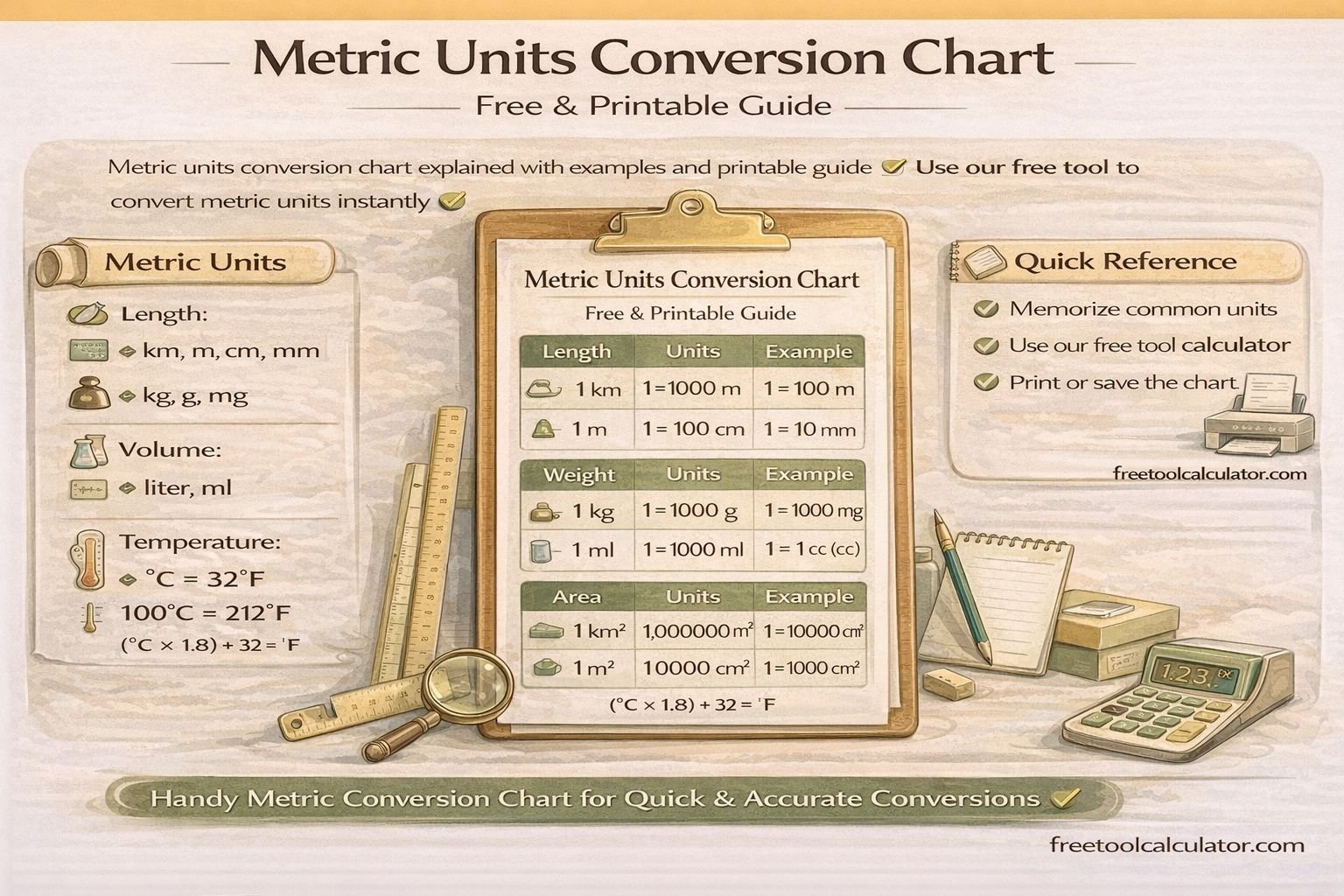
| 1 kilometer | 1,000 meters |
| 1 meter | 100 centimeters |
| 1 centimeter | 10 millimeters |
| 1 meter | 1,000 millimeters |
Mass Conversion Chart
| 1 kilogram | 1,000 grams |
| 1 gram | 1,000 milligrams |
| 1 milligram | 1,000 micrograms |
In everyday language people often say “weight” when referring to kilograms or grams, but scientifically kilograms and grams are units of mass.
Metric Volume Conversion Chart
| 1 liter | 1,000 milliliters |
| 1 milliliter | 1 cubic centimeter (cm³) |
| 1 cubic meter | 1,000 liters |
Temperature Conversion
Temperature does not use simple decimal-prefix movement when converting between Celsius and Fahrenheit. Use these formulas:
- °F = (°C × 9/5) + 32
- °C = (°F − 32) × 5/9
- K = °C + 273.15
How to Convert Metric Units
First identify the relationship between the starting and target units. For example, because 1 meter equals 100 centimeters, multiply meters by 100 to get centimeters. To go in the opposite direction, divide centimeters by 100.
Worked Examples
- 2.4 km to m: 2.4 × 1,000 = 2,400 m.
- 750 mL to L: 750 ÷ 1,000 = 0.75 L.
- 3.5 kg to g: 3.5 × 1,000 = 3,500 g.
- 25°C to °F: (25 × 9/5) + 32 = 77°F.
Avoid These Conversion Mistakes
- Confusing mass, volume and length units.
- Moving the decimal in the wrong direction.
- Dropping unit symbols from intermediate steps.
- Using a linear conversion for area or volume. Squared and cubed units require squared and cubed conversion factors.
- Treating Celsius-to-Fahrenheit as a simple ×10 conversion.
Reference: SI prefix definitions and units follow the International System of Units (SI), maintained by the BIPM. Last reviewed October 2026.