Hypotenuse Calculator and Why It Is Useful
A hypotenuse calculator is one of the most useful geometry tools for students, teachers, engineers, architects, and anyone working with right triangles. The hypotenuse is the longest side of a right triangle and plays a critical role in mathematics, construction, design, navigation, and physics. Calculating it manually is possible, but a hypotenuse calculator makes the process much faster and eliminates mistakes.
Whether you are solving homework problems, designing structures, measuring distances, or working on technical projects, understanding how to find hypotenuse values accurately is an important skill. Modern calculators make these calculations instant and reliable for users of all skill levels.
You can find hypotenuse values using this free calculator without performing complicated manual calculations.
What Is a Hypotenuse
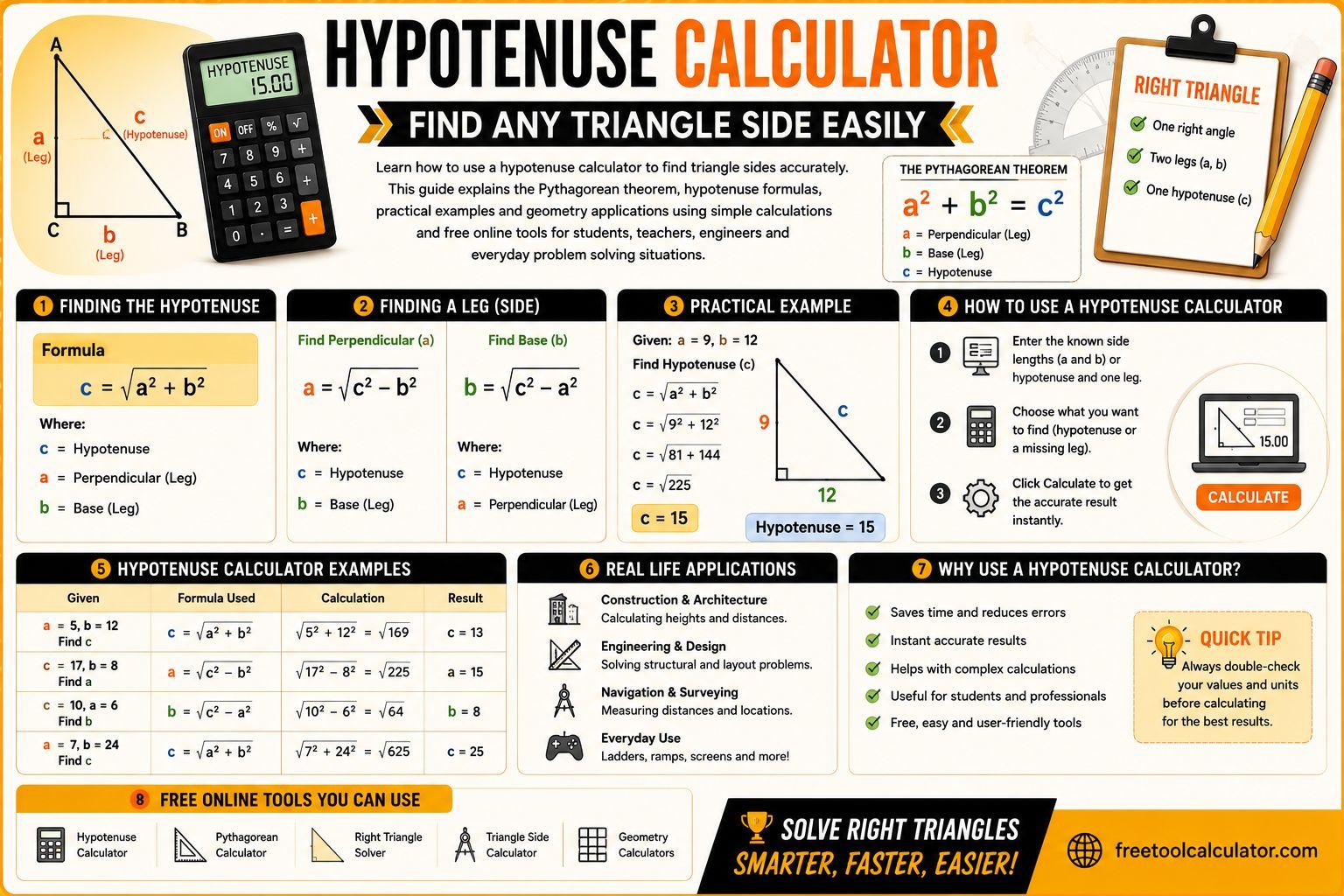
The hypotenuse is the longest side of a right triangle. It is located opposite the right angle and connects the endpoints of the two shorter sides known as legs.
In every right triangle, the hypotenuse is always longer than either of the other two sides. This unique property makes it one of the most important measurements in geometry.
Understanding the hypotenuse helps students learn triangle relationships and provides the foundation for many advanced mathematical concepts including trigonometry and coordinate geometry.
How to Calculate Hypotenuse Using the Pythagorean Theorem
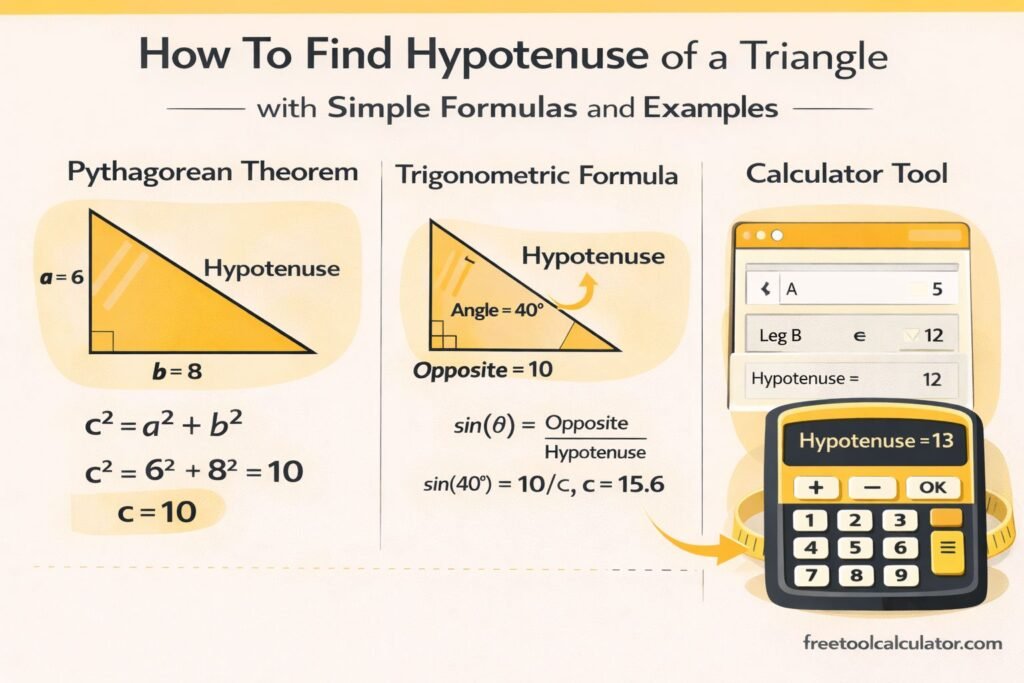
The most common method used to calculate hypotenuse values is the Pythagorean theorem. This theorem states that the square of the hypotenuse equals the sum of the squares of the other two sides.
The formula is shown below:
In this formula, c represents the hypotenuse while a and b represent the two shorter sides of the right triangle.
This equation has been used for centuries and remains one of the most important formulas in mathematics and engineering.
How to Find Hypotenuse Step by Step
To find hypotenuse values manually, first identify the lengths of the two shorter sides. Next, square both values and add them together. Finally, calculate the square root of the result.
For example, consider a right triangle with side lengths of 3 and 4.
3² = 9
4² = 16
9 + 16 = 25
√25 = 5
The hypotenuse length is therefore 5 units.
Although this process is simple for small numbers, larger values become more difficult to calculate manually. That is why many students and professionals use a hypotenuse calculator for instant results.
Why the Pythagorean Theorem Is Important
The Pythagorean theorem is one of the most fundamental concepts in mathematics. It allows users to determine missing triangle dimensions when only two sides are known.
This theorem is widely used in construction, engineering, surveying, architecture, navigation, physics, and computer graphics. It provides a reliable method for measuring distances and solving geometric problems.
Because of its practical value, the theorem is taught in schools worldwide and remains a cornerstone of mathematical education.
Real World Applications of Hypotenuse Calculations
Hypotenuse calculations appear in many real world situations. Builders use them when determining roof slopes, stair dimensions, and structural layouts. Engineers rely on them when designing bridges, roads, and machinery.
Navigation systems use triangle calculations to estimate distances and routes. Surveyors use hypotenuse measurements to determine land dimensions and elevation changes.
Even everyday tasks such as measuring a ladder against a wall involve understanding right triangles and hypotenuse relationships.
Using a Hypotenuse Calculator Online
A hypotenuse calculator online simplifies geometry calculations significantly. Instead of manually squaring numbers and finding square roots, users simply enter the known side lengths and receive instant results.
Online calculators are particularly useful for students checking homework, teachers creating examples, and professionals handling technical measurements.
The calculator reduces errors and saves valuable time while maintaining high accuracy.
How to Find a Missing Triangle Side
The Pythagorean theorem can also be used to find a missing side when the hypotenuse and one other side are known. In these situations, the formula is rearranged to solve for the unknown value.
For example, if the hypotenuse measures 10 units and one side measures 6 units, the missing side can be calculated using the theorem.
Understanding these relationships helps users solve a wide range of geometry problems beyond simply finding the hypotenuse itself.
Common Hypotenuse Examples for Students
Many educational exercises use simple right triangles to demonstrate hypotenuse calculations. Common examples include triangles with side lengths such as:
3, 4, 5
5, 12, 13
8, 15, 17
7, 24, 25
These sets are known as Pythagorean triples because all values are whole numbers that satisfy the theorem perfectly.
Learning these examples helps students recognize common triangle patterns and improve problem solving skills.
Why Geometry Students Need a Hypotenuse Calculator
Geometry students often solve dozens of triangle problems while learning mathematical concepts. Performing every calculation manually can be time consuming and increases the chance of arithmetic mistakes.
A find hypotenuse calculator helps students verify answers quickly and focus on understanding concepts rather than repetitive calculations.
Using educational tools appropriately supports learning while improving confidence and accuracy.
Common Mistakes When Calculating Hypotenuse Values
One common mistake is forgetting to square the side lengths before adding them together. Another mistake occurs when students add side lengths directly instead of applying the Pythagorean theorem.
Errors also occur when incorrect values are entered into calculators or when square roots are calculated improperly.
Carefully following the formula and checking results helps avoid these common mistakes.
How Hypotenuse Calculations Are Used in Construction
Construction professionals frequently use right triangle calculations to ensure structures are built accurately. Roof framing, staircase design, wall alignment, and foundation layouts all rely on geometric measurements.
Accurate hypotenuse calculations help maintain structural integrity and reduce costly errors during construction projects.
Many builders use digital calculators to perform these calculations quickly while working on site.
Hypotenuse Calculations in Engineering and Technology
Engineers use triangle calculations in fields ranging from civil engineering to software development. Structural engineers calculate loads and dimensions, while computer graphics developers use geometry to render visual objects accurately.
Robotics, GPS navigation, and machine design also depend on mathematical relationships involving right triangles.
The ability to calculate hypotenuse values remains relevant across many technical professions.
Benefits of Using Online Math Calculators
Online calculators make mathematical concepts more accessible and efficient. Students can solve problems faster, professionals can verify measurements, and educators can demonstrate formulas more effectively.
Digital tools reduce human error and provide immediate results, making them valuable for both learning and practical applications.
They are particularly useful when working with large numbers or complex geometry problems that would otherwise require extensive manual calculations.
Other Useful Math Tools for Students
Many students use additional calculators alongside a hypotenuse calculator to support broader mathematical learning. Different tools help with percentages, algebra, scientific calculations, and geometry.
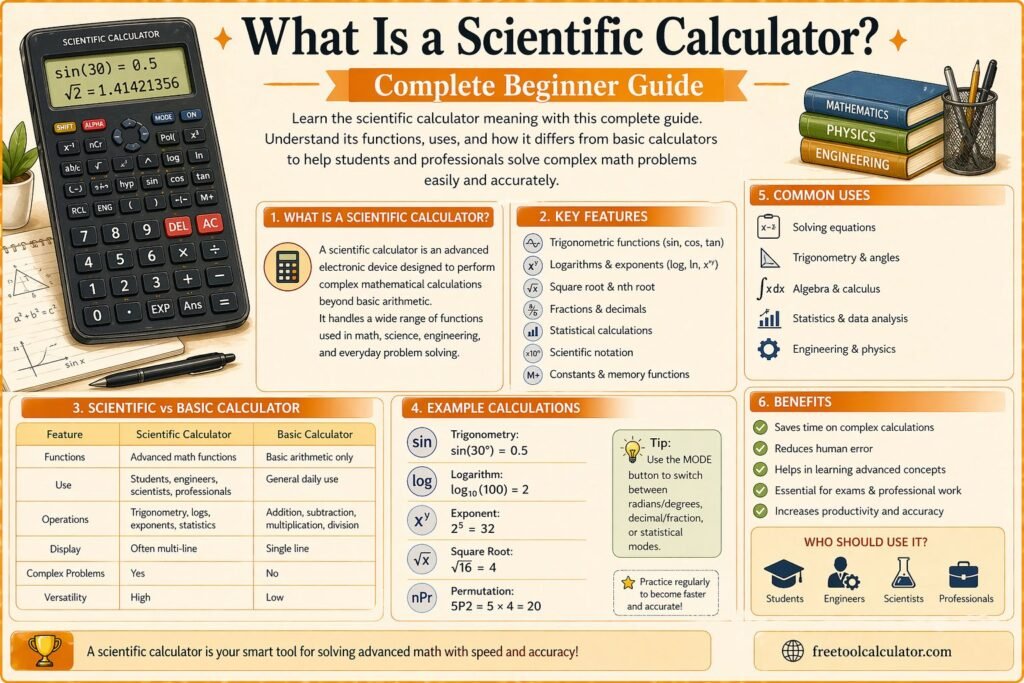
You can also use the scientific calculator for advanced mathematical operations and the percentage calculator for everyday percentage calculations and educational exercises.
Combining multiple math tools helps students solve problems more efficiently and develop stronger mathematical skills.
Conclusion
A hypotenuse calculator is an essential geometry tool for students, teachers, engineers, and professionals who work with right triangles. Understanding how to find hypotenuse values using the Pythagorean theorem improves problem solving skills and supports applications in mathematics, construction, engineering, and everyday measurements.
If you want fast and accurate results, you can use this free hypotenuse calculator along with tools like the scientific calculator and the percentage calculator to simplify geometry calculations and strengthen your understanding of mathematical concepts.