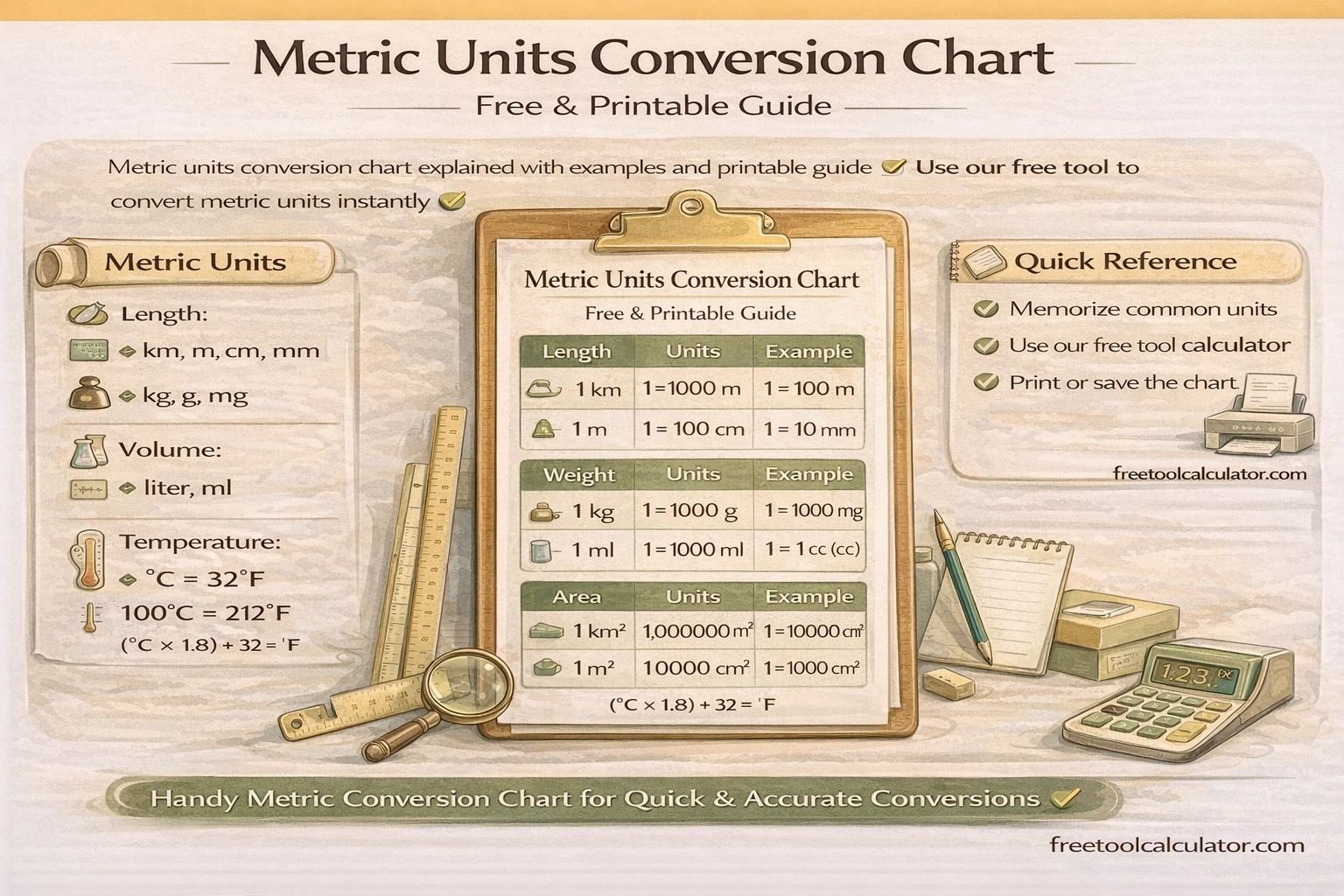
The metric system is one of the most widely used measurement systems in the world. It provides a simple and consistent way to measure length, weight, volume, temperature, and other physical quantities. Unlike many traditional measurement systems, the metric system is based on powers of ten, making conversions much easier.
Whether you’re solving school assignments, performing scientific calculations, cooking, traveling, or working in engineering, learning how to convert metric units is an essential skill.
If you need instant and accurate conversions, our free Unit Converter supports metric and SI conversions across multiple categories, including length, weight, temperature, area, volume, speed, pressure, and energy.
Quick Answer: How Do You Convert Metric Units?
Metric units are converted by moving the decimal point according to the difference between metric prefixes.
The basic steps are:
- Identify the starting unit.
- Identify the target unit.
- Count the number of prefix steps.
- Move the decimal point left or right.
Because every metric prefix represents a power of ten, conversions can usually be completed without complicated calculations.
What Is the Metric System?
The metric system is an internationally recognized measurement system based on decimal units. It is officially known as the International System of Units (SI) and is used in science, education, medicine, engineering, and everyday life throughout most countries.
The metric system is designed to make calculations easier because each unit differs from the next by a factor of ten.
Common Metric Base Units
| Measurement | Base Unit | Symbol |
|---|---|---|
| Length | Meter | m |
| Mass | Gram | g |
| Volume | Liter | L |
| Temperature | Degree Celsius | °C |
Understanding Metric Prefixes
Metric prefixes indicate whether a unit is larger or smaller than the base unit.
| Prefix | Symbol | Multiplier |
|---|---|---|
| Kilo | k | 1,000 |
| Hecto | h | 100 |
| Deka | da | 10 |
| Base Unit | m, g, L | 1 |
| Deci | d | 0.1 |
| Centi | c | 0.01 |
| Milli | m | 0.001 |
The Metric Conversion Ladder
A simple way to remember metric conversions is by using the metric ladder.
Kilo → Hecto → Deka → Base Unit → Deci → Centi → Milli
Each movement:
- One step to the right = multiply by 10.
- One step to the left = divide by 10.
Easy Memory Trick
Many students memorize the order of prefixes using the phrase:
King Henry Died Drinking Chocolate Milk
This represents:
- King = Kilo
- Henry = Hecto
- Died = Deka
- Drinking = Base Unit
- Chocolate = Deci
- Milk = Centi & Milli
Although there are many memory phrases, understanding the order is more important than memorizing any specific sentence.
Step-by-Step Metric Conversion Method
Step 1: Identify the Starting Unit
Example:
5 kilometers
Step 2: Identify the Target Unit
Convert kilometers to meters.
Step 3: Count the Steps
Kilometer → Hecto → Deka → Meter
Total steps: 3
Step 4: Move the Decimal
Move the decimal three places to the right.
5 km = 5,000 m
Length Conversion Examples
| Conversion | Answer |
|---|---|
| 2 km → m | 2,000 m |
| 450 cm → m | 4.5 m |
| 8 m → mm | 8,000 mm |
| 7,500 mm → m | 7.5 m |
Mass Conversion Examples
| Conversion | Answer |
|---|---|
| 5 kg → g | 5,000 g |
| 900 g → kg | 0.9 kg |
| 35 mg → g | 0.035 g |
| 4.5 g → mg | 4,500 mg |
Volume Conversion Examples
| Conversion | Answer |
|---|---|
| 3 L → mL | 3,000 mL |
| 250 mL → L | 0.25 L |
| 12 L → cL | 1,200 cL |
If you prefer automatic conversions instead of moving decimal places manually, use our free Unit Converter. It supports dozens of SI and metric units with instant results.
Converting Metric Units Using Decimal Movement
The easiest way to convert metric units is by moving the decimal point. Since every metric prefix differs by a factor of ten, you simply move the decimal left or right depending on whether you’re converting to a larger or smaller unit.
Move the Decimal to the Right
Move the decimal to the right when converting from a larger unit to a smaller unit.
Examples:
- 1 meter = 100 centimeters
- 1 kilogram = 1,000 grams
- 1 liter = 1,000 milliliters
Example:
7.5 meters → centimeters
Move the decimal two places to the right:
7.5 m = 750 cm
Move the Decimal to the Left
Move the decimal to the left when converting from a smaller unit to a larger unit.
Example:
6,500 millimeters → meters
Move the decimal three places to the left:
6,500 mm = 6.5 m
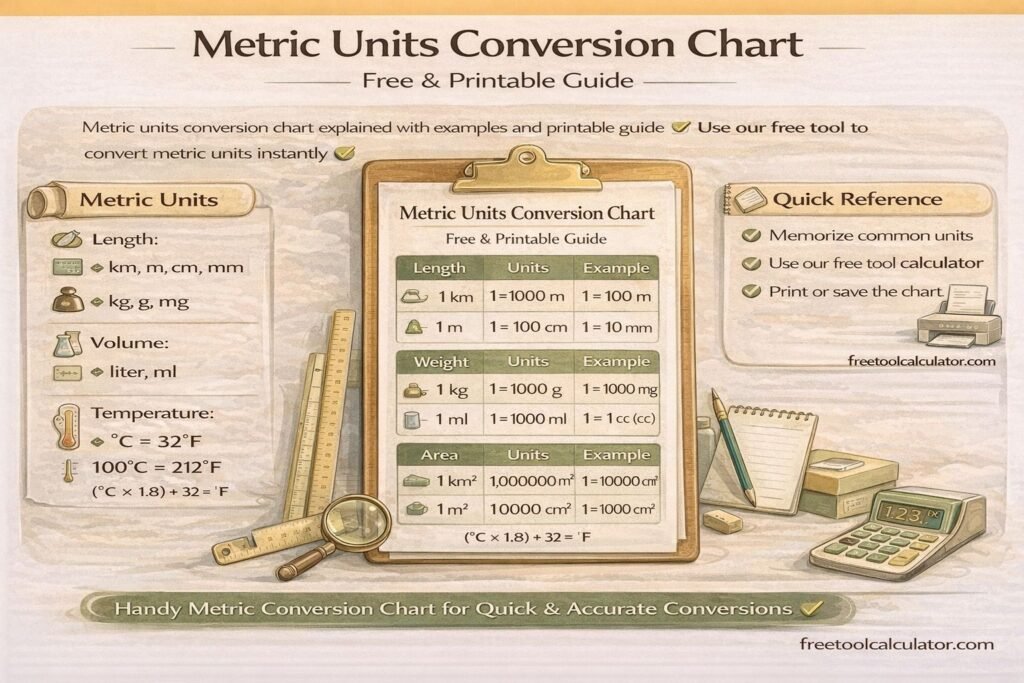
Metric Conversion Chart
| From | To | Multiply or Divide |
|---|---|---|
| Kilometers | Meters | × 1,000 |
| Meters | Centimeters | × 100 |
| Meters | Millimeters | × 1,000 |
| Grams | Kilograms | ÷ 1,000 |
| Kilograms | Grams | × 1,000 |
| Liters | Milliliters | × 1,000 |
| Milliliters | Liters | ÷ 1,000 |
Practice Examples
Working through examples is one of the best ways to understand metric conversions.
Example 1
Convert 8 kilometers into meters.
Solution:
8 × 1,000 = 8,000 meters
Example 2
Convert 950 centimeters into meters.
Solution:
950 ÷ 100 = 9.5 meters
Example 3
Convert 4.2 kilograms into grams.
Solution:
4.2 × 1,000 = 4,200 grams
Example 4
Convert 2,500 milliliters into liters.
Solution:
2,500 ÷ 1,000 = 2.5 liters
Metric Conversion Practice Questions
Try solving these questions on your own before checking the answers.
| Question | Answer |
|---|---|
| 9 km = ? m | 9,000 m |
| 3.8 kg = ? g | 3,800 g |
| 750 cm = ? m | 7.5 m |
| 6 L = ? mL | 6,000 mL |
| 4,200 mm = ? m | 4.2 m |
Common Metric Conversion Mistakes
Even though the metric system is straightforward, mistakes can happen when converting between units.
Moving the Decimal in the Wrong Direction
Always check whether you’re converting to a larger or smaller unit before moving the decimal point.
Skipping Prefix Steps
Each metric prefix represents one power of ten. Count every step carefully when converting.
Confusing Mass and Volume
Grams measure mass, while liters measure volume. Although both use metric prefixes, they measure different quantities.
Forgetting Unit Symbols
Always include the correct unit symbol in your final answer, such as m, cm, kg, g, L, or mL.
Why Learn Metric Conversions?
Understanding metric conversions is useful in many real-world situations, including:
- Mathematics homework
- Science experiments
- Engineering calculations
- Cooking and baking
- Construction projects
- Medical measurements
- International travel
- Manufacturing and industry
Since the metric system is used in most countries, mastering these conversions improves both academic performance and everyday problem-solving.
Using an Online Unit Converter
Although understanding the conversion process is important, online tools save time when working with multiple values or different measurement categories.
Instead of manually counting decimal places, our free Unit Converter instantly converts:
- Length
- Weight
- Volume
- Temperature
- Area
- Speed
- Pressure
- Energy
- Time
- Many other measurement units
Related Measurement Tools
If you regularly work with measurements, these additional tools can simplify calculations across different categories.
- Unit Converter – Convert metric, imperial, and SI units instantly.
- Length Converter – Convert meters, kilometers, feet, inches, miles, and more.
- Weight Converter – Convert kilograms, grams, pounds, ounces, and other weight units.
- Temperature Converter – Convert Celsius, Fahrenheit, and Kelvin quickly.
Frequently Asked Questions
What is the easiest way to convert metric units?
The easiest method is to use the metric ladder and move the decimal point according to the number of prefix steps between the starting unit and the target unit.
How do you remember metric prefixes?
Many students use the order: Kilo, Hecto, Deka, Base Unit, Deci, Centi, Milli. Remembering this sequence makes conversions much easier.
Why is the metric system easier than other measurement systems?
The metric system is based on powers of ten, so conversions involve moving the decimal point instead of using different conversion factors.
Can I convert metric units without formulas?
Yes. Most metric conversions only require counting prefix steps and moving the decimal point in the correct direction.
Is an online unit converter accurate?
Yes. A reliable unit converter performs conversions automatically using standardized conversion factors, reducing the chance of manual calculation errors.
Conclusion
Learning how to convert metric units becomes much easier once you understand the relationship between metric prefixes and decimal movement. Whether you’re converting meters to centimeters, kilograms to grams, or liters to milliliters, the same step-by-step method applies throughout the metric system.
Regular practice helps build confidence and improves accuracy, especially for students, teachers, engineers, scientists, and professionals who work with measurements every day.
For fast, reliable conversions across dozens of measurement categories, use our free Unit Converter. You can also explore the Length Converter, Weight Converter, and Temperature Converter to simplify calculations for school, work, and everyday tasks.